


Shopping Cart
Remove All Your shopping cart is currently empty

Synonyms:
| Pack Size | Price | USA Stock | Global Stock | Quantity |
|---|---|---|---|---|
| 1 mg | $662 | 3-6 months | 3-6 months | |
| 5 mg | $1,530 | 3-6 months | 3-6 months | |
| 10 mg | $2,150 | 3-6 months | 3-6 months | |
| 25 mg | $3,290 | 3-6 months | 3-6 months |
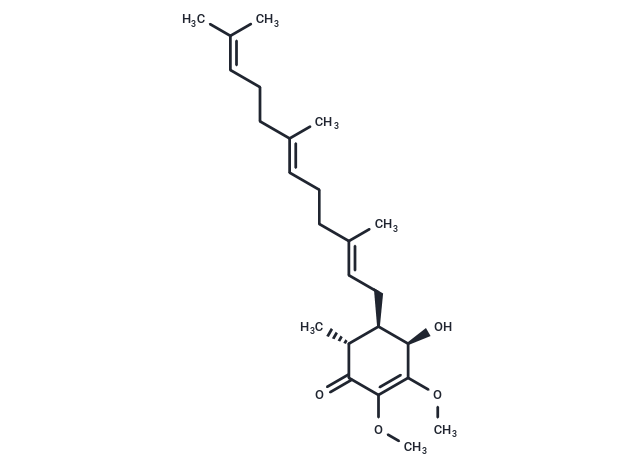
| Description | Antroquinonol ((+)-Antroquinonol) is a natural product and an activator of the Nrf2 signaling pathway, exhibiting anti-inflammatory, antioxidant, and anticancer activities. The compound is cell-permeable and can be used in research on non-small cell lung cancer and colon cancer. Antroquinonol has also shown potential in inhibiting inflammation and fibrosis in models of focal segmental glomerulosclerosis. |
| In vitro | Methods: The sulforhodamine B (SRB) assay was used to detect the in vitro antitumor activity of Antroquinonol, with human non-small cell lung cancer A549 cells and human prostate cancer PC-3 cells as test cells. Cells were incubated with serial concentrations of the drug for 48 hours, with 5-fluorouracil as the positive control. Results: The GI₅₀ values of Antroquinonol A against A549 and PC-3 cells were 5.7±0.2 μM and 13.5±0.2 μM, respectively, showing superior activity compared to other analogs. [1] Methods: The MTT assay was used to detect the in vitro activity of Antroquinonol, with rat hepatic stellate cells NHSC and THSC as test cells. Concentrations of 0, 5, 10, 20, and 40 μM were set, and cells were incubated at 37°C for 24 hours. Results: Antroquinonol inhibited NHSC and THSC cell proliferation in a dose-dependent manner, with 10 μM as the effective concentration. It showed no significant effect on mTOR pathway phosphorylation, but increased intracellular lipid droplet accumulation. [2] |
| In vivo | Methods: Male Wistar rats were used to establish an L-NAME-induced hypertension model. Antroquinonol was administered by dietary admixture at doses of 20 and 40 mg/kg/day for 9 consecutive weeks, once daily; the model group received drinking water containing L-NAME, and the control group received normal drinking water and feed. Results: Antroquinonol reduced blood pressure in rats, improved renal function and renal arteriolar thickening, and alleviated oxidative stress and renal inflammation, with more significant effects at the 40 mg/kg dose. [3] Methods: Male Wistar rats were used to establish a high-fat and high-sugar-induced obesity model. Antroquinonol was administered by dietary admixture at doses of 25 and 50 mg/kg for 12 consecutive weeks with normal daily feeding; the drug was dissolved in oil and mixed evenly into the feed, the control group received standard feed, and the model group received obesity-inducing feed. Results: Antroquinonol reduced body weight and abdominal fat accumulation in rats, decreased hepatic lipids and inflammatory factors, upregulated AMPK expression, and downregulated SREBP-1 and FAS expression, with superior effects at 50 mg/kg. [4] |
| Molecular Weight | 390.56 |
| Formula | C24H38O4 |
| Cas No. | 1010081-09-0 |
| Smiles | C(/C=C(/CC/C=C(/CCC=C(C)C)\C)\C)[C@H]1[C@@H](O)C(OC)=C(OC)C(=O)[C@@H]1C |
| Relative Density. | 1.01 g/cm3 (Predicted) |
| Storage | Store at low temperature,Keep away from direct sunlight Pure form: -20°C for 3 years | In solvent: -80°C for 1 year Shipping with blue ice/Shipping at ambient temperature. |
 For example, if the intended dosage is 10 mg/kg for animals weighing 20 g , with a dosing volume of 100 μL per animal, and a total of 10 animals are to be administered, using a formulation of
  10% DMSO+ 40% PEG300+ 5% Tween 80+ 45% Saline/PBS/ddH2O , the resulting working solution concentration would be 2 mg/mL.
Dissolve 2 mg of the compound in 100 μL DMSO to obtain a stock solution at a concentration of 20 mg/mL . If the required concentration exceeds the compound's known solubility, please contact us for technical support before proceeding.
1) Add 100 μL of the DMSO stock solution to 400 µL PEG300 and mix thoroughly until the solution becomes clear.
2) Add 50 µL Tween 80 and mix well until fully clarified.
3) Add 450 µL Saline,PBS or ddH2O and mix thoroughly until a homogeneous solution is obtained.
| Size | Quantity | Unit Price | Amount | Operation |
|---|
 Feedback
 Hello! How can I help you today?
Copyright © 2015-2026 TargetMol Chemicals Inc. All Rights Reserved.
