


Shopping Cart
Remove All Your shopping cart is currently empty


Synonyms: Hydroginkgolic acid, 6-pentadecylsalicylic Acid
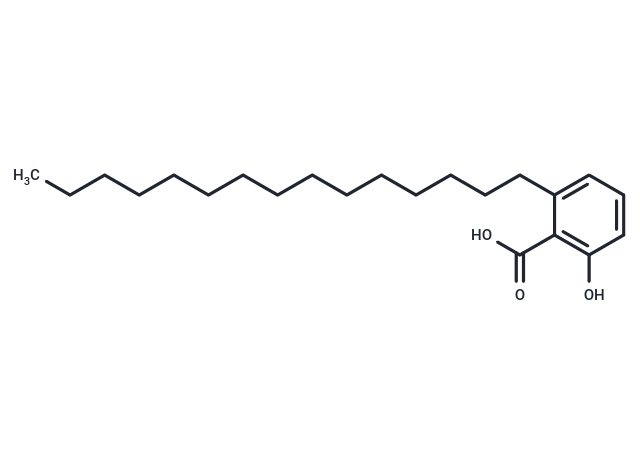

| Pack Size | Price | USA Stock | Global Stock | Quantity |
|---|---|---|---|---|
| 5 mg | $45 | In Stock | In Stock | |
| 10 mg | $71 | In Stock | In Stock | |
| 25 mg | $144 | In Stock | In Stock | |
| 50 mg | $216 | In Stock | In Stock | |
| 100 mg | $325 | In Stock | In Stock | |
| 1 mL x 10 mM (in DMSO) | $50 | In Stock | In Stock |
| Description | Anacardic Acid (6-pentadecylsalicylic Acid) is an effective inhibitor of p300 and p300/CBP-associated factor histone acetyltranferases. It also has antimicrobial activity, antibacterial activity, and inhibits prostaglandin synthase, lipoxygenase, and tyrosinase. |
| Targets & IC50 | p300 HAT:8.5 μM, PCAF(p300/CREB-binding protein-associated factor):5 μM |
| In vitro | Anacardic acid is an inhibitor of several Clinicalally targeted enzymes such as HATs, NF-kB, LOX-1, xanthine oxidase, tyrosinase, and ureases. Anacardic acid is also an effective inhibitor of Tip60 in vitro. It inhibits the Tip60-dependent acetylation and activation of the ATM protein kinase in HeLa cells and sensitizes the cells to the cytotoxic effects of radiation. |
| In vivo | Anacardic acid decreases over-expression of Gata4, α-MHC, and cTnT in fetal mouse hearts exposed to ethanol. Anacardic acid inhibits binding of PCAF, P300 to the promoter of Gata4. |
| Synonyms | Hydroginkgolic acid, 6-pentadecylsalicylic Acid |
| Kinase Assay | HAT and HDAC Activity Assays :After homogenization of cardiac tissues, nucleoproteins are extracted using a Nuclear Extract Kit according to the manufacturer's instructions. HAT and HDAC activities of the nuclear protein extracts are determined using a colorimetric assay included in the HAT and HDAC assay kits. |
| Cell Research | HeLa and 293T cells are grown in Dulbecco's modified Eagle's medium/10% fetal calf serum. SQ20B and SCC35 squamous cell carcinoma cell lines are cultured in modified eagles medium/10% fetal calf serum. For anacardic acid (EMD Biosciences, CA) exposure, cells are preincubated with anacardic acid (0-100 μM) for 40 min, irradiated, then allowed to recover for 4 h. Cells are then switched to fresh media and allowed to grow for 10 days. |
| Animal Research | Animal Models: 9 to 11 week old Kunming mice. Formulation: Dissolved in DMSO,co-injected with ethanol. Dosages: 0,1.25,2.5,5,10 mg/kg. Administration: i.p. |
| Molecular Weight | 348.52 |
| Formula | C22H36O3 |
| Cas No. | 16611-84-0 |
| Smiles | CCCCCCCCCCCCCCCc1cccc(O)c1C(O)=O |
| Relative Density. | 1.002 g/cm3 |
| Storage | Powder: -20°C for 3 years | In solvent: -80°C for 1 year Shipping with blue ice/Shipping at ambient temperature. | ||||||||||||||||||||||||||||||||||||||||
| Solubility Information | Ethanol: 17.4 mg/mL (49.93 mM), Sonication is recommended. DMSO: 252 mg/mL (723.06 mM), Sonication is recommended.  | ||||||||||||||||||||||||||||||||||||||||
| In Vivo Formulation | 10% DMSO+90% Corn Oil: 3.3 mg/mL (9.47 mM), Sonication is recommended. Please add the solvents sequentially, clarifying the solution as much as possible before adding the next one. Dissolve by heating and/or sonication if necessary. Working solution is recommended to be prepared and used immediately. The formulation provided above is for reference purposes only. In vivo formulations may vary and should be modified based on specific experimental conditions. | ||||||||||||||||||||||||||||||||||||||||
Solution Preparation Table | |||||||||||||||||||||||||||||||||||||||||
Ethanol/DMSO
DMSO
Note : The dilution table applies only to solid products. For liquid products, please calculate the stock solution based on the stated concentration and/or density. | |||||||||||||||||||||||||||||||||||||||||
 For example, if the intended dosage is 10 mg/kg for animals weighing 20 g , with a dosing volume of 100 μL per animal, and a total of 10 animals are to be administered, using a formulation of
  10% DMSO+ 40% PEG300+ 5% Tween 80+ 45% Saline/PBS/ddH2O , the resulting working solution concentration would be 2 mg/mL.
Dissolve 2 mg of the compound in 100 μL DMSO to obtain a stock solution at a concentration of 20 mg/mL . If the required concentration exceeds the compound's known solubility, please contact us for technical support before proceeding.
1) Add 100 μL of the DMSO stock solution to 400 µL PEG300 and mix thoroughly until the solution becomes clear.
2) Add 50 µL Tween 80 and mix well until fully clarified.
3) Add 450 µL Saline,PBS or ddH2O and mix thoroughly until a homogeneous solution is obtained.
| Size | Quantity | Unit Price | Amount | Operation |
|---|
 Feedback
 Hello! How can I help you today?
Copyright © 2015-2026 TargetMol Chemicals Inc. All Rights Reserved.
