


Shopping Cart
Remove All Your shopping cart is currently empty


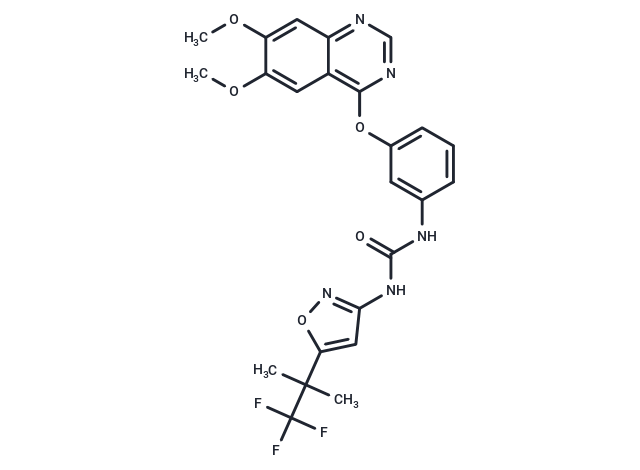
Synonyms: RXDX-105, CEP-32496, CEP32496, CEP 32496
| Pack Size | Price | USA Stock | Global Stock | Quantity |
|---|---|---|---|---|
| 1 mg | $35 | In Stock | In Stock | |
| 5 mg | $89 | In Stock | In Stock | |
| 10 mg | $133 | In Stock | In Stock | |
| 25 mg | $243 | In Stock | In Stock | |
| 50 mg | $397 | In Stock | In Stock | |
| 100 mg | $589 | In Stock | In Stock | |
| 200 mg | $842 | In Stock | In Stock | |
| 1 mL x 10 mM (in DMSO) | $97 | In Stock | In Stock |
| Description | Agerafenib (CEP32496) is a highly potent inhibitor of BRAF. |
| Targets & IC50 | EPHA2:14 nM (Kd), JAK2:4700 nM (Kd), MEK2:8300 nM (Kd), PDGFRβ:2 nM(Kd), RET:2 nM(Kd), c-Met:513 nM (Kd), Abl-1:3 nM(Kd), Lck:2 nM(Kd), CSF1R:9 nM (Kd), MEK1:7100 nM (Kd), B-Raf:36 nM (Kd), c-Kit:2 nM(Kd), Raf:39 nM (Kd), EGFR:22 nM (Kd), B-Raf (V600E):14 nM (Kd), VEGFR2:8 nM (Kd) |
| In vitro | In the Colo-205 xenograft mouse model CEP-32496 (30 mg/kg, oral, BID) showed a 40% incidence of tumor arrest and partial tumor regression (PR), while the 100 mg/kg dose group showed an 80% incidence of tumor arrest and PR. Twice-daily oral treatment of tumor lysates with 30 mg/kg CEP-32496 inhibited 50% and 75% of normalized pMEK at 2 and 6 hours after dosing, respectively, whereas treatment of a mouse model bearing Colo-205 transplanted tumors with 55 mg/kg CEP-32496 for 2 to 10 hours inhibited 57% to 75% of pMEK. 32496 was orally bioavailable in a variety of preclinical species (> 95% in rats, dogs and monkeys).100 mg/kg CEP-32496 treatment resulted in inhibition of pMEK and pERK and sustained tumor arrest and regression in BRAF (V600E) colon cancer xenografts in nude mice.CEP-32496 showed good stability in mouse, dog, monkey, and human hepatic microsomal formulations. CEP-32496 exhibited good stability with intrinsic clearance values of <23 (μL/min)/ mg and t1/2> 60 min measured in all assays. |
| In vivo | CEP-32496 inhibited MAPK/MEK phosphorylation in human melanoma and colorectal cancer cell lines with IC50 of 78 nM and 60 nM.CEP-32496 inhibited the proliferation of A375 cells (BRAFV600E) with an EC50 of 78 nM.CEP-32496 acted on tumor cell lines, and inhibited the proliferation of A375, SK-MEL-28, CEP-32496 acts on tumor cell lines and is more sensitive to the cytotoxicity of mutant BRAF-expressing A375, SK, MEL-28, Colo-205, Colo-679 and HT-144 cells than wild-type BRAF-expressing HCT116, Hs578T, LNCaP, DU145 and PC-3 cells. |
| Synonyms | RXDX-105, CEP-32496, CEP32496, CEP 32496 |
| Kinase Assay | Binding assay: Kinases are produced displayed on T7 phage or by expression in HEK-293 cells and tagged with DNA. Binding reactions are performed at room temperature for 1 hour, and the fraction of kinase not bound to test compound is determined by capture with an immobilized affinity ligand and quantitation by quantitative PCR. Each kinase is tested individually against CEP-32496. Kd values are determined using eleven serial 3-fold dilutions and presented as mean values from experiments performed in duplicate. Variability between individual values is less than 2-fold. |
| Cell Research | Cells are seeded at 104 cells per well in DMEM with 10% fetal calf serum and allowed to attach. The cells are washed with PBS and switched to DMEM with 0.5% of serum and incubated overnight. CEP-32496 is then added at various concentrations with a final DMSO concentration of 0.5% and incubated for 72 h. At the end of incubation, a Cell Titer Blue is added per instructions, and incubation is continued for 3 hours. Remaining viable cells are quantified by measuring the strength of the fluorescence signal using SoftMax Pro (excitation at 560 nm and emission at 590 nm). IC50 values are derived using a 9-point curve fitted with Igor Pro and are presented as mean values from experiments performed in duplicate. Variability between individual values is less than 2-fold.(Only for Reference) |
| Molecular Weight | 517.46 |
| Formula | C24H22F3N5O5 |
| Cas No. | 1188910-76-0 |
| Smiles | COc1cc2ncnc(Oc3cccc(NC(=O)Nc4cc(on4)C(C)(C)C(F)(F)F)c3)c2cc1OC |
| Relative Density. | no data available |
| Storage | Powder: -20°C for 3 years | In solvent: -80°C for 1 year Shipping with blue ice/Shipping at ambient temperature. | ||||||||||||||||||||||||||||||
| Solubility Information | Ethanol: < 1 mg/mL (insoluble or slightly soluble) DMSO: 45 mg/mL (86.96 mM), Sonication is recommended.  | ||||||||||||||||||||||||||||||
| In Vivo Formulation | 10% DMSO+40% PEG300+5% Tween 80+45% Saline: 2 mg/mL (3.87 mM), Sonication is recommended. Please add the solvents sequentially, clarifying the solution as much as possible before adding the next one. Dissolve by heating and/or sonication if necessary. Working solution is recommended to be prepared and used immediately. The formulation provided above is for reference purposes only. In vivo formulations may vary and should be modified based on specific experimental conditions. | ||||||||||||||||||||||||||||||
Solution Preparation Table | |||||||||||||||||||||||||||||||
DMSO
Note : The dilution table applies only to solid products. For liquid products, please calculate the stock solution based on the stated concentration and/or density. | |||||||||||||||||||||||||||||||
 For example, if the intended dosage is 10 mg/kg for animals weighing 20 g , with a dosing volume of 100 μL per animal, and a total of 10 animals are to be administered, using a formulation of
  10% DMSO+ 40% PEG300+ 5% Tween 80+ 45% Saline/PBS/ddH2O , the resulting working solution concentration would be 2 mg/mL.
Dissolve 2 mg of the compound in 100 μL DMSO to obtain a stock solution at a concentration of 20 mg/mL . If the required concentration exceeds the compound's known solubility, please contact us for technical support before proceeding.
1) Add 100 μL of the DMSO stock solution to 400 µL PEG300 and mix thoroughly until the solution becomes clear.
2) Add 50 µL Tween 80 and mix well until fully clarified.
3) Add 450 µL Saline,PBS or ddH2O and mix thoroughly until a homogeneous solution is obtained.
| Size | Quantity | Unit Price | Amount | Operation |
|---|
 Feedback
 Hello! How can I help you today?
Copyright © 2015-2026 TargetMol Chemicals Inc. All Rights Reserved.
