


Shopping Cart
Remove All Your shopping cart is currently empty

Synonyms: AG-14361, AG 14361
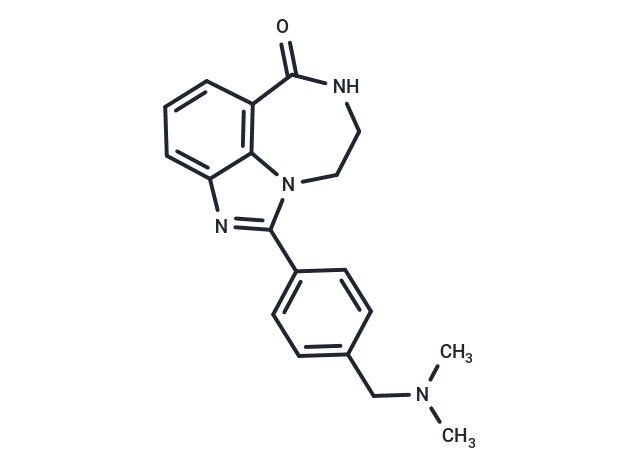

| Pack Size | Price | USA Stock | Global Stock | Quantity |
|---|---|---|---|---|
| 1 mg | $47 | In Stock | In Stock | |
| 2 mg | $70 | In Stock | In Stock | |
| 5 mg | $116 | In Stock | In Stock | |
| 10 mg | $213 | In Stock | In Stock | |
| 25 mg | $415 | In Stock | In Stock | |
| 50 mg | $606 | - | In Stock | |
| 1 mL x 10 mM (in DMSO) | $127 | In Stock | In Stock |
| Description | AG14361 is an effective inhibitor of PARP1 (Ki<5 nM). |
| Targets & IC50 | PARP1:<5 nM(Ki) |
| In vitro | Within non-toxic doses, AG14361 can enhance the growth delay of LoVo xenografts induced by irinotecan, X-ray irradiation, and temozolomide, increasing it by 2 to 3 times. In SW620 xenografts, AG14361 treatment at 10 mg/kg, i.p., for more than 4 hours can inhibit more than 75% of PARP-1 activity. In mice carrying LoVo xenografts, pre-treatment with AG14361 followed by statistical radiation significantly increases sensitivity to radiotherapy. AG14361 can significantly improve blood flow in xenografts, potentially facilitating drug delivery to the tumors. |
| In vivo | AG14361 (0.4 μM) has no impact on cancer cell gene expression or growth but enhances the anti-proliferative activity of temozolomide and topotecan. It also inhibits the recovery of LoVo cells from potentially lethal γ-radiation damage by up to 73%. Despite inhibiting over 85% of PARP-1 activity at 0.4 μM concentration, AG14361 does not affect gene expression or cellular proliferation. It shows no significant impact on the expression of around 6800 genes in A549 cells, even 17 hours post-treatment. At higher concentrations, AG14361 can affect gene expression, but this is not related to the inhibition of PARP-1, as cell proliferation is similarly impacted in both PARP-/- and PARP-1+/+ cells. AG14361 enhances the persistence of DNA single-strand breaks induced by camptothecin and is at least 1,000 times more effective than benzamide. It exerts inhibitory effects on transmembrane SW620 cells (IC50: 29 nM) and intact SW620 cells (IC50: 14 nM). The growth-inhibitory effects of AG14361 are independent of PARP-1 inhibition, as maximal inhibition of PARP-1 occurs at concentrations well below the GI50 (≤1 μM). |
| Synonyms | AG-14361, AG 14361 |
| Kinase Assay | PARP-1 Activity Assays: The activity of full-length recombinant human PARP-1 is measured in a reaction mixture containing 20 nM PARP-1, 500 μM NAD+ plus [32P]NAD+ (0.1–0.3 μCi per reaction mixture), and activated calf thymus DNA (10 μg/mL) at 25oC; the reaction is terminated after 4 minutes by adding ice-cold 10% (wt/vol) trichloroacetic acid. The reaction product [32P]ADP-ribose incorporated into acid-insoluble material is deposited onto Whatman GF/C glass fiber filters with a Bio-Dot microfiltration apparatus and quantified with a PhosphorImager. Inhibition of PARP-1 activity by AG14361 at 0–600 nM is measured, and the Ki for AG14361 is calculated by nonlinear regression analysis. |
| Cell Research | LoVo and SW620 colorectal cancer cells and A549 non–small-cell lung carcinoma cells are maintained in RPMI-1640 medium containing 10% fetal calf serum. Cell growth inhibition is estimated in exponentially growing LoVo, A549, and SW620 cells in 96-well plates. Cells are exposed to AG14361 (0–20 μM) alone or in the presence of 400 μM temozolomide. After 5 days of culture, these cells are fixed with 10% trichloroacetic acid and stained with sulforhodamine B. The concentration of temozolomide, topotecan, and AG14361 alone or in combination that inhibits growth by 50% (GI50) is calculated from computer-generated curves. Recovery from potentially lethal damage is measured in confluent LoVo cell cultures arrested in G1 phase to mimic the radiation-resistant quiescent cell population in tumors. Such cells are exposed to 8 Gy of γ-irradiation and then harvested and plated for colony formation assay immediately or maintained as growth-arrested confluent cultures for a 4-hour or 24-hour recovery period before harvesting and plating for the colony formation assay. Where indicated, 0.4 μM AG14361 is added 30 minutes before irradiation and is present in the recovery incubation. (Only for Reference) |
| Molecular Weight | 320.39 |
| Formula | C19H20N4O |
| Cas No. | 328543-09-5 |
| Smiles | CN(C)Cc1ccc(cc1)-c1nc2cccc3C(=O)NCCn1c23 |
| Relative Density. | 1.27 g/cm3 |
| Storage | Powder: -20°C for 3 years | In solvent: -80°C for 1 year Shipping with blue ice/Shipping at ambient temperature. | |||||||||||||||||||||||||
| Solubility Information | DMSO: 15 mg/mL (46.82 mM), Sonication is recommended.  H2O: < 1 mg/mL (insoluble or slightly soluble) Ethanol: < 1 mg/mL (insoluble or slightly soluble) | |||||||||||||||||||||||||
| In Vivo Formulation | 10% DMSO+40% PEG300+5% Tween 80+45% Saline: 1 mg/mL (3.12 mM), Sonication is recommended. Please add the solvents sequentially, clarifying the solution as much as possible before adding the next one. Dissolve by heating and/or sonication if necessary. Working solution is recommended to be prepared and used immediately. The formulation provided above is for reference purposes only. In vivo formulations may vary and should be modified based on specific experimental conditions. | |||||||||||||||||||||||||
Solution Preparation Table | ||||||||||||||||||||||||||
DMSO
Note : The dilution table applies only to solid products. For liquid products, please calculate the stock solution based on the stated concentration and/or density. | ||||||||||||||||||||||||||
 For example, if the intended dosage is 10 mg/kg for animals weighing 20 g , with a dosing volume of 100 μL per animal, and a total of 10 animals are to be administered, using a formulation of
  10% DMSO+ 40% PEG300+ 5% Tween 80+ 45% Saline/PBS/ddH2O , the resulting working solution concentration would be 2 mg/mL.
Dissolve 2 mg of the compound in 100 μL DMSO to obtain a stock solution at a concentration of 20 mg/mL . If the required concentration exceeds the compound's known solubility, please contact us for technical support before proceeding.
1) Add 100 μL of the DMSO stock solution to 400 µL PEG300 and mix thoroughly until the solution becomes clear.
2) Add 50 µL Tween 80 and mix well until fully clarified.
3) Add 450 µL Saline,PBS or ddH2O and mix thoroughly until a homogeneous solution is obtained.
| Size | Quantity | Unit Price | Amount | Operation |
|---|
 Feedback
 Hello! How can I help you today?
Copyright © 2015-2026 TargetMol Chemicals Inc. All Rights Reserved.
