


Shopping Cart
Remove All Your shopping cart is currently empty


Synonyms: C59
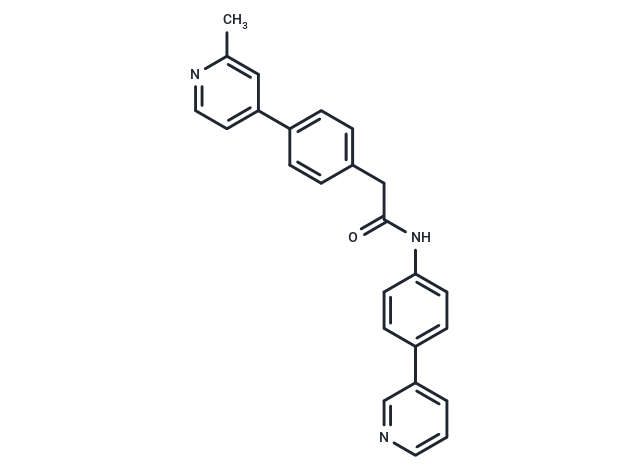

| Pack Size | Price | USA Stock | Global Stock | Quantity |
|---|---|---|---|---|
| 2 mg | $33 | In Stock | In Stock | |
| 5 mg | $48 | In Stock | In Stock | |
| 10 mg | $75 | In Stock | In Stock | |
| 25 mg | $132 | In Stock | In Stock | |
| 50 mg | $210 | In Stock | In Stock | |
| 100 mg | $360 | In Stock | In Stock | |
| 1 mL x 10 mM (in DMSO) | $53 | In Stock | In Stock |
| Description | Wnt-C59 (C59) is a highly effective and specific Wnt signaling antagonis with PORCN enzymatic activity. |
| Targets & IC50 | Porcn:74 pM |
| In vitro | In female nude mice with independently transplanted in-situ MMTV-WNT1 tumors, Wnt-C59 (10 mg/kg) effectively reduces the expression of β-catenin-targeted genes and decreases Wnt pathway activity, suppressing tumor cell growth. Additionally, in 14CREER/Rosa-SmoM2 mice, topical administration of Wnt-C59 (5 mg/kg) inhibits cell proliferation. |
| In vivo | In PORCN-deficient HT1080 cells transfected with PORCN, Wnt-C59 (100 nM) inhibits PORCN activity. Similarly, in HeLa cells transfected with WNT3A-V5, Wnt-C59 (10 -100 nM) suppresses the activity of the PORCN acyltransferase. |
| Synonyms | C59 |
| Kinase Assay | Aurora A radioactive Flashplate enzyme assay: Aurora A radioactive Flashplate enzyme assay is conducted to determine the nature and degree of MLN8237-mediated inhibition in vitro. Recombinant Aurora A is expressed in Sf9 cells and purified with GST affinity chromatography. The peptide substrate for Aurora A is conjugated with biotin (Biotin-GLRRASLG). Aurora A kinase (5 nM) is assayed in 50 mM Hepes (pH 7.5), 10 mM MgCl2, 5 mM DTT, 0.05% Tween 20, 2 μM peptide substrate, 3.3 μCi/mL [γ-33P]ATP at 2 μM, and increasing concentrations of MLN8237 by using Image FlashPlates. |
| Cell Research | Wnt-C59 (C59) is dissolved in DMSO (10 mM) and stored, and then diluted with appropriate medium before use[1]. Approximately, 1×10⁴ cells are seeded in 24-well plates, and Wnt-C59 (5 μM, 10 μM, and 20 μM) is added the next day. Each group is tested in triplicate and control groups with addition of DMSO are also established. Cell confluence is determined by microscopy at 24, 48, 72, and 96 hours after seeding of cells. The IC50 of Wnt-C59 is determined by MTT assay, using 96-well dishes. Next day, various concentrations of Wnt-C59 are added, and cellular viabilities are measured by a spectrophotometer at both 24 and 48 hours. For sphere formation, approximately one hundred cells are seeded onto the Low Cell Bind Surface 24-well Nunc dish. Each group is done in triplicate and each well had 2 mL medium. Media are changed twice a week, and only half of the media is changed each time. Approximately, 1×10³ cells are seeded for each well in the sphere inhibition assay. At 1 to 5 days after plating, all tested cells formed small spheres. Five days later, Wnt-C59 (1 μM, 5 μM, and 20 μM) is added into experimental groups. Abilities for cell growth and sphere images are compared and recorded at the end of the first, second, and third weeks after addition of Wnt-C59, or DMSO in control groups. The sphere growths are observed and recorded daily under microscopy, and the area of spheres is analyzed using Metamorph and recorded as average area (μm2)[1]. |
| Molecular Weight | 379.45 |
| Formula | C25H21N3O |
| Cas No. | 1243243-89-1 |
| Smiles | Cc1cc(ccn1)-c1ccc(CC(=O)Nc2ccc(cc2)-c2cccnc2)cc1 |
| Relative Density. | 1.198 g/cm3 (Predicted) |
| Storage | Store at low temperature,Keep away from direct sunlight Powder: -20°C for 3 years | In solvent: -80°C for 1 year Shipping with blue ice/Shipping at ambient temperature. | ||||||||||||||||||||||||||||||||||||||||
| Solubility Information | Ethanol: 7.6 mg/mL (20.03 mM), Sonication is recommended. DMSO: 38.32 mg/mL (100.99 mM), Sonication is recommended.  | ||||||||||||||||||||||||||||||||||||||||
| In Vivo Formulation | 10% DMSO+40% PEG300+5% Tween 80+45% Saline: 2 mg/mL (5.27 mM), Sonication is recommended. Please add the solvents sequentially, clarifying the solution as much as possible before adding the next one. Dissolve by heating and/or sonication if necessary. Working solution is recommended to be prepared and used immediately. The formulation provided above is for reference purposes only. In vivo formulations may vary and should be modified based on specific experimental conditions. | ||||||||||||||||||||||||||||||||||||||||
Solution Preparation Table | |||||||||||||||||||||||||||||||||||||||||
Ethanol/DMSO
DMSO
Note : The dilution table applies only to solid products. For liquid products, please calculate the stock solution based on the stated concentration and/or density. | |||||||||||||||||||||||||||||||||||||||||
 For example, if the intended dosage is 10 mg/kg for animals weighing 20 g , with a dosing volume of 100 μL per animal, and a total of 10 animals are to be administered, using a formulation of
  10% DMSO+ 40% PEG300+ 5% Tween 80+ 45% Saline/PBS/ddH2O , the resulting working solution concentration would be 2 mg/mL.
Dissolve 2 mg of the compound in 100 μL DMSO to obtain a stock solution at a concentration of 20 mg/mL . If the required concentration exceeds the compound's known solubility, please contact us for technical support before proceeding.
1) Add 100 μL of the DMSO stock solution to 400 µL PEG300 and mix thoroughly until the solution becomes clear.
2) Add 50 µL Tween 80 and mix well until fully clarified.
3) Add 450 µL Saline,PBS or ddH2O and mix thoroughly until a homogeneous solution is obtained.
| Size | Quantity | Unit Price | Amount | Operation |
|---|
 Feedback
 Hello! How can I help you today?
Copyright © 2015-2026 TargetMol Chemicals Inc. All Rights Reserved.
