


Shopping Cart
Remove All Your shopping cart is currently empty


Synonyms:

| Pack Size | Price | USA Stock | Global Stock | Quantity |
|---|---|---|---|---|
| 5 mg | $35 | In Stock | In Stock | |
| 10 mg | $45 | In Stock | In Stock | |
| 25 mg | $78 | In Stock | In Stock | |
| 50 mg | $126 | In Stock | In Stock | |
| 100 mg | $223 | In Stock | In Stock | |
| 200 mg | $289 | In Stock | In Stock | |
| 1 mL x 10 mM (in DMSO) | $50 | In Stock | In Stock |
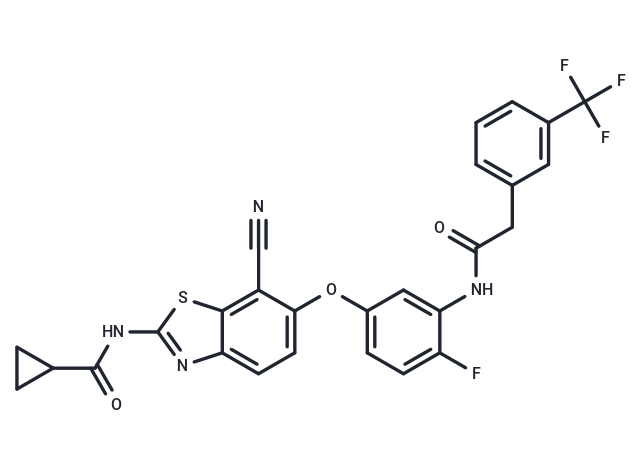
| Description | TAK-632, a potent pan-Raf inhibitor (GenScript, 2020), is characterized by its molecular weight [M] for [C 22 H 19 FN 2 O 2] of 362.4 by LC-MS, with a purity of 99% (HPLC). The compound exhibits white to off-white solid form and has a melting point [M] ranging from 178°C to 182°C (GenScript, 2020). Its solubility profile includes DMSO, in which it is soluble to 100mM (GenScript, 2020). |
| Targets & IC50 | C-Raf:1.4 nM, CDK1:790 nM, Aurora B:66 nM, Tie2:740 nM, PDGFRβ:120 nM, p38α:600 nM, B-Raf:8.3 nM, IKKβ:3700 nM, MEK1:3700 nM, CDK2:580 nM, FGFR3:280 nM, GSK-3β:500 nM, PDGFRα:610 nM |
| In vitro | In an SK-MEL-2 xenograft mouse model bearing NRAS-mutant melanoma, oral administration of TAK-632 (at doses of 60 or 120 mg/kg) inhibits the MAPK signaling pathway, thereby suppressing tumor growth. |
| In vivo | TAK-632 effectively inhibits cell proliferation in A375 (GI50=66 nM) and HMVII cell lines (GI50=200 nM). Specifically, in the melanoma A375 cell line (BRAFV600E), TAK-632 suppresses MEK phosphorylation (IC50=2 nM) and ERK phosphorylation (IC50=16 nM). Additionally, in the human melanoma HMVII cell line (NRASQ61K/BRAFG469V), TAK-632 inhibits pMEK (IC50=49 nM) and pERK (IC50=50 nM). |
| Kinase Assay | Kinase Profile Assay: Assays for serine/threonine kinases using radio labeled [γ-33P] ATP are performed in 96 well plates. BRAF and c-RAF are expressed as N-terminal FLAG-tagged protein using a baculovirus expression system. The reaction conditions are optimized for each kinase: BRAF (25 ng/well of enzyme, 1 μg/well of GST-MEK1(K96R), 0.1 μCi/well of [γ-32P] ATP, room temperature, 20 min reaction); c-RAF (25 ng/well of enzyme, 1 μg/well of GST-MEK1 (K96R), 0.1 μCi/well of [γ-32P] ATP, room temperature, 20 min reaction). Enzyme reactions are performed in 25 mM HEPES, pH 7.5, 10 mM magnesium acetate, 1 mM dithiothreitol and 0.5 μM ATP containing optimized concentration of enzyme, substrate and radiolabeled ATP as described above in a total volume of 50 μL. Prior to the kinase reaction, compound and enzyme are incubated for 5 min at reaction temperature as described above. The kinase reactions are initiated by adding ATP. After the reaction period as described above, the reactions are terminated by the addition of 10% (final concentration) trichloroacetic acid. The [γ-33P] or [γ-32P]-phosphorylated proteins are filtered in GFC filter plates with a Cell Harvester and then the plates are washed out with 3% phosphoric acid. The plates are dried, followed by the addition of 40 μL of MicroScint0. The radioactivity is counted by a TopCount scintillation counter. |
| Cell Research | The cells are proliferated in appropriate medium (vender recommended) supplemented with 10% heat-inactivated fetal bovine serum (FBS) and antibiotics, in tissue culture dishes placed in a humidified incubator maintained at 37°C in an atmosphere of 5% CO2 and 95% air. The anti-proliferative activity of compound is determined by treating cell lines with the compound for 3 days, followed by measurement of viable cell number in the Cell Titer-Glo assay. The cells are seeded in a 96-multiwell plate at 1500 to 4000 cells per well in medium containing FBS and cells allowed to sit down overnight. After 18–20 h, compounds at various concentrations by serial dilution are added to the cells and were cultured for 3 days in chamber. After the treatment culture, cellular proliferation is determined by a Cell Titer-Glo Luminescent Cell Viability Assay. In brief, 100 bL/well of Cell Titer-Glo Substrate solution is added to each well and the cells were cultured for an additional 10 minutes (approximately). The chemi-luminescence value is measured using a Luminescence Counter 1420 ARVO MX Light. Concentration response curves are generated by calculating the decrease in chemi-luminescence values in compound-treated samples relative to the vehicle (DMSO) treated controls. (Only for Reference) |
| Molecular Weight | 554.52 |
| Formula | C27H18F4N4O3S |
| Cas No. | 1228591-30-7 |
| Smiles | Fc1ccc(Oc2ccc3nc(NC(=O)C4CC4)sc3c2C#N)cc1NC(=O)Cc1cccc(c1)C(F)(F)F |
| Relative Density. | 1.52 g/cm3 (Predicted) |
| Storage | Powder: -20°C for 3 years | In solvent: -80°C for 1 year Shipping with blue ice/Shipping at ambient temperature. | ||||||||||||||||||||||||||||||||||||||||
| Solubility Information | DMSO: 93 mg/mL (167.71 mM), Sonication is recommended. Ethanol: 2 mg/mL (3.61 mM), Sonication is recommended. H2O: < 1 mg/mL (insoluble or slightly soluble) | ||||||||||||||||||||||||||||||||||||||||
| In Vivo Formulation | 10% DMSO+90% Corn Oil: 3.3 mg/mL (5.95 mM), Sonication is recommended. Please add the solvents sequentially, clarifying the solution as much as possible before adding the next one. Dissolve by heating and/or sonication if necessary. Working solution is recommended to be prepared and used immediately. The formulation provided above is for reference purposes only. In vivo formulations may vary and should be modified based on specific experimental conditions. | ||||||||||||||||||||||||||||||||||||||||
Solution Preparation Table | |||||||||||||||||||||||||||||||||||||||||
Ethanol/DMSO
DMSO
Note : The dilution table applies only to solid products. For liquid products, please calculate the stock solution based on the stated concentration and/or density. | |||||||||||||||||||||||||||||||||||||||||
 For example, if the intended dosage is 10 mg/kg for animals weighing 20 g , with a dosing volume of 100 μL per animal, and a total of 10 animals are to be administered, using a formulation of
  10% DMSO+ 40% PEG300+ 5% Tween 80+ 45% Saline/PBS/ddH2O , the resulting working solution concentration would be 2 mg/mL.
Dissolve 2 mg of the compound in 100 μL DMSO to obtain a stock solution at a concentration of 20 mg/mL . If the required concentration exceeds the compound's known solubility, please contact us for technical support before proceeding.
1) Add 100 μL of the DMSO stock solution to 400 µL PEG300 and mix thoroughly until the solution becomes clear.
2) Add 50 µL Tween 80 and mix well until fully clarified.
3) Add 450 µL Saline,PBS or ddH2O and mix thoroughly until a homogeneous solution is obtained.
| Size | Quantity | Unit Price | Amount | Operation |
|---|
 Feedback
 Hello! How can I help you today?
Copyright © 2015-2026 TargetMol Chemicals Inc. All Rights Reserved.
