


Shopping Cart
Remove All Your shopping cart is currently empty


Synonyms: FTC, Emtriva, BW1592
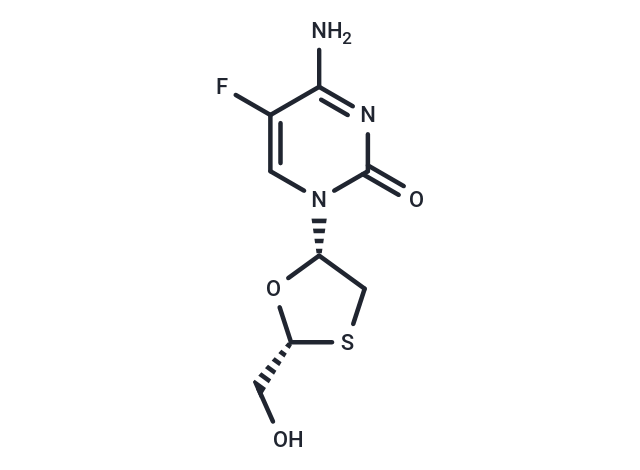
| Pack Size | Price | USA Stock | Global Stock | Quantity |
|---|---|---|---|---|
| 50 mg | $45 | In Stock | In Stock | |
| 100 mg | $68 | In Stock | In Stock | |
| 500 mg | $113 | In Stock | In Stock |
| Description | Emtricitabine is a nucleoside reverse transcriptase inhibitor with anti-human immunodeficiency virus (HIV) and hepatitis B virus activity, with an EC50 value of 0.01 µM in PBMC cells, and can be used to study HIV infection. |
| Targets & IC50 | NRTI:0.01 µM(EC50) |
| In vitro | METHODS: Vero E6 cells were treated with Emtricitabine (25, 50, 100 μM), and the SARS-CoV-2 titers obtained before and after treatment were measured. The MTT assay was used to evaluate the cytotoxicity of Emtricitabine against Vero E6 cells. RESULTS Emtricitabine showed anti-SARS-CoV-2 activity at 100 μM (59.6%), 50 μM (43.4%), and 25 μM (33.3%). [5] |
| In vivo | Reproductive and developmental toxicology studies conducted on emtricitabine show a favorable pre-clinical safety profile. When administered orally at doses up to 1000 mg/kg/day, pregnant animals experienced emtricitabine exposure levels (AUC0→24) approximately 60-fold (in mice) to 120-fold (in rabbits) higher than the human exposure at the recommended 200 mg daily dosage. Findings from a mouse fertility study indicate that emtricitabine does not impact fertility, sperm count, or early embryonic development. Additionally, there was no observed increase in malformations in mouse and rabbit embryofetal toxicology studies, nor did emtricitabine affect the development and fertility of the F1 progeny in a mouse pre- and post-natal study. These results underscore emtricitabine's lack of adverse effects on reproductive and developmental outcomes[6]. |
| Synonyms | FTC, Emtriva, BW1592 |
| Cell Research | EA.hy926 cells were plated in a 12-, 24- or 96-well plates and grown in DMEM media supplemented with 3% FCS. Endothelial cells from PARP+/+and PARP-/- mice were isolated and cultured. Cell viability was determined by the reduction of yellow MTT into a purple formazan product by mitochondrial dehydrogenases of metabolically active cells. Following the treatment period, the experimental medium was removed and 100 μL MTT (1 mg/mL) added. After 1 h incubation, the MTT solution was carefully removed and the purple crystals were solubilized in 100 μL of DMSO. The DMSO was transferred to an ELISA plate and absorbance measured at 550 nm with a 620 nm[3]. |
| Molecular Weight | 247.25 |
| Formula | C8H10FN3O3S |
| Cas No. | 143491-57-0 |
| Smiles | Nc1nc(=O)n(cc1F)[C@@H]1CS[C@H](CO)O1 |
| Relative Density. | 1.82 g/cm3 (Predicted) |
| Storage | Store at low temperature,Keep away from direct sunlight Powder: -20°C for 3 years | In solvent: -80°C for 1 year Shipping with blue ice/Shipping at ambient temperature. | |||||||||||||||||||||||||||||||||||
| Solubility Information | DMSO: 237 mg/mL (958.54 mM), Sonication is recommended.  | |||||||||||||||||||||||||||||||||||
| In Vivo Formulation | 10% DMSO+40% PEG300+5% Tween 80+45% Saline: 5 mg/mL (20.22 mM), Sonication is recommended. Please add the solvents sequentially, clarifying the solution as much as possible before adding the next one. Dissolve by heating and/or sonication if necessary. Working solution is recommended to be prepared and used immediately. The formulation provided above is for reference purposes only. In vivo formulations may vary and should be modified based on specific experimental conditions. | |||||||||||||||||||||||||||||||||||
Solution Preparation Table | ||||||||||||||||||||||||||||||||||||
DMSO
Note : The dilution table applies only to solid products. For liquid products, please calculate the stock solution based on the stated concentration and/or density. | ||||||||||||||||||||||||||||||||||||
 For example, if the intended dosage is 10 mg/kg for animals weighing 20 g , with a dosing volume of 100 μL per animal, and a total of 10 animals are to be administered, using a formulation of
  10% DMSO+ 40% PEG300+ 5% Tween 80+ 45% Saline/PBS/ddH2O , the resulting working solution concentration would be 2 mg/mL.
Dissolve 2 mg of the compound in 100 μL DMSO to obtain a stock solution at a concentration of 20 mg/mL . If the required concentration exceeds the compound's known solubility, please contact us for technical support before proceeding.
1) Add 100 μL of the DMSO stock solution to 400 µL PEG300 and mix thoroughly until the solution becomes clear.
2) Add 50 µL Tween 80 and mix well until fully clarified.
3) Add 450 µL Saline,PBS or ddH2O and mix thoroughly until a homogeneous solution is obtained.
| Size | Quantity | Unit Price | Amount | Operation |
|---|
 Feedback
 Hello! How can I help you today?
Copyright © 2015-2026 TargetMol Chemicals Inc. All Rights Reserved.
