


Shopping Cart
Remove All Your shopping cart is currently empty

Synonyms:
| Pack Size | Price | USA Stock | Global Stock | Quantity |
|---|---|---|---|---|
| 5 mg | $918 | Inquiry | Inquiry |
| Description | 8-Prenylkaempferol is an effective agent for attenuating pro-inflammatory NO induction, it may be an anti-inflammatory agent for suppressing influenza A virus-induced RANTES production acts by blocking PI3K-mediated transcriptional activation of NF-κB and IRF-3 and in part by interfering with IκB degradation which subsequently decreases NF-κB translocation. |
| In vitro | MC3T3-E1 cells were exposed to 8-Prenylkaempferol and the cytotoxicity was assayed. Osteoblast differentiation and maturation were evaluated by analyzing alkaline phosphatase (ALP) activity and cell mineralization, respectively. RT-PCR and Western blot were executed to determine the effects of 8-Prenylkaempferol on osteoblast differentiation-related gene expression and signaling pathway. 8-Prenylkaempferol significantly promoted ALP activity, up-regulated mRNA expressions of osteocalcin, osteopontin, and type I collagen, and induced bone nodules formation. Induction of differentiation by 8-Prenylkaempferol was associated with increased bone morphogenetic protein (BMP)-2 expression, and sequentially up-regulated the phosphorylations of Smad1/5/8 and p38, and increased the nuclear translocation of runt-related transcription factor 2 (Runx2). Addition of BMP-2 antagonist noggin blocked 8-Prenylkaempferol and recombinant mouse BMP-2-induced ALP activity, reconfirming that BMP-2 production is required in 8-Prenylkaempferol-mediated osteoblast differentiation. Noggin also abrogated 8-Prenylkaempferol evoked phosphorylations of Smad1/5/8 and p38, suggesting that BMP-2 signaling is required for p38 activation in 8-Prenylkaempferol-treated cells. Application of p38 inhibitor SB203580 repressed not only 8-Prenylkaempferol-mediated activation of ALP, but also the nuclear translocation of Runx2 and bone nodules formation[1] |
| Molecular Weight | 354.35 |
| Formula | C20H18O6 |
| Cas No. | 28610-31-3 |
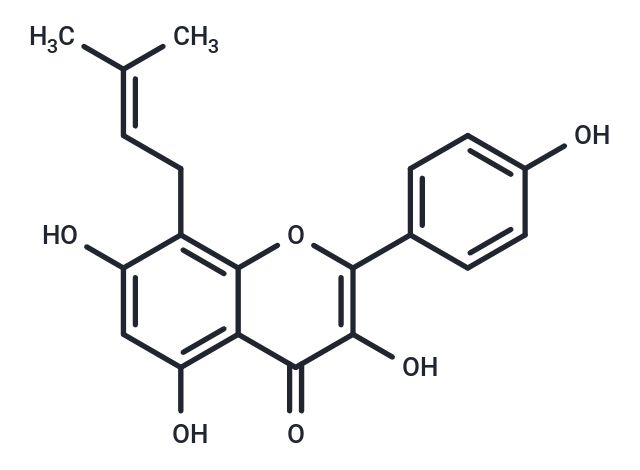
| Smiles | CC(C)=CCc(c(OC(c(cc1)ccc1O)=C1O)c(c(O)c2)C1=O)c2O |
| Relative Density. | 1.444 g/cm3 (Predicted) |
| Storage | Powder: -20°C for 3 years | In solvent: -80°C for 1 year Shipping with blue ice/Shipping at ambient temperature. |
 For example, if the intended dosage is 10 mg/kg for animals weighing 20 g , with a dosing volume of 100 μL per animal, and a total of 10 animals are to be administered, using a formulation of
  10% DMSO+ 40% PEG300+ 5% Tween 80+ 45% Saline/PBS/ddH2O , the resulting working solution concentration would be 2 mg/mL.
Dissolve 2 mg of the compound in 100 μL DMSO to obtain a stock solution at a concentration of 20 mg/mL . If the required concentration exceeds the compound's known solubility, please contact us for technical support before proceeding.
1) Add 100 μL of the DMSO stock solution to 400 µL PEG300 and mix thoroughly until the solution becomes clear.
2) Add 50 µL Tween 80 and mix well until fully clarified.
3) Add 450 µL Saline,PBS or ddH2O and mix thoroughly until a homogeneous solution is obtained.
| Size | Quantity | Unit Price | Amount | Operation |
|---|
 Feedback
 Hello! How can I help you today?
Copyright © 2015-2026 TargetMol Chemicals Inc. All Rights Reserved.
