


Shopping Cart
Remove All Your shopping cart is currently empty


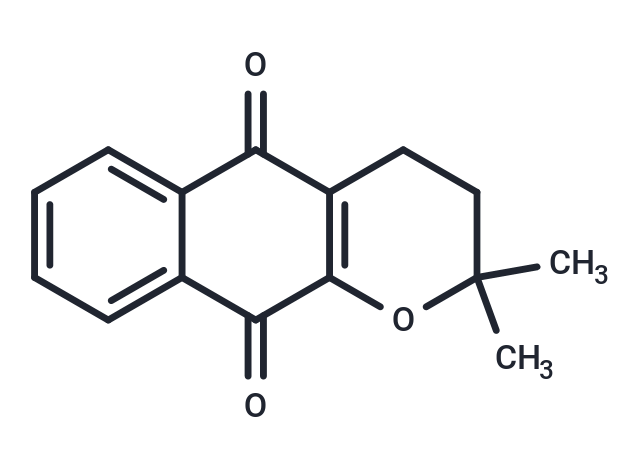
α-Lapachone has antineoplastic activity, it shows an approximately trypanocidal activity against Trypanosoma cruzi.
| Pack Size | Price | USA Warehouse | Global Warehouse | Quantity |
|---|---|---|---|---|
| 1 mg | $30 | - | In Stock | |
| 5 mg | $64 | - | In Stock | |
| 10 mg | $97 | - | In Stock | |
| 25 mg | $213 | - | In Stock | |
| 50 mg | $318 | - | In Stock | |
| 100 mg | $473 | - | In Stock | |
| 1 mL x 10 mM (in DMSO) | $65 | - | In Stock |
| Description | α-Lapachone has antineoplastic activity, it shows an approximately trypanocidal activity against Trypanosoma cruzi. |
| In vitro | The photophysical and photochemical reactions of β-lapachone were studied using femtosecond transient absorption, nanosecond transient absorption, and nanosecond time-resolved resonance Raman spectroscopy techniques and density functional theory calculations. In acetonitrile, β-lapachone underwent an efficient intersystem crossing to form the triplet state of β-lapachone. However, in water-rich solutions, the singlet state of β-lapachone was predominantly quenched by the photoinduced protonation of the carbonyl group at the β position (O9). After protonation, a series of fast reaction steps occurred to eventually generate the triplet state α±-lapachone intermediate. This triplet state of α±-lapachone then underwent intersystem crossing to produce the ground singlet state of α±-lapachone as the final product. 1,2-Naphthoquinone is examined in acetonitrile and water solutions in order to elucidate the important roles that water and the pyran ring play during the photoconversion from β-lapachone to α±-lapachone. β-Lapachone can also be converted to α±-lapachone in the ground state when a strong acid is added to an aqueous solution[1] |
| Synonyms | alpha-Lapachone |
| Molecular Weight | 242.27 |
| Formula | C15H14O3 |
| Cas No. | 4707-33-9 |
| Smiles | CC1(C)CCC2=C(O1)C(=O)c1ccccc1C2=O |
| Relative Density. | 1.25g/cm3 |
| Storage | Powder: -20°C for 3 years | In solvent: -80°C for 1 year | Shipping with blue ice/Shipping at ambient temperature. | |||||||||||||||||||||||||||||||||||
| Solubility Information | DMSO: 50 mg/mL (206.38 mM), Sonication is recommended.  | |||||||||||||||||||||||||||||||||||
Solution Preparation Table | ||||||||||||||||||||||||||||||||||||
DMSO
| ||||||||||||||||||||||||||||||||||||
 For example, if the intended dosage is 10 mg/kg for animals weighing 20 g , with a dosing volume of 100 μL per animal, and a total of 10 animals are to be administered, using a formulation of
  10% DMSO+ 40% PEG300+ 5% Tween 80+ 45% Saline/PBS/ddH2O , the resulting working solution concentration would be 2 mg/mL.
Dissolve 2 mg of the compound in 100 μL DMSO to obtain a stock solution at a concentration of 20 mg/mL . If the required concentration exceeds the compound's known solubility, please contact us for technical support before proceeding.
1) Add 100 μL of the DMSO stock solution to 400 μL PEG300 and mix thoroughly until the solution becomes clear.
2) Add 50 μL Tween 80 and mix well until fully clarified.
3) Add 450 μL Saline,PBS or ddH2O and mix thoroughly until a homogeneous solution is obtained.

| Size | Quantity | Unit Price | Amount | Operation |
|---|
 Feedback
 Hello! How can I help you today?
Copyright © 2015-2026 TargetMol Chemicals Inc. All Rights Reserved.
