


Shopping Cart
Remove All Your shopping cart is currently empty

Synonyms:
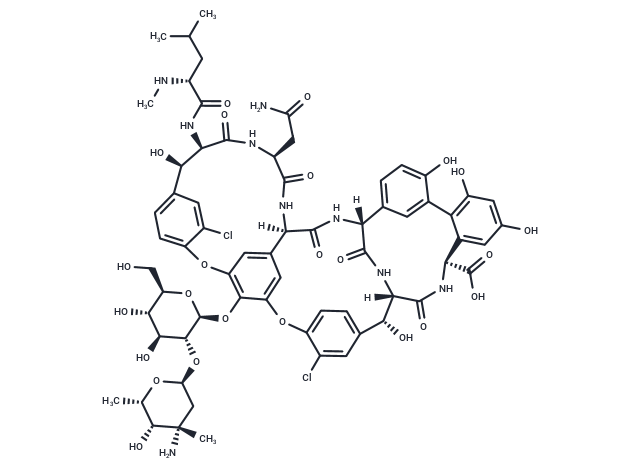
| Pack Size | Price | USA Stock | Global Stock | Quantity |
|---|---|---|---|---|
| 10 mg | $30 | In Stock | In Stock | |
| 25 mg | $42 | In Stock | In Stock | |
| 50 mg | $66 | In Stock | In Stock | |
| 100 mg | $98 | In Stock | In Stock | |
| 500 mg | $212 | - | In Stock |
| Description | Vancomycin is a glycopeptide antibiotic that exerts its antibacterial activity by inhibiting the second stage of cell wall synthesis in susceptible bacteria. It also alters cell membrane permeability and selectively inhibits RNA synthesis. Vancomycin is commonly used to treat severe infections resistant to other antibiotics and is frequently employed in experimental studies to induce kidney injury models. |
| Targets & IC50 | L1210 cells:> 1000 μg/mL, L02 cells:> 30 μM, HEK293 cells:> 100 μM (CC50) |
| In vitro | METHODS: B. burgdorferi was treated with Vancomycin (0.5-2.0 µg/mL) for 24 h and cell morphology was examined using real-time time-lapse microscopy. RESULTS: At higher concentrations of Vancomycin (≥1.0 µg/mL), many abnormal cells were observed, which were visually identified by vesiculation, granule formation, and morphological changes. The proportion of these abnormal bacteria in the population increased in a dose-dependent manner. [1] METHODS: Human osteosarcoma cells MG-63 were treated with Vancomycin (10-10000 µg/mL) for 24-72 h. Cell counts were measured using an Elzone Celi Counter. RESULTS: Localized levels of Vancomycin at 1000 µg/mL and below had little effect on osteoblast replication, and concentrations of 10,000 µg/mL resulted in cell death. [2] |
| In vivo | METHODS: To detect nephrotoxicity, Vancomycin (400 mg/kg) and Vitamin C (200 mg/kg) were administered intraperitoneally to C57BL/6J mice once daily for seven days. RESULTS: Renal index, renal injury score, apoptosis, serum Cr and BUN, as well as renal Cr, BUN, MDA, IL-1β, IL-6, TNF-α, and NF-κB were higher in the Vancomycin group than in the control group, whereas body weight and renal SOD activity were lower. On the contrary, no differences were observed between the control and Vitamin C groups in all these indices. [3] METHODS: To deplete the intestinal microbiota of mice, the antibiotics (ABX) Vancomycin (0.5 g/L), Ampicillin (1 g/L), Neomycin sulfate (1 g/L), and metronidazole (1 g/L) were administered to mice by drinking water for two weeks. RESULTS: Antibiotics significantly reduced the diversity and composition of the gut microbiota. [4] |
| Disease Modeling Protocol | Acute Kidney Injury (AKI) Model
*Precautions: On day 8, all rats were euthanized with CO2; serum and tissue samples were then collected. |
| Molecular Weight | 1449.25 |
| Formula | C66H75Cl2N9O24 |
| Cas No. | 1404-90-6 |
| Smiles | O(C=1C2=CC3=CC1OC=4C(Cl)=CC(=CC4)[C@@H](O)[C@@H](NC([C@@H](CC(C)C)NC)=O)C(=O)N[C@@H](CC(N)=O)C(=O)N[C@]3(C(=O)N[C@@]5(C=6C=C(C=7C([C@@H](C(O)=O)NC(=O)[C@]([C@H](O)C=8C=C(Cl)C(O2)=CC8)(NC5=O)[H])=CC(O)=CC7O)C(O)=CC6)[H])[H])[C@H]9[C@H](O[C@H]%10C[C@](C)(N)[C@H](O)[C@H](C)O%10)[C@@H](O)[C@H](O)[C@@H](CO)O9 |
| Relative Density. | 1.65 g/cm3 |
| Sequence | {d-Leu}-{d-Tyr}-Asn-{d-Nty}-{d-Nty}-Tyr-{Nty} (Covalent bridge:Tyr2-Nty4, Nty4-Tyr6, Nty5-Nty7) |
| Sequence Short | {d-Leu}-{d-Tyr}-N-{d-Nty}-{d-Nty}-Y-{Nty} (Covalent bridge:Tyr2-Nty4, Nty4-Tyr6, Nty5-Nty7) |
| Storage | Powder: -20°C for 3 years | In solvent: -80°C for 1 year Shipping with blue ice/Shipping at ambient temperature. | |||||||||||||||||||||||||||||||||||
| Solubility Information | DMSO: 250 mg/mL (172.5 mM), Sonication is recommended.  | |||||||||||||||||||||||||||||||||||
| In Vivo Formulation | 10% DMSO+90% Saline: 1 mg/mL (0.69 mM), Solution. Please add the solvents sequentially, clarifying the solution as much as possible before adding the next one. Dissolve by heating and/or sonication if necessary. Working solution is recommended to be prepared and used immediately. The formulation provided above is for reference purposes only. In vivo formulations may vary and should be modified based on specific experimental conditions. | |||||||||||||||||||||||||||||||||||
Solution Preparation Table | ||||||||||||||||||||||||||||||||||||
DMSO
Note : The dilution table applies only to solid products. For liquid products, please calculate the stock solution based on the stated concentration and/or density. | ||||||||||||||||||||||||||||||||||||
 For example, if the intended dosage is 10 mg/kg for animals weighing 20 g , with a dosing volume of 100 μL per animal, and a total of 10 animals are to be administered, using a formulation of
  10% DMSO+ 40% PEG300+ 5% Tween 80+ 45% Saline/PBS/ddH2O , the resulting working solution concentration would be 2 mg/mL.
Dissolve 2 mg of the compound in 100 μL DMSO to obtain a stock solution at a concentration of 20 mg/mL . If the required concentration exceeds the compound's known solubility, please contact us for technical support before proceeding.
1) Add 100 μL of the DMSO stock solution to 400 µL PEG300 and mix thoroughly until the solution becomes clear.
2) Add 50 µL Tween 80 and mix well until fully clarified.
3) Add 450 µL Saline,PBS or ddH2O and mix thoroughly until a homogeneous solution is obtained.
| Size | Quantity | Unit Price | Amount | Operation |
|---|
 Feedback
 Hello! How can I help you today?
Copyright © 2015-2026 TargetMol Chemicals Inc. All Rights Reserved.
