


Shopping Cart
Remove All Your shopping cart is currently empty


Synonyms: TSA
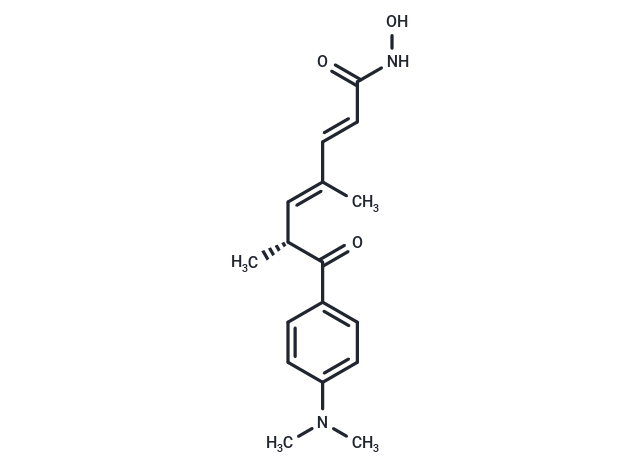
| Pack Size | Price | USA Stock | Global Stock | Quantity |
|---|---|---|---|---|
| 1 mg | $86 | In Stock | In Stock | |
| 2 mg | $112 | In Stock | In Stock | |
| 5 mg | $197 | In Stock | In Stock | |
| 10 mg | $373 | In Stock | In Stock | |
| 25 mg | $522 | In Stock | In Stock | |
| 50 mg | $755 | In Stock | In Stock | |
| 1 mL x 10 mM (in DMSO) | $183 | In Stock | In Stock |
| Description | Trichostatin A (TSA), a natural derivative of diene isohydroxamic acids, is a specific and reversible histone deacetylase inhibitor (IC50=1.8 nM) that induces hyperacetylation of core histones to regulate chromatin structure. |
| Targets & IC50 | HDAC1:6.0 ± 2.5 nM, HDAC4:38 ± 4 nM, MDA-MB-231 cells:500 nM, HeLa cells:20 nM, MCF-7 cells:500 nM, HDAC:1.8 nM, HDAC (Vascular Smooth Muscle cells):0.08 μM, HDAC6:8.6 ± 1.4 nM |
| In vitro | METHODS: Eight breast cancer cells MCF-7, T-47D, ZR-75-1, BT-474, MDA-MB-231, MDA-MB-453, CAL 51 and SK-BR-3 were treated with Trichostatin A (10-12 -10-5 M) for 96 h. The viability of the cells was determined by SRB. Cell viability was determined by SRB RESULTS: Trichostatin A inhibited the proliferation of eight breast cancer cell lines with a mean IC50=124.4±120.4 nM (range 26.4-308.1 nM). [1] METHODS: Esophageal squamous cell carcinoma cells EC9706 and EC1 were treated with Trichostatin A (0.3-1 μM) for 48 h. Apoptosis was detected using Flow Cytometry. RESULTS: There was no significant increase in the percentage of early apoptosis at 0.3 and 0.5 μM Trichostatin A doses. However, 1.0 μM Trichostatin A treatment significantly induced early apoptosis compared with control. In addition, the percentage of mid- and late-stage apoptosis increased in a concentration-dependent manner. [2] METHODS: Esophageal squamous cell carcinoma cells EC9706 and EC1 were treated with Trichostatin A (0.3-1 μM) for 60 min, and the expression levels of target proteins were detected using Western Blot. RESULTS: Trichostatin A decreased the protein levels of PI3K as well as p-Akt and p-ERK1/2 in a dose-dependent manner. acetylation of histone H4 was increased in a concentration-dependent manner. [2] |
| In vivo | METHODS: To assay antitumor activity in vivo, Trichostatin A (500 μg/kg) was injected subcutaneously into rats with NMU-induced mammary carcinoma tumors once daily for four weeks. RESULTS: Trichostatin A showed significant antitumor activity in vivo. tumors in Trichostatin A-treated rats had benign phenotypes, fibroadenomas or tubular adenomas, suggesting that the antitumor activity of Trichostatin A may be attributable to induction of differentiation. [1] METHODS: To assay antitumor activity in vivo, Trichostatin A (0.5-1 mg/kg twice weekly) and Quercetin (10 mg/kg three times weekly) were injected intraperitoneally into nude mice bearing human lung adenocarcinoma tumor A549 for thirteen weeks. RESULTS: High-dose Trichostatin A significantly inhibited tumor growth, while low-dose Trichostatin A and Quercetin alone had no effect. However, the combination of low-dose Trichostatin A and Quercetin significantly inhibited tumor growth. [3] |
| Synonyms | TSA |
| Kinase Assay | In vitro HDAC activity: Total cellular extracts are prepared from each breast cancer cell line (MCF-7, T-47D, ZR-75-1, BT-474, MDA-MB-231, MDA-MB-453, CAL 51, or SK-BR-3). A 20 μL crude cell extract (~2.5 ×10⁵ cells), in the presence of varying concentrations of Trichostatin A in 0.1% (v/v) ethanol or 0.1% (v/v) ethanol as vehicle control, are incubated for 60 minutes at 25 °C with 1 μL (~1.5 × 10⁶ cpm) of [3H]acetyl-labeled histone H4 peptide substrate (NH2-terminal residues 2-20) that has been acetylated with [3H]acetic acid, sodium salt (3.7 GBq/mmol) by an in vitro incorporation method. Each 200 μL reaction is quenched with 50 μL of 1 M HCl/0.16 M acetic acid and extracted with 600 μL of ethyl acetate, and released [3H]acetate is quantified by scintillation counting. IC50 values are determined graphically using nonlinear regression to fit inhibition data to the appropriate dose-response curve. |
| Cell Research | Cells are exposed to various concentrations of Trichostatin A for 96 hours. After treatment, cell proliferation is estimated using the sulforhodamine B colorimetric assay. Cell viability is determined by trypan blue exclusion. (Only for Reference) |
| Molecular Weight | 302.37 |
| Formula | C17H22N2O3 |
| Cas No. | 58880-19-6 |
| Smiles | C[C@H](\C=C(/C)\C=C\C(=O)NO)C(=O)c1ccc(cc1)N(C)C |
| Relative Density. | 1.139 g/cm3 |
| Storage | Store at low temperature Powder: -20°C for 3 years | In solvent: -80°C for 1 year Shipping with blue ice/Shipping at ambient temperature. | ||||||||||||||||||||||||||||||||||||||||
| Solubility Information | DMSO: 50 mg/mL (165.36 mM), Sonication is recommended.  Ethanol: 3 mg/mL (9.92 mM), Sonication is recommended. | ||||||||||||||||||||||||||||||||||||||||
Solution Preparation Table | |||||||||||||||||||||||||||||||||||||||||
Ethanol/DMSO
DMSO
Note : The dilution table applies only to solid products. For liquid products, please calculate the stock solution based on the stated concentration and/or density. | |||||||||||||||||||||||||||||||||||||||||
 For example, if the intended dosage is 10 mg/kg for animals weighing 20 g , with a dosing volume of 100 μL per animal, and a total of 10 animals are to be administered, using a formulation of
  10% DMSO+ 40% PEG300+ 5% Tween 80+ 45% Saline/PBS/ddH2O , the resulting working solution concentration would be 2 mg/mL.
Dissolve 2 mg of the compound in 100 μL DMSO to obtain a stock solution at a concentration of 20 mg/mL . If the required concentration exceeds the compound's known solubility, please contact us for technical support before proceeding.
1) Add 100 μL of the DMSO stock solution to 400 µL PEG300 and mix thoroughly until the solution becomes clear.
2) Add 50 µL Tween 80 and mix well until fully clarified.
3) Add 450 µL Saline,PBS or ddH2O and mix thoroughly until a homogeneous solution is obtained.
| Size | Quantity | Unit Price | Amount | Operation |
|---|
 Feedback
 Hello! How can I help you today?
Copyright © 2015-2026 TargetMol Chemicals Inc. All Rights Reserved.
