


Shopping Cart
Remove All
  • TargetMol
    Your shopping cart is currently empty

Taurocholic acid sodium salt hydrate

Copy Product Info
😃Good
Catalog No. T1138Cas No. 345909-26-4
Alias Taurocholic Acid sodium hydrate, Sodium taurocholate hydrate
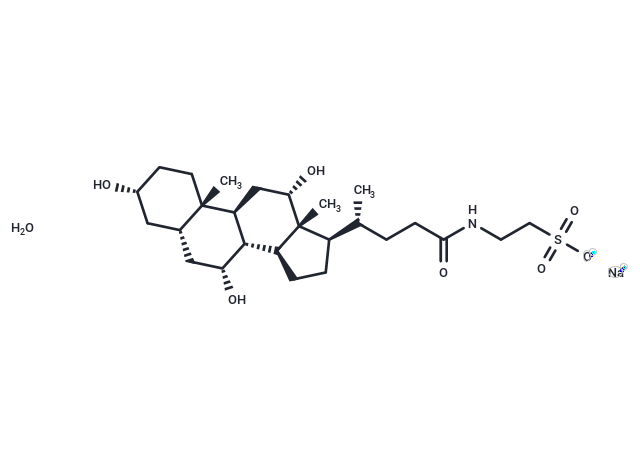
Taurocholic acid sodium salt hydrate is a bile acid sodium salt hydrate that participates in fat emulsification and can be used to establish pancreatitis models.

Taurocholic acid sodium salt hydrate

Taurocholic acid sodium salt hydrate

Copy Product Info
😃Good
Purity: 99.95%
Catalog No. T1138Alias Taurocholic Acid sodium hydrate, Sodium taurocholate hydrateCas No. 345909-26-4
Taurocholic acid sodium salt hydrate is a bile acid sodium salt hydrate that participates in fat emulsification and can be used to establish pancreatitis models.
Pack SizePriceUSA WarehouseGlobal WarehouseQuantity
500 mg$29-In Stock
1 mL x 10 mM (in DMSO)$29In StockIn Stock
Add to Cart
Add to Quotation
In Stock Estimated shipping dateUSA Warehouse[1-2 days] Global Warehouse[5-7 days]
All TargetMol products are for research purposes only and cannot be used for human consumption. We do not provide products or services to individuals. Please comply with the intended use and do not use TargetMol products for any other purpose.
Questions
TargetMol
View More

Batch Information

Select Batch
Purity:99.95%
Color:White
Contact us for more batch information

Resource Download

Product Introduction

Bioactivity
Description
Taurocholic acid sodium salt hydrate is a bile acid sodium salt hydrate that participates in fat emulsification and can be used to establish pancreatitis models.
Disease Modeling Protocol
Pancreatitis model
  • Modeling Mechanism:

    After retrograde injection of taurocholic acid sodium salt hydrate into the bile and pancreatic ducts, it activates the release of pancreatic digestive enzymes (such as lipase), triggering pancreatic autodigestion; at the same time, it induces oxidative stress (glutathione depletion, enhanced lipid peroxidation), inhibits the activity of serine/threonine protein phosphatases (PP1, PP2A), and upregulates pro-inflammatory cytokines; in obese states, increased abdominal fat is prone to necrosis, releasing large amounts of free fatty acids, which exacerbates pancreatic and systemic inflammatory responses.

  • Related Products:

    Taurocholic acid sodium salt hydrate (T1138)

  • Modeling Method:

    Experimental Subject:

    Rats, Zucker, Male, Lean rats 308±25g, obese rats 433±35g

    Dosage and Administration Route:

    3.5% sodium taurocholate, 0.3 ml dissolved in physiological saline, retrograde injection into the bile duct via the duodenum

    Dosing Frequency and Duration Model:

    Single dose

  • Validation:

    The pancreatic glutathione (GSH) level decreased, the oxidized glutathione (GSSG) level increased, and the activities of PP1 and PP2A decreased; the plasma and ascites fluid levels of isoprostaglandins and malondialdehyde (MDA) increased, and the plasma and ascites fluid levels of triglycerides and free fatty acids increased significantly.

*Precautions: All rats were sacrificed in batches at 0, 1, and 6 hours after modeling, and pancreatic, adipose tissue, plasma, and ascites samples were collected simultaneously.

*References:Pereda J,et,al. Obese rats exhibit high levels of fat necrosis and isoprostanes in taurocholate-induced acute pancreatitis. PLoS One. 2012;7(9):e44383.

Liver regeneration model
  • Modeling Mechanism:

    Taurocholic acid sodium salt hydrate can activate the Hippo-YAP/TAZ signaling pathway, downregulate the expression of MST1 and LATS1/2, and upregulate SAV1, MOB1 and downstream Cyclin D1, CYR61, and CTGF genes; at the same time, it regulates bile acid metabolism, activates the FXR-SHP signaling axis, maintains bile acid homeostasis, and synergistically promotes hepatocyte proliferation and liver regeneration, accompanied by mild liver damage.

  • Related Products:

    Taurocholic acid sodium salt hydrate (T1138)

  • Modeling Method:

    Experimental Subject:

    Rat, Wistar, Male, 230-270g

    Dosage and Administration Route:

    0.5% Taurocholic acid sodium salt, Administered orally mixed with feed

    Dosing Frequency and Duration Model:

    Postoperative continuous administration

  • Validation:

    The regeneration rate of unligated liver lobes was significantly increased, and the proportion of Ki67 positive hepatocytes increased; serum and liver tissue TBA levels were elevated, FXR and SHP gene expression was upregulated, and Cyp7a1 expression was downregulated; the expression of key genes in the Hippo signaling pathway was altered; and serum ALT, AST, and TBil levels were slightly elevated.

*Precautions: All rats were sacrificed in batches on days 1, 2, 3, 5, and 7 after surgery; fasting was required for 12 hours before modeling; the concentration of sodium taurocholate in the feed was strictly controlled at 0.5% to avoid excessive concentration leading to severe liver damage.

*References:Ge X,et,al. Sodium taurocholate promotes liver regeneration after portal vein ligation in rats. Sci Rep. 2025 Nov 26;15(1):45436.

SynonymsTaurocholic Acid sodium hydrate, Sodium taurocholate hydrate
Chemical Properties
Molecular Weight537.68
FormulaC26H44NNaO7S·xH2O
Cas No.345909-26-4
SmilesO.[Na+].C[C@H](CCC(=O)NCCS([O-])(=O)=O)[C@H]1CC[C@H]2[C@@H]3[C@H](O)C[C@@H]4C[C@H](O)CC[C@]4(C)[C@H]3C[C@H](O)[C@]12C
Relative Density.no data available
Storage & Solubility Information
StoragePowder: -20°C for 3 years | In solvent: -80°C for 1 year | Shipping with blue ice/Shipping at ambient temperature.
Solubility Information
H2O: 110 mg/mL (204.58 mM), Sonication is recommended.
DMSO: 255 mg/mL (474.26 mM), Sonication is recommended.

In Vivo Formulation
10% DMSO+40% PEG300+5% Tween 80+45% Saline: 2 mg/mL (3.72 mM), Sonication is recommended.
Please add the solvents sequentially, clarifying the solution as much as possible before adding the next one. Dissolve by heating and/or sonication if necessary. Working solution is recommended to be prepared and used immediately. The formulation provided above is for reference purposes only. In vivo formulations may vary and should be modified based on specific experimental conditions.
Solution Preparation Table
H2O/DMSO
1mg5mg10mg50mg
1 mM1.8598 mL9.2992 mL18.5984 mL92.9921 mL
5 mM0.3720 mL1.8598 mL3.7197 mL18.5984 mL
10 mM0.1860 mL0.9299 mL1.8598 mL9.2992 mL
20 mM0.0930 mL0.4650 mL0.9299 mL4.6496 mL
50 mM0.0372 mL0.1860 mL0.3720 mL1.8598 mL
100 mM0.0186 mL0.0930 mL0.1860 mL0.9299 mL

Calculator

  • Molarity Calculator
  • Dilution Calculator
  • Reconstitution Calculator
  • Molecular Weight Calculator

In Vivo Formulation Calculator (Clear solution)

Please enter your animal experiment information in the following box and click Calculate to obtain the stock solution preparation method and in vivo formula preparation method:
TargetMol | Animal experiments For example, if the intended dosage is 10 mg/kg for animals weighing 20 g , with a dosing volume of 100 μL per animal, TargetMol | Animal experiments and a total of 10 animals are to be administered, using a formulation of TargetMol | reagent 10% DMSO+ 40% PEG300+ 5% Tween 80+ 45% Saline/PBS/ddH2O , the resulting working solution concentration would be 2 mg/mL.

Stock Solution Preparation:

Dissolve 2 mg of the compound in 100 μL DMSOTargetMol | reagent to obtain a stock solution at a concentration of 20 mg/mL . If the required concentration exceeds the compound's known solubility, please contact us for technical support before proceeding.

Preparation of the In Vivo Formulation:

1) Add 100 μL of the DMSOTargetMol | reagent stock solution to 400 μL PEG300TargetMol | reagent and mix thoroughly until the solution becomes clear.

2) Add 50 μL Tween 80 and mix well until fully clarified.

3) Add 450 μL Saline,PBS or ddH2OTargetMol | reagent and mix thoroughly until a homogeneous solution is obtained.

This example is provided solely to demonstrate the use of the In Vivo Formulation Calculator and does not constitute a recommended formulation for any specific compound. Please select an appropriate dissolution and formulation strategy based on your experimental model and route of administration.
All co-solvents required for this protocol, includingDMSO, PEG300/PEG400, Tween 80, SBE-β-CD, and Corn oil, are available for purchase on the TargetMol website.
1 Enter information below:
mg/kg
g
μL
2 Enter the in vivo formulation:
% DMSO
%
% Tween 80
% Saline/PBS/ddH2O

Dose Conversion

You can also refer to dose conversion for different animals. More Dose Conversion

Tech Support

Please see Inhibitor Handling Instructions for more frequently ask questions. Topics include: how to prepare stock solutions, how to store products, and cautions on cell-based assays & animal experiments, etc

Keywords

Related Tags: buy Taurocholic acid sodium salt hydrate | purchase Taurocholic acid sodium salt hydrate | Taurocholic acid sodium salt hydrate cost | order Taurocholic acid sodium salt hydrate | Taurocholic acid sodium salt hydrate chemical structure | Taurocholic acid sodium salt hydrate formula | Taurocholic acid sodium salt hydrate molecular weight




