


Shopping Cart
Remove All Your shopping cart is currently empty

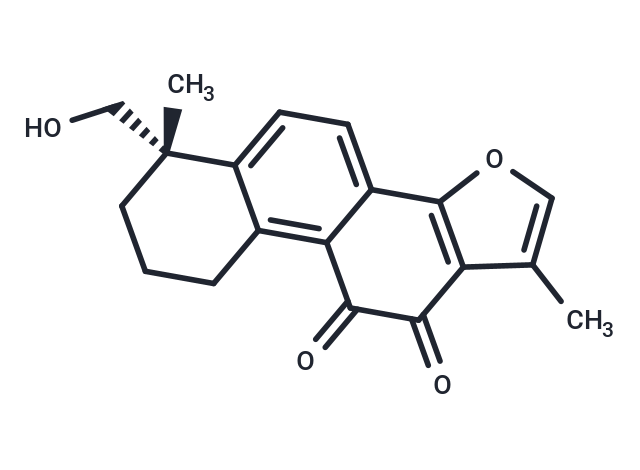
Synonyms: Tanshinone II-b, 6-(hydroxymethyl)-1,6-dimethyl-8,9-dihydro-7H-naphtho(1,2-g)(1)benzofuran-10,11-dione
| Pack Size | Price | USA Stock | Global Stock | Quantity |
|---|---|---|---|---|
| 1 mg | $198 | - | In Stock | |
| 5 mg | $496 | - | In Stock |
| Description | Tanshinone IIB (6-(hydroxymethyl)-1,6-dimethyl-8,9-dihydro-7H-naphtho(1,2-g)(1)benzofuran-10,11-dione) , a major active ingredient in the roots of Salvia miltiorrhiza, is widely studied in Asian countries for its role in stroke and coronary heart disease. Tanshinone IIB exerts its neuroprotective effects primarily through the inhibition of apoptosis. |
| In vitro | Method: Primary rat brain microvascular endothelial cells (RBMVECs) were used to examine the uptake and efflux of Tanshinone IIB. The transmembrane transport of Tanshinone IIB was observed in RBMVEC monolayers. P-glycoprotein (P-gp) or multidrug resistance-associated protein (Mrp1/2) inhibitors, as well as the P-gp inhibitor verapamil, were added. Result: The uptake and efflux of Tanshinone IIB in RBMVECs were ATP-dependent and were significantly altered in the presence of P-gp or Mrp1/2 inhibitors. Polarized transport of Tanshinone IIB was observed in RBMVEC monolayers, characterized by enhanced efflux from the basolateral side to the apical side. This polarized transport was attenuated when a P-gp inhibitor was added to both the basolateral and apical sides [1]. |
| In vivo | Method: An in situ rat brain perfusion model was used to compare the permeability of Tanshinone IIB and sucrose across the blood-brain barrier (BBB) and blood-cerebrospinal fluid barrier. Co-administration of verapamil, quinidine, or probenecid was performed in rats. Animal models included rats subjected to middle cerebral artery occlusion (MCAO) or treated with the neurotoxin quinolinic acid, as well as mdr1a(-/-) and mrp1(-/-) knockout mice. Result: Tanshinone IIB crossed the BBB and blood-cerebrospinal fluid barrier at a higher rate than sucrose, and brain penetration was increased in the presence of P-gp or Mrp1/2 inhibitors. Brain levels of Tanshinone IIB in rats were only about 30% of those in plasma, but could rise to up to 72% of plasma levels when verapamil, quinidine, or probenecid was co-administered. Compared with normal rats, the entry of Tanshinone IIB into the CNS increased by 67–97% in rats subjected to MCAO or treated with quinolinic acid. Furthermore, brain levels of Tanshinone IIB in mdr1a(-/-) and mrp1(-/-) mice were 28‑fold and 2.6‑fold higher, respectively, than those in wild‑type mice [1]. |
| Synonyms | Tanshinone II-b, 6-(hydroxymethyl)-1,6-dimethyl-8,9-dihydro-7H-naphtho(1,2-g)(1)benzofuran-10,11-dione |
| Molecular Weight | 310.34 |
| Formula | C19H18O4 |
| Cas No. | 17397-93-2 |
| Smiles | O=C1C=2C(C3=C(C1=O)C(C)=CO3)=CC=C4C2CCC[C@@]4(CO)C |
| Relative Density. | 1.282 g/cm3 (Predicted) |
| Storage | Keep away from direct sunlight, Powder: -20°C for 3 years | In solvent: -80°C for 1 year Shipping with blue ice/Shipping at ambient temperature. |
| Solubility Information | Methanol: < 1 mg/mL (insoluble) |
 For example, if the intended dosage is 10 mg/kg for animals weighing 20 g , with a dosing volume of 100 μL per animal, and a total of 10 animals are to be administered, using a formulation of
  10% DMSO+ 40% PEG300+ 5% Tween 80+ 45% Saline/PBS/ddH2O , the resulting working solution concentration would be 2 mg/mL.
Dissolve 2 mg of the compound in 100 μL DMSO to obtain a stock solution at a concentration of 20 mg/mL . If the required concentration exceeds the compound's known solubility, please contact us for technical support before proceeding.
1) Add 100 μL of the DMSO stock solution to 400 µL PEG300 and mix thoroughly until the solution becomes clear.
2) Add 50 µL Tween 80 and mix well until fully clarified.
3) Add 450 µL Saline,PBS or ddH2O and mix thoroughly until a homogeneous solution is obtained.
| Size | Quantity | Unit Price | Amount | Operation |
|---|
 Feedback
 Hello! How can I help you today?
Copyright © 2015-2026 TargetMol Chemicals Inc. All Rights Reserved.
