


Shopping Cart
Remove All Your shopping cart is currently empty


Synonyms: PD-123654, N-acetyldinaline, Goe-5549, CI994, Acetyldinaline
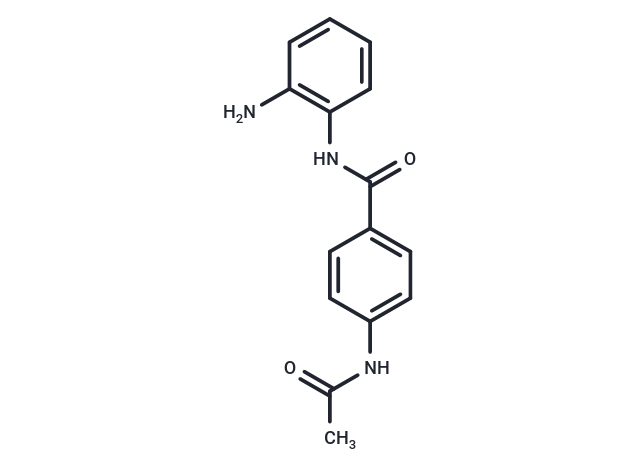

| Pack Size | Price | USA Stock | Global Stock | Quantity |
|---|---|---|---|---|
| 10 mg | $43 | In Stock | In Stock | |
| 50 mg | $66 | In Stock | In Stock | |
| 100 mg | $97 | In Stock | In Stock | |
| 200 mg | $171 | In Stock | In Stock | |
| 500 mg | $369 | In Stock | In Stock | |
| 1 mL x 10 mM (in DMSO) | $30 | In Stock | In Stock |
| Description | Tacedinaline (CI994) is a selective class I HDAC inhibitor with potential antineoplastic activity. |
| Targets & IC50 | HDAC2:0.9 μM, HDAC1:0.9 μM, HDAC3:1.2 μM |
| In vitro | In models of chemotherapy-resistant pancreatic ductal adenocarcinoma in mice and human prostate tumor, CI-994 consistently demonstrated antitumor activity. |
| In vivo | CI-994 exhibits antitumor activity, displaying enhanced cytocidal effects in solid tumors. It inhibits cell growth across various cell types, including rat leukemia BCLO cells (IC50=2.5 µM) and LNCaP cells (IC50=7.4 µM). In A-549 and LX-1 cells, CI-994 (<160 mM) increases the number of cells in the G0/G1 phase while decreasing those in the S phase, effectively inhibiting cell growth and inducing apoptosis. |
| Synonyms | PD-123654, N-acetyldinaline, Goe-5549, CI994, Acetyldinaline |
| Cell Research | LNCaP cell lines are maintained in RPMI 1640 medium containing 10% fetal bovine serum, 1% penicillin and streptomycin, as the complete culture medium. Cells (2×10⁴) are seeded in 24-well plates and incubated in a 5% CO2 incubator at 37 °C for 1 day. Cultures are treated with CI-994, alone and in combination on day 2 and 4. Cells are washed on day 2 and 4 and media are changed. Mitochondrial metabolism is measured as a marker for cell growth by adding 100 μL/well MTT (5 mg/mL in medium) with 2 hours incubation at 37 °C on Day 6. Crystals formed are dissolved in 500 μL of DMSO. The absorbance is determined using a microplate reader at 560 nm. The absorbance data are converted into cell proliferation percentage. Each assay is performed in triplicate. (Only for Reference) |
| Molecular Weight | 269.3 |
| Formula | C15H15N3O2 |
| Cas No. | 112522-64-2 |
| Smiles | N(C(=O)C1=CC=C(NC(C)=O)C=C1)C2=C(N)C=CC=C2 |
| Relative Density. | 1.322 g/cm3 (Predicted) |
| Storage | Store at low temperature Powder: -20°C for 3 years | In solvent: -80°C for 1 year Shipping with blue ice/Shipping at ambient temperature. | |||||||||||||||||||||||||||||||||||
| Solubility Information | DMSO: 33.33 mg/mL (123.77 mM), Sonication is recommended.  | |||||||||||||||||||||||||||||||||||
| In Vivo Formulation | 10% DMSO+40% PEG300+5% Tween 80+45% Saline: 2 mg/mL (7.43 mM), Sonication is recommended. Please add the solvents sequentially, clarifying the solution as much as possible before adding the next one. Dissolve by heating and/or sonication if necessary. Working solution is recommended to be prepared and used immediately. The formulation provided above is for reference purposes only. In vivo formulations may vary and should be modified based on specific experimental conditions. | |||||||||||||||||||||||||||||||||||
Solution Preparation Table | ||||||||||||||||||||||||||||||||||||
DMSO
Note : The dilution table applies only to solid products. For liquid products, please calculate the stock solution based on the stated concentration and/or density. | ||||||||||||||||||||||||||||||||||||
 For example, if the intended dosage is 10 mg/kg for animals weighing 20 g , with a dosing volume of 100 μL per animal, and a total of 10 animals are to be administered, using a formulation of
  10% DMSO+ 40% PEG300+ 5% Tween 80+ 45% Saline/PBS/ddH2O , the resulting working solution concentration would be 2 mg/mL.
Dissolve 2 mg of the compound in 100 μL DMSO to obtain a stock solution at a concentration of 20 mg/mL . If the required concentration exceeds the compound's known solubility, please contact us for technical support before proceeding.
1) Add 100 μL of the DMSO stock solution to 400 µL PEG300 and mix thoroughly until the solution becomes clear.
2) Add 50 µL Tween 80 and mix well until fully clarified.
3) Add 450 µL Saline,PBS or ddH2O and mix thoroughly until a homogeneous solution is obtained.
| Size | Quantity | Unit Price | Amount | Operation |
|---|
 Feedback
 Hello! How can I help you today?
Copyright © 2015-2026 TargetMol Chemicals Inc. All Rights Reserved.
