


Shopping Cart
Remove All Your shopping cart is currently empty

Synonyms: SUN 11602
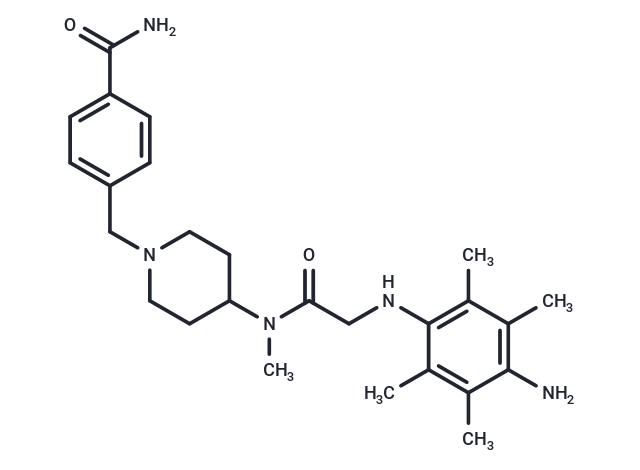

| Pack Size | Price | USA Stock | Global Stock | Quantity |
|---|---|---|---|---|
| 2 mg | $30 | In Stock | In Stock | |
| 5 mg | $48 | In Stock | In Stock | |
| 10 mg | $77 | In Stock | In Stock | |
| 25 mg | $156 | In Stock | In Stock | |
| 50 mg | $247 | In Stock | In Stock | |
| 100 mg | $372 | - | In Stock | |
| 1 mL x 10 mM (in DMSO) | $53 | In Stock | In Stock |
| Description | SUN11602, an aniline compound, mimics the neuroprotective mechanisms of basic fibroblast growth factor. It mimics the neuroprotective effects of bFGF and prevents glutamate-induced neuronal death. It also increases levels of CALB1 gene expression in cerebrocortical neurons and triggers phosphorylation of FGFR and ERK1/2. |
| In vitro | Physiological actions of SUN11602 mimic several phenomena of the neuroprotection that is induced by bFGF. SUN11602 plays a pivotal role in allowing primary cultured neurons to survive in adverse environments of glutamate toxicity and activating intracellular key molecules that are involved in the neuroprotective mechanisms. These actions are quite similar to those of bFGF. Such neuroprotective mechanisms are specific and distinctive to SUN11602 and bFGF and differs clearly from those of the other growth factors that are investigated. But unlike bFGF, SUN11602 can either directly or indirectly trigger the phosphorylation of the cytosolic domain of the FGFR without binding to the extracellular domain of the FGFR-1[1]. SUN11602 demonstrates no cell proliferative activity of somatic cells, unlike bFGF. SUN11602 significantly affects neuronal survival in adverse conditions through a FGFR1-mitogen-activated protein kinase/extracellular signal-regulated kinase-1/2 kinase (FGFR-1–MEK/ERK) signaling pathway[2]. |
| In vivo | In WT mice, SUN11602 and bFGF increase the levels of newly synthesized Calb in cerebrocortical neurons and suppress the glutamate-induced rise in intracellular Ca2+. This Ca2+-capturing ability of Calb allows the neurons to survive severe toxic conditions of glutamate. In contrast, Calb levels remain unchanged in Calb-/- mice after exposure to SUN11602 or bFGF, and due to a loss of function of the gene, these neurons are no longer resistant to toxic conditions of glutamate[1]. Neuroprotective activities of SUN11602 and FGF-2 are due to exogenously induced hyperexpression of CalB in hippocampal neurons. The pharmacokinetic properties of SUN11602 appear to hold promise in terms of bioavailability (>65%) after oral administration in rodents (rats and mice) and dogs (beagles)[2]. |
| Synonyms | SUN 11602 |
| Cell Research | Actinomycin D or cycloheximide is first added to the cultures, and, 2 h later, SUN11602 or bFGF is added. After a 24 h incubation, neurons in the cultures are exposed to 150 μM glutamate for another 24 h, and cell viability is determined by a (3-(4,5-dimethyl-2-thiazolyl)-2,5-diphenyl-2H tetrazolium bromide (MTT) assay.(Only for Reference) |
| Molecular Weight | 451.6 |
| Formula | C26H37N5O2 |
| Cas No. | 704869-38-5 |
| Smiles | CN(C1CCN(Cc2ccc(cc2)C(N)=O)CC1)C(=O)CNc1c(C)c(C)c(N)c(C)c1C |
| Relative Density. | 1.19 g/cm3 (Predicted) |
| Storage | Powder: -20°C for 3 years | In solvent: -80°C for 1 year Shipping with blue ice/Shipping at ambient temperature. | |||||||||||||||||||||||||||||||||||
| Solubility Information | Ethanol: 9 mg/mL (19.93 mM), Sonication is recommended. DMSO: 40 mg/mL (88.57 mM), Sonication is recommended.  | |||||||||||||||||||||||||||||||||||
| In Vivo Formulation | 10% DMSO+40% PEG300+5% Tween 80+45% Saline: 2 mg/mL (4.43 mM), Sonication is recommended. Please add the solvents sequentially, clarifying the solution as much as possible before adding the next one. Dissolve by heating and/or sonication if necessary. Working solution is recommended to be prepared and used immediately. The formulation provided above is for reference purposes only. In vivo formulations may vary and should be modified based on specific experimental conditions. | |||||||||||||||||||||||||||||||||||
Solution Preparation Table | ||||||||||||||||||||||||||||||||||||
Ethanol/DMSO
DMSO
Note : The dilution table applies only to solid products. For liquid products, please calculate the stock solution based on the stated concentration and/or density. | ||||||||||||||||||||||||||||||||||||
 For example, if the intended dosage is 10 mg/kg for animals weighing 20 g , with a dosing volume of 100 μL per animal, and a total of 10 animals are to be administered, using a formulation of
  10% DMSO+ 40% PEG300+ 5% Tween 80+ 45% Saline/PBS/ddH2O , the resulting working solution concentration would be 2 mg/mL.
Dissolve 2 mg of the compound in 100 μL DMSO to obtain a stock solution at a concentration of 20 mg/mL . If the required concentration exceeds the compound's known solubility, please contact us for technical support before proceeding.
1) Add 100 μL of the DMSO stock solution to 400 µL PEG300 and mix thoroughly until the solution becomes clear.
2) Add 50 µL Tween 80 and mix well until fully clarified.
3) Add 450 µL Saline,PBS or ddH2O and mix thoroughly until a homogeneous solution is obtained.
| Size | Quantity | Unit Price | Amount | Operation |
|---|
 Feedback
 Hello! How can I help you today?
Copyright © 2015-2026 TargetMol Chemicals Inc. All Rights Reserved.
