


Shopping Cart
Remove All Your shopping cart is currently empty


Synonyms: SNS-314
| Pack Size | Price | USA Stock | Global Stock | Quantity |
|---|---|---|---|---|
| 2 mg | $33 | In Stock | In Stock | |
| 5 mg | $56 | In Stock | In Stock | |
| 10 mg | $89 | In Stock | In Stock | |
| 25 mg | $179 | In Stock | In Stock | |
| 50 mg | $263 | In Stock | In Stock | |
| 100 mg | $413 | In Stock | In Stock | |
| 1 mL x 10 mM (in DMSO) | $65 | In Stock | In Stock |
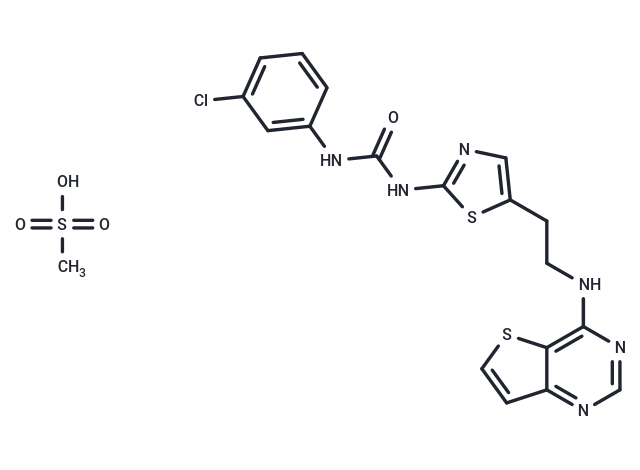
| Description | SNS-314 Mesylate (SNS-314) is an effective and specific Aurora A/B/C inhibitor (IC50: 9/31/3 nM). It is less inhibition of Trk A/B, Fms, Flt4, c-Raf, Axl, and DDR2. |
| Targets & IC50 | Aurora A:9 nM, Aurora B:31 nM, Aurora C:3 nM |
| In vitro | In HCT116 colon xenograft models, SNS-314 exhibits significant and sustained anticancer effects. Additionally, in xenograft models of human breast cancer, prostate cancer, lung cancer (H1299 and Calu-6), ovarian cancer, and malignant melanoma, SNS-314 (170 mg/kg) demonstrates a tumor growth inhibition rate of 54-91%. |
| In vivo | Continuous treatment with SNS-314 in combination with gemcitabine, carboplatin, doxorubicin, fluorouracil, and SN-38 enhances antiproliferative effects. Synergistic effects are observed when SNS-314 is used together with gemcitabine, docetaxel, or vincristine. SNS-314 exhibits significant inhibitory activity against tumor cell lines (IC50: 1.8-24 nM), independent of the relative protein levels of Aurora-A or Aurora-B. |
| Synonyms | SNS-314 |
| Kinase Assay | Aurora-A Kinase Assay: Humanized mouse Aurora A (amino acids 107-403) is expressed in E. coli as described previously. For IC50 assays, compounds are titrated three-fold in DMSO and diluted 12.5-fold into assay buffer (10 mM Tris HCl pH 7.2, 10 mM MgCl2, 0.05% NaN3, 0.01% Tween-20, and 0.1% BSA). Compounds are then diluted 4-fold into assay buffer containing Aurora A and FAM-PKAtide at final concentrations of 2 nM and 50 nM, respectively. The kinase reaction is initiated by adding ATP in assay buffer at a final concentration of 10 mM and incubated at 21 °C for 25 minutes. As a positive control, DMSO is added instead of compound and as a negative control assay buffer is added instead of Aurora A. Both control reactions are conducted in triplicate. To detect phosphorylated PKAtide, the kinase reaction is combined with Progressive Binding Solution (1:400 Progressive Binding Reagent, 1 × Buffer A, Molecular Devices) in a 1:3 ratio. The mixture is incubated for 30 minutes at 21 °C and the plate is scanned on an Analyst AD with excitation at 485 nm and emission at 530 nm. The percent relative enzymatic activity is calculated by normalizing the mP value for each well to the average positive control. Relative enzymatic activity values are plotted as a function of the logarithm of compound concentration and IC50 values are generated in GraphPad Prism software using a sigmoidal dose-response curve-fit. IC50's are calculated as the concentration of compound at which enzymatic activity i |
| Cell Research | Viability is measured using the CellTiter-Blue cell viability assay. Cells are treated as described above, although with a 5-day incubation period. Cytotoxicity is determined by measuring intracellular ATP using the CellTiter-Glo Luminescence Cell Viability Assay. Cells are seeded in white 96-well tissue culture plates at a density of 1.5-2 × 10³ cells/well, and a serial dilution of SNS-314 is dosed in combination with fixed concentrations of either docetaxel or vincristine for a total of 72 hours. Viability is determined as the ratio between the ATP in treated cells versus control cells. Apoptosis is measured using the caspase-Glo 3/7 system. Cells are plated in white 96-well plates as described above and treated first with SNS-314 for 24 hours, washed with 200 μL of 1× PBS, and fresh medium is added with the second agent for 24 hours.(Only for Reference) |
| Molecular Weight | 527.04 |
| Formula | C18H15ClN6OS2·CH4O3S |
| Cas No. | 1146618-41-8 |
| Smiles | CS(O)(=O)=O.Clc1cccc(NC(=O)Nc2ncc(CCNc3ncnc4ccsc34)s2)c1 |
| Relative Density. | no data available |
| Storage | Powder: -20°C for 3 years | In solvent: -80°C for 1 year Shipping with blue ice/Shipping at ambient temperature. | ||||||||||||||||||||||||||||||
| Solubility Information | DMSO: 50 mg/mL (94.87 mM), Sonication is recommended.  | ||||||||||||||||||||||||||||||
| In Vivo Formulation | 10% DMSO+40% PEG300+5% Tween 80+45% Saline: 5 mg/mL (9.49 mM), Solution. 10% DMSO+90% Saline: < 5 mg/mL (9.49 mM), Lower concentrations may be soluble, but exact solubility limit is unknown. Please add the solvents sequentially, clarifying the solution as much as possible before adding the next one. Dissolve by heating and/or sonication if necessary. Working solution is recommended to be prepared and used immediately. The formulation provided above is for reference purposes only. In vivo formulations may vary and should be modified based on specific experimental conditions. | ||||||||||||||||||||||||||||||
Solution Preparation Table | |||||||||||||||||||||||||||||||
DMSO
Note : The dilution table applies only to solid products. For liquid products, please calculate the stock solution based on the stated concentration and/or density. | |||||||||||||||||||||||||||||||
 For example, if the intended dosage is 10 mg/kg for animals weighing 20 g , with a dosing volume of 100 μL per animal, and a total of 10 animals are to be administered, using a formulation of
  10% DMSO+ 40% PEG300+ 5% Tween 80+ 45% Saline/PBS/ddH2O , the resulting working solution concentration would be 2 mg/mL.
Dissolve 2 mg of the compound in 100 μL DMSO to obtain a stock solution at a concentration of 20 mg/mL . If the required concentration exceeds the compound's known solubility, please contact us for technical support before proceeding.
1) Add 100 μL of the DMSO stock solution to 400 µL PEG300 and mix thoroughly until the solution becomes clear.
2) Add 50 µL Tween 80 and mix well until fully clarified.
3) Add 450 µL Saline,PBS or ddH2O and mix thoroughly until a homogeneous solution is obtained.
| Size | Quantity | Unit Price | Amount | Operation |
|---|
 Feedback
 Hello! How can I help you today?
Copyright © 2015-2026 TargetMol Chemicals Inc. All Rights Reserved.
