


Shopping Cart
Remove All Your shopping cart is currently empty


Synonyms: PIM1/2 Kinase Inhibitor VI

| Pack Size | Price | USA Stock | Global Stock | Quantity |
|---|---|---|---|---|
| 1 mg | $30 | In Stock | In Stock | |
| 2 mg | $40 | In Stock | In Stock | |
| 5 mg | $64 | In Stock | In Stock | |
| 10 mg | $89 | In Stock | In Stock | |
| 25 mg | $163 | In Stock | In Stock | |
| 50 mg | $247 | In Stock | In Stock | |
| 100 mg | $372 | In Stock | In Stock | |
| 1 mL x 10 mM (in DMSO) | $71 | In Stock | In Stock |
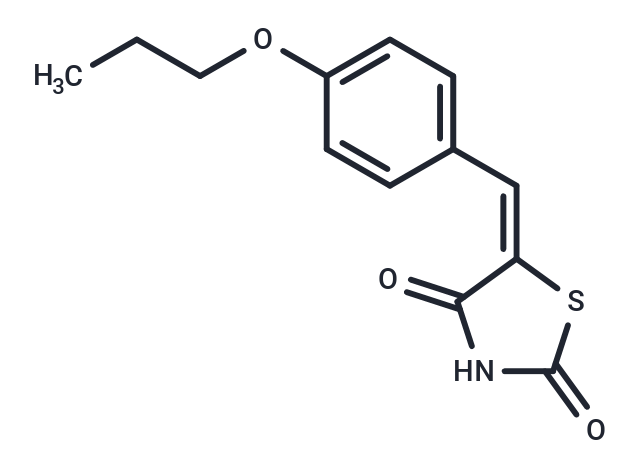
| Description | SMI-16a (PIM1/2 Kinase Inhibitor VI) , a cell-permeable thiazolidinedione compound, acts as an effective, ATP-competitive inhibitor against Pim-1/2 kinases (IC50: 150/20 nM) while exhibiting little or no activity against a panel of 57 other kinases (≤18% inhibition at 5 μM). |
| Targets & IC50 | Pim1:150 nM, Pim2:20 nM |
| In vitro | PIM1/2 Kinase Inhibitor VI exhibits antitumor activity in PC3 human prostate cancer cultures in vitro (IC50: 48 μM). |
| In vivo | PIM1/2 Kinase Inhibitor VI exhibits antitumor activity in JC adenocarcinoma-transplanted Balb/C mice in vivo (~46% tumor mass reduction on day 20; 50 mg/kg/day, i.p.). |
| Synonyms | PIM1/2 Kinase Inhibitor VI |
| Kinase Assay | Competition binding reactions used 25 μg human M1 CHO membrane protein, BQCA or vehicle, and 0.15 nM [3H]NMS in 96-well deep-well plates. Binding reactions (30 °C for 2-3 h) are terminated by rapid filtration. Nonspecific binding is determined by adding 10 μM atropine. Filter plates are ished 4×with ice-cold 20 mM HEPES, 100 mM NaCl, and 5 mM MgCl2, pH 7.4 using a 96-well harvester. Plates are dried and radioactivity counted with a microplate scintillation counter[1]. |
| Molecular Weight | 263.31 |
| Formula | C13H13NO3S |
| Cas No. | 587852-28-6 |
| Smiles | CCCOc1ccc(\C=C2\SC(=O)NC2=O)cc1 |
| Relative Density. | 1.303 g/cm3 (Predicted) |
| Storage | Powder: -20°C for 3 years | In solvent: -80°C for 1 year Shipping with blue ice/Shipping at ambient temperature. | |||||||||||||||||||||||||||||||||||
| Solubility Information | DMSO: 166.67 mg/mL (632.98 mM), Sonication is recommended.  | |||||||||||||||||||||||||||||||||||
| In Vivo Formulation | 10% DMSO+90% (20% SBE-β-CD in Saline): < 10 mg/mL (37.98 mM), Lower concentrations may be soluble, but exact solubility limit is unknown. 10% DMSO+90% Saline: < 10 mg/mL (37.98 mM), Lower concentrations may be soluble, but exact solubility limit is unknown. 10% DMSO+40% PEG300+5% Tween 80+45% Saline: < 10 mg/mL (37.98 mM), Lower concentrations may be soluble, but exact solubility limit is unknown. 10% DMSO+90% Corn oil: < 10 mg/mL (37.98 mM), Lower concentrations may be soluble, but exact solubility limit is unknown. Please add the solvents sequentially, clarifying the solution as much as possible before adding the next one. Dissolve by heating and/or sonication if necessary. Working solution is recommended to be prepared and used immediately. The formulation provided above is for reference purposes only. In vivo formulations may vary and should be modified based on specific experimental conditions. | |||||||||||||||||||||||||||||||||||
Solution Preparation Table | ||||||||||||||||||||||||||||||||||||
DMSO
Note : The dilution table applies only to solid products. For liquid products, please calculate the stock solution based on the stated concentration and/or density. | ||||||||||||||||||||||||||||||||||||
 For example, if the intended dosage is 10 mg/kg for animals weighing 20 g , with a dosing volume of 100 μL per animal, and a total of 10 animals are to be administered, using a formulation of
  10% DMSO+ 40% PEG300+ 5% Tween 80+ 45% Saline/PBS/ddH2O , the resulting working solution concentration would be 2 mg/mL.
Dissolve 2 mg of the compound in 100 μL DMSO to obtain a stock solution at a concentration of 20 mg/mL . If the required concentration exceeds the compound's known solubility, please contact us for technical support before proceeding.
1) Add 100 μL of the DMSO stock solution to 400 µL PEG300 and mix thoroughly until the solution becomes clear.
2) Add 50 µL Tween 80 and mix well until fully clarified.
3) Add 450 µL Saline,PBS or ddH2O and mix thoroughly until a homogeneous solution is obtained.
| Size | Quantity | Unit Price | Amount | Operation |
|---|
 Feedback
 Hello! How can I help you today?
Copyright © 2015-2026 TargetMol Chemicals Inc. All Rights Reserved.
