


Shopping Cart
Remove All Your shopping cart is currently empty


Synonyms:
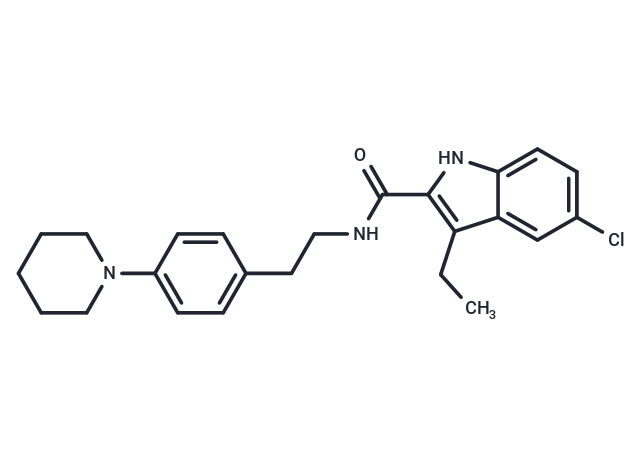

| Pack Size | Price | USA Stock | Global Stock | Quantity |
|---|---|---|---|---|
| 2 mg | $31 | In Stock | In Stock | |
| 5 mg | $48 | In Stock | In Stock | |
| 10 mg | $81 | In Stock | In Stock | |
| 25 mg | $159 | In Stock | In Stock | |
| 50 mg | $297 | In Stock | In Stock | |
| 100 mg | $443 | In Stock | - | |
| 1 mL x 10 mM (in DMSO) | $48 | In Stock | In Stock |
| Description | Org 27569, an allosteric modulator of cannabinoid CB1 receptor, can induce a CB1 receptor state that is characterized by decreased inverse agonist affinity and enhanced agonist affinity. |
| In vivo | ORG 27569 (3.2 and 5.6 mg/kg, intraperitoneally) significantly reduces both cue-induced and priming-induced reinstatement of cocaine and methamphetamine in rats[4]. At a dosage of 30 mg/kg, intraperitoneally, ORG 27569 suppresses appetite independent of CB1 receptors and does not alter the discriminative stimulus effects of anandamide (AEA). Additionally, intracerebroventricular administration of ORG 27569 (100 μg) does not influence the pharmacological effects of systemic CP55,940 compared to a vehicle[5]. |
| Kinase Assay | Equilibrium Binding Assays.: Binding assays are performed with the CB1 receptor agonist [3H]CP 55,940 (0.7 nM) and the CB1 receptor antagonist [3H]SR 141716A (1.2 nM), 1 mg/ml BSA and 50 mM Tris buffer containing 0.1 mM EDTA and 0.5 mM MgCl2, pH 7.4, in a total assay volume of 500 μl. Binding is initiated by the addition of mouse brain membranes (30 μg). Assays are carried out at 37°C for 60 min before termination by addition of ice-cold wash buffer (50 mM Tris buffer and 1 mg/ml BSA) and vacuum filtration using a 24-well sampling manifold and Whatman GF/B glass-fiber filters that have been soaked in wash buffer at 4°C for 24 h. Each reaction tube is washed five times with a 4-ml aliquot of buffer. The filters are oven-dried for 60 min and then placed in 5 ml of scintillation fluid, and radioactivity is quantitated by liquid scintillation spectrometry. Specific binding is defined as the difference between the binding that occurred in the presence and absence of 1 μM concentrations of the corresponding unlabeled ligand and is 70 to 80% of the total binding. |
| Cell Research | Cells expressing CB1 receptors are exposed to ORG27569 (10 μM) for 5 to 15 min. For toxin treatment to abrogate Gi coupling effects, PTX is added to the medium at 5 ng/ml. Following an 18-h incubation in the presence of toxin, cells are washed twice with PBS and treated with compounds. Cells are washed with ice-cold PBS, and cell lysates are obtained by harvesting the cells with ice-cold lysis buffer (150 mM NaCl, 1.0% IGEPAL CA-630, 0.5% sodium deoxycholate, 0.1% SDS, and 50 mM Tris, pH 7.5 containing 4-(2-aminoethyl)benzenesulfonyl fluoride, pepstatin A, E-64, bestatin, leupeptin, and aprotinin as protease inhibitors).(Only for Reference) |
| Molecular Weight | 409.95 |
| Formula | C24H28ClN3O |
| Cas No. | 868273-06-7 |
| Smiles | CCc1c([nH]c2ccc(Cl)cc12)C(=O)NCCc1ccc(cc1)N1CCCCC1 |
| Relative Density. | 1.218g/cm3 |
| Storage | Powder: -20°C for 3 years | In solvent: -80°C for 1 year Shipping with blue ice/Shipping at ambient temperature. | |||||||||||||||||||||||||||||||||||
| Solubility Information | DMSO: 41 mg/mL (100.01 mM), Sonication is recommended. | |||||||||||||||||||||||||||||||||||
| In Vivo Formulation | 10% DMSO+90% Corn Oil: 2 mg/mL (4.88 mM), Sonication is recommended. Please add the solvents sequentially, clarifying the solution as much as possible before adding the next one. Dissolve by heating and/or sonication if necessary. Working solution is recommended to be prepared and used immediately. The formulation provided above is for reference purposes only. In vivo formulations may vary and should be modified based on specific experimental conditions. | |||||||||||||||||||||||||||||||||||
Solution Preparation Table | ||||||||||||||||||||||||||||||||||||
DMSO
Note : The dilution table applies only to solid products. For liquid products, please calculate the stock solution based on the stated concentration and/or density. | ||||||||||||||||||||||||||||||||||||
 For example, if the intended dosage is 10 mg/kg for animals weighing 20 g , with a dosing volume of 100 μL per animal, and a total of 10 animals are to be administered, using a formulation of
  10% DMSO+ 40% PEG300+ 5% Tween 80+ 45% Saline/PBS/ddH2O , the resulting working solution concentration would be 2 mg/mL.
Dissolve 2 mg of the compound in 100 μL DMSO to obtain a stock solution at a concentration of 20 mg/mL . If the required concentration exceeds the compound's known solubility, please contact us for technical support before proceeding.
1) Add 100 μL of the DMSO stock solution to 400 µL PEG300 and mix thoroughly until the solution becomes clear.
2) Add 50 µL Tween 80 and mix well until fully clarified.
3) Add 450 µL Saline,PBS or ddH2O and mix thoroughly until a homogeneous solution is obtained.
| Size | Quantity | Unit Price | Amount | Operation |
|---|
 Feedback
 Hello! How can I help you today?
Copyright © 2015-2026 TargetMol Chemicals Inc. All Rights Reserved.
