


Shopping Cart
Remove All Your shopping cart is currently empty

Synonyms:
| Pack Size | Price | USA Stock | Global Stock | Quantity |
|---|---|---|---|---|
| 5 mg | $970 | Inquiry | Inquiry |
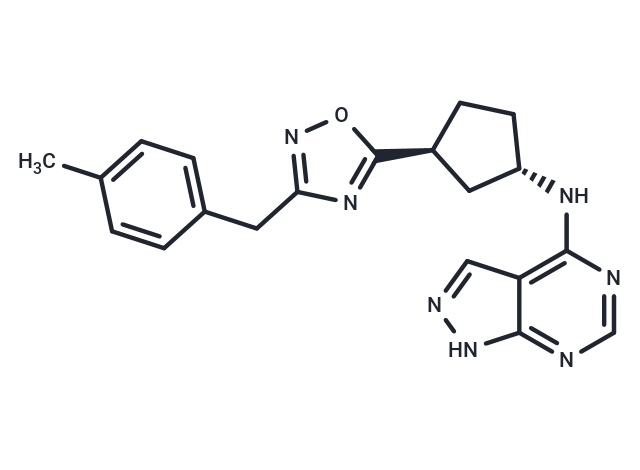
| Description | NMDA receptor antagonist 2 is a highly potent and orally active NR2B subtype-selective antagonist of the N-methyl-D-aspartate (NMDA) receptor, with an IC50 of 1.0 nM and a Ki value of 0.88 nM. This compound is valuable in scientific investigations of neuropathic pain and Parkinson's disease. |
| Targets & IC50 | NMDA NR2B:0.88 nM (Ki) |
| In vitro | NMDA receptor antagonist 2 demonstrates remarkable efficacy and selectivity, displaying potent inhibition towards NR2B with a Ki value of 0.88 nM and significant selectivity against hERG binding (IP=20000 nM). Its effectiveness is further evidenced in a Ca2+ flux assay using cells with recombinant NR1/NR2B receptors, and its hERG-channel selectivity is confirmed via an MK-499-binding assay. Additionally, this compound maintains its potency in both a functional assay with NR2B-expressing cells (IC50=1.0 nM) and a binding assay on human temporal cortex homogenate (Ki=0.81 nM). In electrophysiology assays, Compound 22 achieves complete ion flux blockade across NR2B receptors with a KD of 0.35 nM. It also demonstrates substantial selectivity over NR2A (IC50=200 μM), hERG binding (IP=20 μM), α-adrenergic receptors (IC50>100 μM), and several CYP P450 isoenzymes including CYP3A4, 2C9, and 2D6. |
| In vivo | In pharmacokinetic studies, NMDA receptor antagonist 2 demonstrated favorable pharmacological properties across different species. In dogs, it exhibited excellent oral bioavailability (F=83%), a half-life (T 1/2 =7.5 hours), and a clearance rate (CL=3.6 mL/min/kg). In contrast, rhesus monkeys showed a moderate clearance rate (CL=12 mL/min/kg) and lower oral bioavailability (F=17%), with a significantly shorter half-life (T 1/2 =1.5 hours). Rats presented an oral bioavailability (F=23%), a brief half-life (T 1/2 =0.7 hours), and a higher clearance rate (CL=24 mL/min/kg), with an ED50 for receptor occupancy at 4.8 mg/kg following oral administration. Furthermore, in a rat spinal nerve ligation model to simulate neuropathic pain, NMDA receptor antagonist 2 effectively inhibited tactile allodynia in a dose-dependent manner, significantly improving the condition by 15% (3 mg/kg), 41% (10 mg/kg), and 69% (30 mg/kg) compared to the control group. Similarly, in an acute rodent model of Parkinson’s disease, oral administration of NMDA receptor antagonist 2 reduced haloperidol-induced catalepsy, improving scores by 34% (3 mg/kg), 86% (10 mg/kg), and 92% (30 mg/kg), establishing its dose-dependent efficacy. |
| Molecular Weight | 375.436 |
| Formula | C20H21N7O |
| Cas No. | 875898-41-2 |
| Smiles | Cc1ccc(Cc2noc(n2)[C@H]2CC[C@@H](C2)Nc2ncnc3[nH]ncc23)cc1 |
| Storage | Powder: -20°C for 3 years | In solvent: -80°C for 1 year Shipping with blue ice/Shipping at ambient temperature. |
 For example, if the intended dosage is 10 mg/kg for animals weighing 20 g , with a dosing volume of 100 μL per animal, and a total of 10 animals are to be administered, using a formulation of
  10% DMSO+ 40% PEG300+ 5% Tween 80+ 45% Saline/PBS/ddH2O , the resulting working solution concentration would be 2 mg/mL.
Dissolve 2 mg of the compound in 100 μL DMSO to obtain a stock solution at a concentration of 20 mg/mL . If the required concentration exceeds the compound's known solubility, please contact us for technical support before proceeding.
1) Add 100 μL of the DMSO stock solution to 400 µL PEG300 and mix thoroughly until the solution becomes clear.
2) Add 50 µL Tween 80 and mix well until fully clarified.
3) Add 450 µL Saline,PBS or ddH2O and mix thoroughly until a homogeneous solution is obtained.
| Size | Quantity | Unit Price | Amount | Operation |
|---|
 Feedback
 Hello! How can I help you today?
Copyright © 2015-2026 TargetMol Chemicals Inc. All Rights Reserved.
