


Shopping Cart
Remove All Your shopping cart is currently empty


Synonyms: GAT-107, GAT 107
| Pack Size | Price | USA Stock | Global Stock | Quantity |
|---|---|---|---|---|
| 1 mg | $155 | In Stock | In Stock | |
| 5 mg | $385 | In Stock | In Stock | |
| 10 mg | $548 | In Stock | In Stock | |
| 25 mg | $822 | In Stock | In Stock |
| Description | GAT107 is a novel and potent α7 nicotinic cholinergic receptor modifier agonist and modulator with anti-inflammatory activity that reverses injury perception in a mouse model of neuropathic pain. |
| In vitro | The incubation of macrophages with 3.3 μM of GAT107 significantly decreased hyperoxia-induced extracellular HMGB1 accumulation and HMGB1-induced macrophage phagocytic dysfunction. Hyperoxia-compromised macrophage function was correlated with impaired mitochondrial membrane integrity, increased superoxide levels, and decreased manganese superoxide dismutase (MnSOD) activity. This compromised MnSOD activity is due to a significant increase in its level of glutathionylation. The incubation of hyperoxic macrophages with 3.3 μM of GAT107 significantly decreases the levels of glutathionylated MnSOD and restores MnSOD activity and mitochondrial membrane integrity. Thus, GAT107 restored hyperoxia-compromised phagocytic functions by decreasing HMGB1 release, most likely via a mitochondrial-directed pathway.[1] |
| In vivo | GAT107 (3.3 mg/kg; i.p.) significantly decreased animal mortality and markers of inflammatory injury in mice exposed to hyperoxia and subsequently infected with Pseudomonas aeruginosa.[1] |
| Synonyms | GAT-107, GAT 107 |
| Molecular Weight | 405.31 |
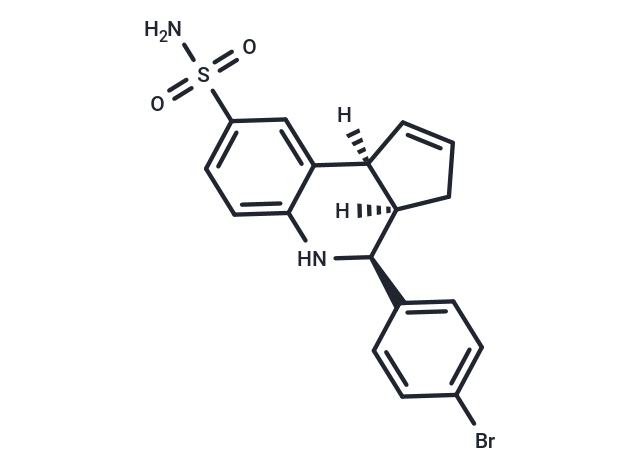
| Formula | C18H17BrN2O2S |
| Cas No. | 1476807-74-5 |
| Smiles | S(N)(=O)(=O)C=1C=C2[C@@]3([C@]([C@H](NC2=CC1)C4=CC=C(Br)C=C4)(CC=C3)[H])[H] |
| Relative Density. | 1.505 g/cm3 (Predicted) |
| Storage | Powder: -20°C for 3 years | In solvent: -80°C for 1 year Shipping with blue ice/Shipping at ambient temperature. | |||||||||||||||||||||||||||||||||||
| Solubility Information | DMSO: 45 mg/mL (111.03 mM), Sonication is recommended.  | |||||||||||||||||||||||||||||||||||
Solution Preparation Table | ||||||||||||||||||||||||||||||||||||
DMSO
Note : The dilution table applies only to solid products. For liquid products, please calculate the stock solution based on the stated concentration and/or density. | ||||||||||||||||||||||||||||||||||||
 For example, if the intended dosage is 10 mg/kg for animals weighing 20 g , with a dosing volume of 100 μL per animal, and a total of 10 animals are to be administered, using a formulation of
  10% DMSO+ 40% PEG300+ 5% Tween 80+ 45% Saline/PBS/ddH2O , the resulting working solution concentration would be 2 mg/mL.
Dissolve 2 mg of the compound in 100 μL DMSO to obtain a stock solution at a concentration of 20 mg/mL . If the required concentration exceeds the compound's known solubility, please contact us for technical support before proceeding.
1) Add 100 μL of the DMSO stock solution to 400 µL PEG300 and mix thoroughly until the solution becomes clear.
2) Add 50 µL Tween 80 and mix well until fully clarified.
3) Add 450 µL Saline,PBS or ddH2O and mix thoroughly until a homogeneous solution is obtained.
| Size | Quantity | Unit Price | Amount | Operation |
|---|
 Feedback
 Hello! How can I help you today?
Copyright © 2015-2026 TargetMol Chemicals Inc. All Rights Reserved.
