


Shopping Cart
Remove All Your shopping cart is currently empty

Synonyms: Dihydrostreptomycin sesquisulfate
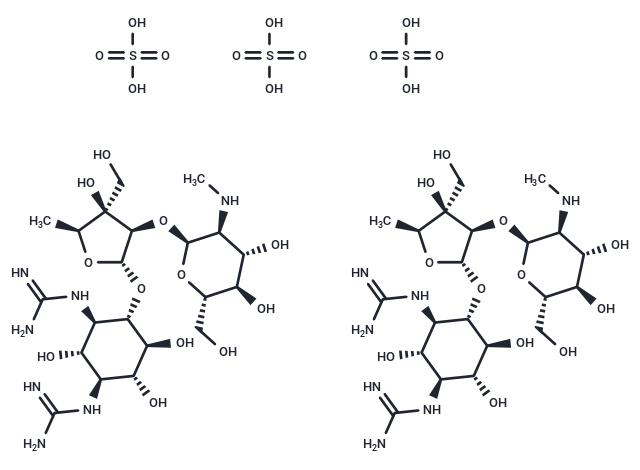
| Pack Size | Price | USA Stock | Global Stock | Quantity |
|---|---|---|---|---|
| 5 g | $45 | - | In Stock |
| Description | Dihydrostreptomycin sulfate (Dihydrostreptomycin sesquisulfate) inhibits protein synthesis by binding to the 30S ribosomal subunit. Dihydrostreptomycin Sulfate is a semi-synthetic aminoglycoside antibiotic with bactericidal properties. This antibiotic is active against most gram-positive and gram-negative organisms and is used in the treatment of tuberculosis and tularemia. |
| In vitro | The primary mechanism of action of the antibiotic dihydrostreptomycin is binding to and modifying the function of the bacterial ribosome, thus leading to decreased and aberrant translation of proteins. It enters bacterial cells by binding to a specific site on MscL(mechanosensitive channel of large conductance) and modifying its conformation, thus allowing the passage of K+ and glutamate out of, and dihydrostreptomycin into, the cell[1]. |
| In vivo | Dihydrostreptomycin sulfate would cause cochlea damage in mouse model and cell proliferation in the spiral ligament may occur after the dihydrostreptomycin sulfate -induced damage. This process is probably related to the recovery of cochlear function[2]. |
| Synonyms | Dihydrostreptomycin sesquisulfate |
| Kinase Assay | Briefly, the peptide substrate N-acetyl-Asp-Glu-Val-Asp-ρ-nitroanilide (Ac-DEVD-ρNA) is added to the cell lysates in assay buffer (50 mM HEPES, pH 7.4, 100 mM NaCl, 0.1% CHAPS, 10 mM dithiothreitol, 1 mM EDTA, 10% glycerol) and incubated at 37°C. The cleavage of the substrate is monitored at 405 nm. |
| Molecular Weight | 730.71 |
| Formula | C21H41N7O12·1·5H2SO4 |
| Cas No. | 5490-27-7 |
| Smiles | OS(O)(=O)=O.OS(O)(=O)=O.OS(O)(=O)=O.CN[C@H]1[C@H](O)[C@@H](O)[C@H](CO)O[C@H]1O[C@H]1[C@H](O[C@@H]2[C@@H](O)[C@H](O)[C@@H](NC(N)=N)[C@H](O)[C@H]2NC(N)=N)O[C@@H](C)[C@]1(O)CO.CN[C@H]1[C@H](O)[C@@H](O)[C@H](CO)O[C@H]1O[C@H]1[C@H](O[C@@H]2[C@@H](O)[C@H](O)[C@@H](NC(N)=N)[C@H](O)[C@H]2NC(N)=N)O[C@@H](C)[C@]1(O)CO |
| Relative Density. | no data available |
| Storage | Store at low temperature Powder: -20°C for 3 years | In solvent: -80°C for 1 year Shipping with blue ice/Shipping at ambient temperature. | |||||||||||||||||||||||||||||||||||
| Solubility Information | H2O: 257.5 mg/mL (352.4 mM), Sonication is recommended.  DMSO: Insoluble | |||||||||||||||||||||||||||||||||||
Solution Preparation Table | ||||||||||||||||||||||||||||||||||||
H2O
Note : The dilution table applies only to solid products. For liquid products, please calculate the stock solution based on the stated concentration and/or density. | ||||||||||||||||||||||||||||||||||||
 For example, if the intended dosage is 10 mg/kg for animals weighing 20 g , with a dosing volume of 100 μL per animal, and a total of 10 animals are to be administered, using a formulation of
  10% DMSO+ 40% PEG300+ 5% Tween 80+ 45% Saline/PBS/ddH2O , the resulting working solution concentration would be 2 mg/mL.
Dissolve 2 mg of the compound in 100 μL DMSO to obtain a stock solution at a concentration of 20 mg/mL . If the required concentration exceeds the compound's known solubility, please contact us for technical support before proceeding.
1) Add 100 μL of the DMSO stock solution to 400 µL PEG300 and mix thoroughly until the solution becomes clear.
2) Add 50 µL Tween 80 and mix well until fully clarified.
3) Add 450 µL Saline,PBS or ddH2O and mix thoroughly until a homogeneous solution is obtained.
| Size | Quantity | Unit Price | Amount | Operation |
|---|
 Feedback
 Hello! How can I help you today?
Copyright © 2015-2026 TargetMol Chemicals Inc. All Rights Reserved.
