


Shopping Cart
Remove All Your shopping cart is currently empty


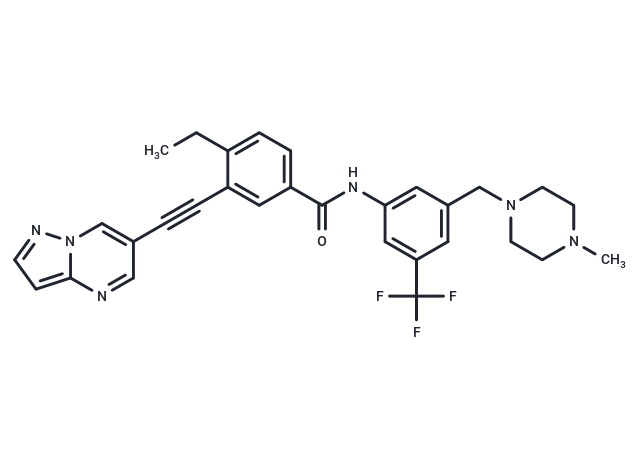
Synonyms: DDR1 inhibitor 7rh

| Pack Size | Price | USA Stock | Global Stock | Quantity |
|---|---|---|---|---|
| 1 mg | $44 | In Stock | In Stock | |
| 5 mg | $97 | In Stock | In Stock | |
| 10 mg | $175 | In Stock | In Stock | |
| 25 mg | $365 | In Stock | In Stock | |
| 50 mg | $557 | In Stock | In Stock | |
| 100 mg | $815 | In Stock | In Stock | |
| 500 mg | $1,630 | In Stock | In Stock | |
| 1 mL x 10 mM (in DMSO) | $127 | In Stock | In Stock |
| Description | DDR1-IN-2 (DDR1 inhibitor 7rh) (DDR1 inhibitor 7rh) is a potent, selective, ATP-competitive Discoidin domain receptor 1 (DDR1) inhibitor (IC50: 6.8 nM in cell-free kinase assays). |
| Targets & IC50 | DDR1:6.8 nM (cell free), DDR2:101.4 nM (cell free) |
| In vitro | DDR1-IN-2 inhibited the enzymatic activity of DDR1, with IC50 values of 6.8 nM, but were significantly less potent in suppressing the kinase activities of DDR2, Bcr-Abl, and c-Kit. It bound with DDR1 with a Kd value of 0.6 nM, while it was significantly less potent to the other 455 kinases tested. It also potently inhibited the proliferation of cancer cells expressing high levels of DDR1 and strongly suppressed cancer cell invasion, adhesion, and tumorigenicity [1]. Pharmacologic inhibition of DDR1 with an ATP-competitive orally available small-molecule kinase inhibitor (DDR1-IN-2) abrogated collagen-induced DDR1 signaling in pancreatic tumor cells and consequently reduced colony formation and migration [2]. |
| In vivo | DDR1-IN-2 possessed good PK profiles, with oral bioavailabilities of 67.4% [1]. The inhibition of DDR1 with DDR1-IN-2 showed striking efficacy in combination with chemotherapy in orthotopic xenografts and autochthonous pancreatic tumors where it significantly reduced DDR1 activation and downstream signaling, reduced primary tumor burden, and improved chemoresponse [2]. |
| Synonyms | DDR1 inhibitor 7rh |
| Kinase Assay | The functional assays of compounds on the kinase activities of c-kit and Abl were determined using the FRET-based Z'-Lyte assay system according to the manufacturer's instructions. Tyrosine 2 Peptide was used as Abl substrate and Ser/Thr 6 peptide was used as the substrate for c-kit. The reactions were carried out in 384-well plates in a 10 μl of reaction volume with an appropriate amount of kinases in 50 mM HEPES (pH 7.5), 10 mM MgCl2, 1 mM EGTA, and 0.01% Brij-35. The reactions were incubated 1 hour at room temperature in the presence of 2 μM of substrate with 10 μM of ATP (for Abl1 assays) or 300 μM of ATP (kit assay) and in the presence of various concentrations of the compounds. The development reagent was then added for further 2 hours room temperature incubation followed by the addition of stop solution. Fluorescence signal ratio of 445 nm (Coumarin)/520 nm (fluorescin) was examined on EnVision Multilabel Reader. The effects of compounds on the kinases DDR1 and DDR2 were assessed by using a LanthaScreen Eu kinase activity assay technology. Kinase reactions are performed in a 10 μL volume in low-volume 384-well plates. The kinases in reaction buffer consist of 50 mM HEPES pH 7.5, 0.01% BRIJ-35, 10 mM MgCl2, and 1 mM EGTA, the concentration of Fluorescein-Poly GAT Substrate in the assay is 100 nM, Kinase reactions were initiated with the addition of 100 nM ATP in the presence of serials of dilutions of compounds. The reactions were allowed to proceed for 1 hour at room temperature before a 10 μL preparation of EDTA (20 mM) and Eu-labeled antibody (4 nM) in TR-FRET dilution buffer are added. The final concentration of antibody in the assay well is 2 nM, and the final concentration of EDTA is 10 mM. The plate is allowed to incubate at room temperature for one more hour before the TR-FRET emission ratios of 665 nm/340 nm were acquired on a PerkinElmer EnVision Multilabel Reader [1]. |
| Cell Research | Adherent Cells were plated in 96-well culture plates with a cell density of 3000-4000 cells/well and treated with indicated compounds by adding 100μL medium containing compounds of various concentrations on the second day. After 72-hour's treatment, MTT was added to each well and incubated for additional 4-5 hours, and the absorbance was measured on a microplate reader at 570nm. Cell growth inhibition was evaluated as the ratio of the absorbance of the sample to that of the control. The results are representative of at least 4 independent experiments [1]. |
| Animal Research | Compounds 7rh and 7rj were dissolved in mixed solvents (DMSO : EtOH:Cremophor EL : H2O = 2 : 4 : 4 : 90) as clear solution. The final concentrations were 2.5 mg/mL. Sprague Dawley (SD) rats (male, 4 animals per group) weighted 180~220g were injected intravenously or administrated orally at doses of 5 mg/kg (i.v.) or 25mg/kg (p.o.), respectively. After dose administration, 0.3 mL of the orbital blood was taken at 2.0 min, 10.0 min, 30.0 min, 1.0 h, 2.0 h, 3.0 h, 4.0 h, 6.0 h, 8.0 h, 12.0 h, 21.0 h, 24.0 h, 30.0 h, 36.0 h, 48.0 h, and 72.0 h. Samples were stored at -70℃ until shipment to the analytical laboratory and tested by HPLC/MS using propranolol as internal standard to measure the compound concentration in the blood [1]. |
| Molecular Weight | 546.59 |
| Formula | C30H29F3N6O |
| Cas No. | 1429617-90-2 |
| Smiles | CCc1ccc(cc1C#Cc1cnc2ccnn2c1)C(=O)Nc1cc(CN2CCN(C)CC2)cc(c1)C(F)(F)F |
| Relative Density. | no data available |
| Storage | Powder: -20°C for 3 years | In solvent: -80°C for 1 year Shipping with blue ice/Shipping at ambient temperature. | ||||||||||||||||||||
| Solubility Information | DMSO: 9.33 mg/mL (17.07 mM), Sonication is recommended.  | ||||||||||||||||||||
| In Vivo Formulation | 10% DMSO+40% PEG300+5% Tween-80+45% Saline: 1.5 mg/mL (2.74 mM), Sonication is recommended. 10% DMSO+90% Saline: 0.93 mg/mL (1.7 mM), Suspension. Please add the solvents sequentially, clarifying the solution as much as possible before adding the next one. Dissolve by heating and/or sonication if necessary. Working solution is recommended to be prepared and used immediately. The formulation provided above is for reference purposes only. In vivo formulations may vary and should be modified based on specific experimental conditions. | ||||||||||||||||||||
Solution Preparation Table | |||||||||||||||||||||
DMSO
Note : The dilution table applies only to solid products. For liquid products, please calculate the stock solution based on the stated concentration and/or density. | |||||||||||||||||||||
 For example, if the intended dosage is 10 mg/kg for animals weighing 20 g , with a dosing volume of 100 μL per animal, and a total of 10 animals are to be administered, using a formulation of
  10% DMSO+ 40% PEG300+ 5% Tween 80+ 45% Saline/PBS/ddH2O , the resulting working solution concentration would be 2 mg/mL.
Dissolve 2 mg of the compound in 100 μL DMSO to obtain a stock solution at a concentration of 20 mg/mL . If the required concentration exceeds the compound's known solubility, please contact us for technical support before proceeding.
1) Add 100 μL of the DMSO stock solution to 400 µL PEG300 and mix thoroughly until the solution becomes clear.
2) Add 50 µL Tween 80 and mix well until fully clarified.
3) Add 450 µL Saline,PBS or ddH2O and mix thoroughly until a homogeneous solution is obtained.
| Size | Quantity | Unit Price | Amount | Operation |
|---|
 Feedback
 Hello! How can I help you today?
Copyright © 2015-2026 TargetMol Chemicals Inc. All Rights Reserved.
