


Shopping Cart
Remove All Your shopping cart is currently empty

Synonyms:
| Pack Size | Price | USA Stock | Global Stock | Quantity |
|---|---|---|---|---|
| 2 mg | $33 | - | In Stock | |
| 5 mg | $52 | - | In Stock | |
| 10 mg | $81 | - | In Stock | |
| 25 mg | $129 | - | In Stock | |
| 50 mg | Preferential | - | In Stock |
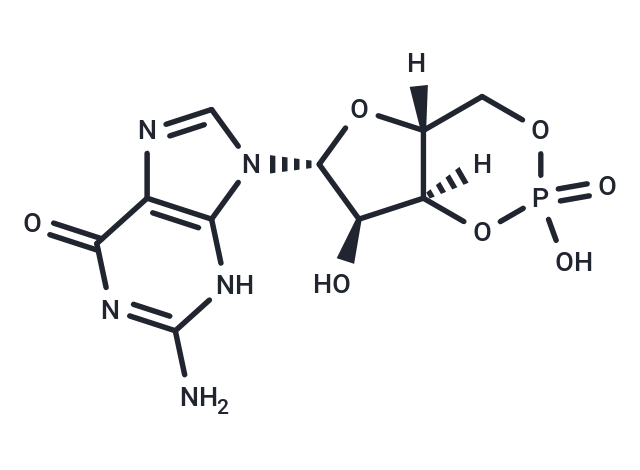
| Description | Cyclic GMP (cGMP) belongs to the class of endogenous metabolites and is a pivotal intracellular second messenger that mediates extracellular signals such as nitric oxide (NO) and natriuretic peptides (NPs). The effects of Cyclic GMP are primarily executed through three main target groups: cGMP-dependent protein kinases (PKGs), cGMP-gated cation channels, and phosphodiesterases (PDEs). Cyclic GMP is capable of inhibiting platelet adhesion and aggregation and participates in enhancing antiviral immune responses. |
| In vitro | In vitro studies on cardiac cells show that Cyclic GMP (1 microM) accumulation stimulated by ACh acts synergistically with Isoprenaline to activate cGMP-stimulated phosphodiesterases. This process inhibits cAMP-induced inward calcium current (ICa) and shortens action potentials. Additionally, its conjugate cGAMP induces IRF3 phosphorylation and nuclear translocation[1]. |
| In vivo | In anesthetized rat models, Cyclic GMP has been demonstrated to effectively prevent renal platelet accumulation following ischemia-reperfusion, a protective effect not shared by cAMP, indicating its specificity in maintaining microcirculatory stability[1]. |
| Molecular Weight | 345.21 |
| Formula | C10H12N5O7P |
| Cas No. | 7665-99-8 |
| Smiles | O=C1C2=C(N(C=N2)[C@H]3[C@H](O)[C@]4([C@](O3)(COP(=O)(O)O4)[H])[H])NC(N)=N1 |
| Storage | Powder: -20°C for 3 years | In solvent: -80°C for 1 year Shipping with blue ice/Shipping at ambient temperature. | ||||||||||||||||||||
| Solubility Information | H2O: 4.00 mg/mL (11.59 mM), Sonication is recommended. | ||||||||||||||||||||
Solution Preparation Table | |||||||||||||||||||||
H2O
Note : The dilution table applies only to solid products. For liquid products, please calculate the stock solution based on the stated concentration and/or density. | |||||||||||||||||||||
 For example, if the intended dosage is 10 mg/kg for animals weighing 20 g , with a dosing volume of 100 μL per animal, and a total of 10 animals are to be administered, using a formulation of
  10% DMSO+ 40% PEG300+ 5% Tween 80+ 45% Saline/PBS/ddH2O , the resulting working solution concentration would be 2 mg/mL.
Dissolve 2 mg of the compound in 100 μL DMSO to obtain a stock solution at a concentration of 20 mg/mL . If the required concentration exceeds the compound's known solubility, please contact us for technical support before proceeding.
1) Add 100 μL of the DMSO stock solution to 400 µL PEG300 and mix thoroughly until the solution becomes clear.
2) Add 50 µL Tween 80 and mix well until fully clarified.
3) Add 450 µL Saline,PBS or ddH2O and mix thoroughly until a homogeneous solution is obtained.
| Size | Quantity | Unit Price | Amount | Operation |
|---|
 Feedback
 Hello! How can I help you today?
Copyright © 2015-2026 TargetMol Chemicals Inc. All Rights Reserved.
