


Shopping Cart
Remove All Your shopping cart is currently empty

Synonyms:
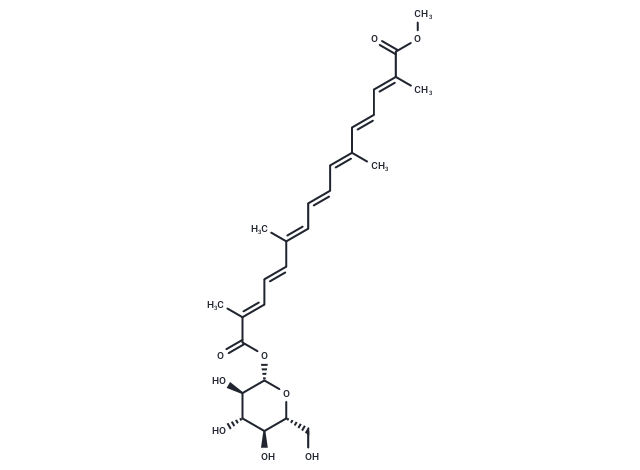
| Pack Size | Price | USA Stock | Global Stock | Quantity |
|---|---|---|---|---|
| 25 mg | $1,520 | Inquiry | Inquiry |
| Description | Crocin-4, a carotenoid compound found in saffron, possesses potent antioxidant properties and can penetrate the brain. It effectively inhibits the aggregation and deposition of Aβ fibrils, making it useful for Alzheimer's Disease research. Additionally, Crocin-4 demonstrates antitumor and anti-inflammatory activities. |
| In vitro | Crocin-4, within the concentration range of 0.1-1000 μM and over a period of 24-72 hours, maintains the viability of neuron-like cells without causing harm. At a concentration of 1 mM and after 72 hours of treatment, it achieves a downregulation in key Alzheimer's disease-related proteins in SH-SY5Y-APP cells, specifically decreasing total Presenilin 1 (PSEN1), Presenilin complexes (PSEN1 and PSEN2), Beta-Secretase 1 (BACE1), APP-C99, and soluble APPα, while elevating the levels of PSEN1 C-terminal fragment (PSEN1-CTF) and PSEN2. Furthermore, in PC12-htau cells treated under the same conditions, it suppresses Glycogen Synthase Kinase 3 beta (GSK3β) and Extracellular Signal-Regulated Kinase 1/2 (ERK1/2), markedly reducing total tau protein levels as well as the phosphorylation of tau at pThr231 and pSer199/Ser202 epitopes. Western Blot analysis confirms these effects, showing significant reductions in the amyloidogenic pathway markers, BACE1 (20%) and APP-C99 (28%), and the non-amyloidogenic marker sAPPα (44%), while PSEN1-CTF increased by 26% and PSEN2 by 43%. In PC12-htau cells, there was a considerable decrease in total tau (32%) and phosphorylated tau (pThr231 and pSer199/Ser202-tau decreased by 22% and 75%, respectively), accompanied by downregulation of both active and inactive GSK3β (by 34% and 30% for total and pSer9-GSK3β, respectively) and ERK1/2 (total ERK2 by 37%, pERK1 by 40%, and pERK2 by 50%). |
| In vivo | Crocin-4, administered intraperitoneally at a dose of 50 mg/kg, effectively crosses the Blood-Brain Barrier (BBB) and accumulates in the mouse brain[3]. |
| Molecular Weight | 504.576 |
| Formula | C27H36O9 |
| Cas No. | 55750-86-2 |
| Smiles | COC(=O)C(\C)=C\C=C\C(\C)=C\C=C\C=C(/C)\C=C\C=C(/C)C(=O)O[C@@H]1O[C@H](CO)[C@@H](O)[C@H](O)[C@H]1O |
| Storage | Powder: -20°C for 3 years | In solvent: -80°C for 1 year Shipping with blue ice/Shipping at ambient temperature. |
 For example, if the intended dosage is 10 mg/kg for animals weighing 20 g , with a dosing volume of 100 μL per animal, and a total of 10 animals are to be administered, using a formulation of
  10% DMSO+ 40% PEG300+ 5% Tween 80+ 45% Saline/PBS/ddH2O , the resulting working solution concentration would be 2 mg/mL.
Dissolve 2 mg of the compound in 100 μL DMSO to obtain a stock solution at a concentration of 20 mg/mL . If the required concentration exceeds the compound's known solubility, please contact us for technical support before proceeding.
1) Add 100 μL of the DMSO stock solution to 400 µL PEG300 and mix thoroughly until the solution becomes clear.
2) Add 50 µL Tween 80 and mix well until fully clarified.
3) Add 450 µL Saline,PBS or ddH2O and mix thoroughly until a homogeneous solution is obtained.
| Size | Quantity | Unit Price | Amount | Operation |
|---|
 Feedback
 Hello! How can I help you today?
Copyright © 2015-2026 TargetMol Chemicals Inc. All Rights Reserved.
