Shopping Cart
Remove All
  • TargetMol
    Your shopping cart is currently empty

Clothianidin

Copy Product Info
😃Good
Catalog No. T21153Cas No. 210880-92-5
Alias TI-435, TI435, TI 435, Celero

Clothianidin (TI 435), an insecticide, acts as an agonist of acetylcholine to stimulate nAChR, thereby activating post-synaptic acetylcholine receptors but not inhibiting AChE.

Clothianidin

Clothianidin

Copy Product Info
😃Good
Purity: 99.87%
Catalog No. T21153Alias TI-435, TI435, TI 435, CeleroCas No. 210880-92-5
Clothianidin (TI 435), an insecticide, acts as an agonist of acetylcholine to stimulate nAChR, thereby activating post-synaptic acetylcholine receptors but not inhibiting AChE.
Pack SizePriceUSA WarehouseGlobal WarehouseQuantity
100 mg$39In StockIn Stock
200 mg$56In StockIn Stock
500 mg$92-In Stock
1 g$135-In Stock
1 mL x 10 mM (in DMSO)$29In StockIn Stock
Add to Cart
Add to Quotation
In Stock Estimated shipping dateUSA Warehouse[1-2 days] Global Warehouse[5-7 days]
All TargetMol products are for research purposes only and cannot be used for human consumption. We do not provide products or services to individuals. Please comply with the intended use and do not use TargetMol products for any other purpose.
Questions
TargetMol
View More

Batch Information

Select Batch
Purity:99.87%
Color:White to Yellow
Contact us for more batch information

Resource Download

Product Introduction

Clothianidin AI Summary
Clothianidin displays diverse bioactivities and possesses significant potential as an acetylcholinesterase inhibitor and insecticide. In assays involving Aplysia AChBP expressed in HEK293S cells, it shows Ki values of 808 nM for [3H]ACE displacement and 574 nM for [3H]EPI displacement. Furthermore, Clothianidin acts as an agonist of glucocorticoid receptor signaling (89.1 nM potency), activates the p53 (28183.8 nM potency) and ARE signaling pathways (61130.6 nM potency), and inhibits Oryctolagus cuniculus AOX and Agaricus bisporus tyrosinase at IC50 concentrations, displaying some inhibition against xanthine oxidase with an IC50 of 1860000 nM. The compound exhibits high insecticidal efficacy, demonstrating 100% mortality in adult Aphis gossypii on cucumber cotyledons at 500 ppm after 72 hours and significant binding to [3H]IMI from nicotinic acetylcholine receptors in Drosophila melanogaster brain with a Ki of 4.0 nM. It also displaces [3H]IMI from nicotinic acetylcholine receptors in numerous insect species (IC50 values 1.8 nM to 9.2 nM), suggesting its use as a potent insecticide. It effectively inhibits first-instar larvae of Cheumatopsyche brevilineata (EC50 0.00444 µg/mL) and demonstrates insecticidal activity against Daphnia magna (EC50 >119 µg/mL). Clothianidin also shows strong insecticidal activity against both neonicotinoid-resistant and susceptible strains of Myzus persicae, with a high resistance index of 3013.0 and low LC50 of 0.3 ppm in susceptible strains. Additionally, it significantly reduces the body weight, honeydew excretion, and survival of imidacloprid-resistant Aphis gossypii. In beetle species, it achieves near-total mortality in Anomala orientalis (98.6%) and Maladera castanea (100%) after 30 days. Moreover, it effectively binds to the nAChR receptors in aphids, showing Ki values of 0.058 nM for [3H]-methyl-SFX displacement. Against Paralobesia viteana and Popillia japonica, the compound effectively reduces infestation and leaf damage using irrigation injection methods. In agricultural settings, it inhibits larval development of Contarinia nasturtii and emergence of Ceutorhynchus obstrictus adults in treated plants. Lastly, in Urochloa mutica (buffalo grass), it shows progressive drug uptake, reaching 6.48 µg/g of fresh weight after 3 days. Overall, Clothianidin's interdisciplinary activities, including its potential as an acetylcholinesterase inhibitor and versatile insecticidal properties, highlight it as a strong candidate for various applications in pest control and biochemical research..
Note: Summary generated by AI. Data source: ChEMBL
Bioactivity
Description
Clothianidin (TI 435), an insecticide, acts as an agonist of acetylcholine to stimulate nAChR, thereby activating post-synaptic acetylcholine receptors but not inhibiting AChE.
SynonymsTI-435, TI435, TI 435, Celero
Chemical Properties
Molecular Weight249.68
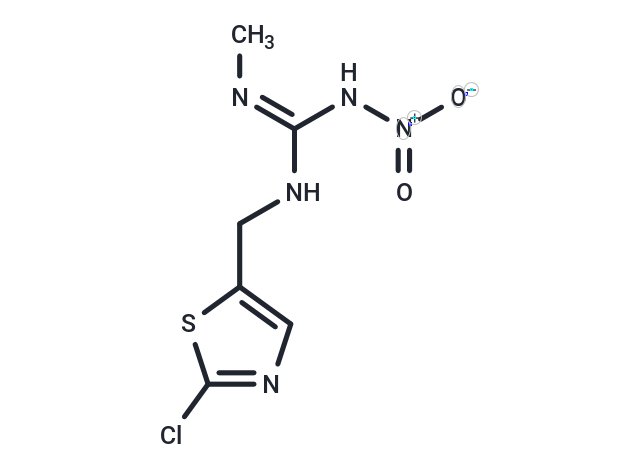
FormulaC6H8ClN5O2S
Cas No.210880-92-5
SmilesC\N=C(\NCc1cnc(Cl)s1)N[N+]([O-])=O
Relative Density.1.61
Storage & Solubility Information
StoragePowder: -20°C for 3 years | In solvent: -80°C for 1 year | Shipping with blue ice/Shipping at ambient temperature.
Solubility Information
DMSO: 125 mg/mL (500.64 mM), Sonication is recommended.

In Vivo Formulation
10% DMSO+40% PEG300+5% Tween 80+45% Saline: 2 mg/mL (8.01 mM), Sonication is recommended.
Please add the solvents sequentially, clarifying the solution as much as possible before adding the next one. Dissolve by heating and/or sonication if necessary. Working solution is recommended to be prepared and used immediately. The formulation provided above is for reference purposes only. In vivo formulations may vary and should be modified based on specific experimental conditions.
Solution Preparation Table
DMSO
1mg5mg10mg50mg
1 mM4.0051 mL20.0256 mL40.0513 mL200.2563 mL
5 mM0.8010 mL4.0051 mL8.0103 mL40.0513 mL
10 mM0.4005 mL2.0026 mL4.0051 mL20.0256 mL
20 mM0.2003 mL1.0013 mL2.0026 mL10.0128 mL
50 mM0.0801 mL0.4005 mL0.8010 mL4.0051 mL
100 mM0.0401 mL0.2003 mL0.4005 mL2.0026 mL

Calculator

  • Molarity Calculator
  • Dilution Calculator
  • Reconstitution Calculator
  • Molecular Weight Calculator

In Vivo Formulation Calculator (Clear solution)

Please enter your animal experiment information in the following box and click Calculate to obtain the stock solution preparation method and in vivo formula preparation method:
TargetMol | Animal experiments For example, if the intended dosage is 10 mg/kg for animals weighing 20 g , with a dosing volume of 100 μL per animal, TargetMol | Animal experiments and a total of 10 animals are to be administered, using a formulation of TargetMol | reagent 10% DMSO+ 40% PEG300+ 5% Tween 80+ 45% Saline/PBS/ddH2O , the resulting working solution concentration would be 2 mg/mL.

Stock Solution Preparation:

Dissolve 2 mg of the compound in 100 μL DMSOTargetMol | reagent to obtain a stock solution at a concentration of 20 mg/mL . If the required concentration exceeds the compound's known solubility, please contact us for technical support before proceeding.

Preparation of the In Vivo Formulation:

1) Add 100 μL of the DMSOTargetMol | reagent stock solution to 400 μL PEG300TargetMol | reagent and mix thoroughly until the solution becomes clear.

2) Add 50 μL Tween 80 and mix well until fully clarified.

3) Add 450 μL Saline,PBS or ddH2OTargetMol | reagent and mix thoroughly until a homogeneous solution is obtained.

This example is provided solely to demonstrate the use of the In Vivo Formulation Calculator and does not constitute a recommended formulation for any specific compound. Please select an appropriate dissolution and formulation strategy based on your experimental model and route of administration.
All co-solvents required for this protocol, includingDMSO, PEG300/PEG400, Tween 80, SBE-β-CD, and Corn oil, are available for purchase on the TargetMol website.
1 Enter information below:
mg/kg
g
μL
2 Enter the in vivo formulation:
% DMSO
%
% Tween 80
% Saline/PBS/ddH2O

Dose Conversion

You can also refer to dose conversion for different animals. More Dose Conversion

Tech Support

Please see Inhibitor Handling Instructions for more frequently ask questions. Topics include: how to prepare stock solutions, how to store products, and cautions on cell-based assays & animal experiments, etc

Keywords

Related Tags: buy Clothianidin | purchase Clothianidin | Clothianidin cost | order Clothianidin | Clothianidin chemical structure | Clothianidin formula | Clothianidin molecular weight