


Shopping Cart
Remove All Your shopping cart is currently empty


Synonyms: 6-HF
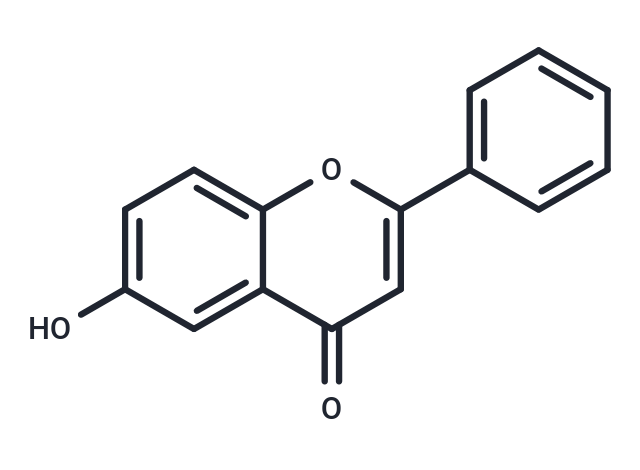
| Pack Size | Price | USA Stock | Global Stock | Quantity |
|---|---|---|---|---|
| 100 mg | $29 | In Stock | In Stock |
| Description | 6-Hydroxyflavone (6-HF) is a noncompetitive inhibitors of cytochrome P450 2C9. It is a flavone, a type of chemical compound. It is reported in leaves of Barleria prionitis Linn. (a common Acanthaceae from India). 6-Hydroxyflavone may have a potential as a therapeutic drug capable for the treatment of anxiety-like disorders. |
| Synonyms | 6-HF |
| Kinase Assay | For Jak3 kinase assays, Fsk-treated MT-2 cells are lysed, clarified, and immunoprecipitated using Jak3 antibody. Kinase reactions are carried out at 30°C for 20 min. For PKA kinase assays, untreated MT-2 cells are lysed, and Jak3 is immunoprecipitated and bound to PAS beads. Immunoprecipitated Jak3 is washed with kinase buffer (50 mM Hepes-NaOH (pH 7.4), 10 mM MgCl2, 0.5 mM EGTA, 0.5 mM DTT, 20 μg/mL aprotinin, 10 μg/mL leupeptin, 1 μg/mL pepstatin A) and incubated with 200 μM ATP and purified protein kinase A catalytic subunit (PKAc) as indicated in the figure legends. Kinase reactions are carried out at 32 °C for 30 min followed by vigorous washing of the beads with cold kinase wash buffer. For [γ-32P]ATP radiolabeled kinase assays using recombinant Jak3, Hek293 cells are transfected with wild type (WT) Jak3 or kinase-dead Jak3 K855A using Lipofectamine 2000 according to the manufacturer's instructions. Cells are lysed and immunoprecipitated with Jak3 antibody. Jak3-bound PAS beads are washed three times in cold lysis buffer followed by kinase buffer. Kinase reactions are initiated by adding 10 μCi [γ-32P]ATP, 10 μM unlabeled ATP, and 1 μg of purified PKAc to Jak3-bound PAS bead reaction mixtures. Kinase reactions are performed at 32°C for 30 min. Jak3-bound PAS beads are washed three times in radioimmunoassay buffer (10 mM Tris-HCl, pH 7.4, 75 mM NaCl, 20 mM EDTA, 10 mM EGTA, 20 mM Na4P2O7, 50 mM NaF, 20 mM 2-glycerolphosphate, 1 mM p-nitrophenylphosphate, 0.1% Triton X-100) and one time in kinase wash buffer. The reactions are stopped by adding 2× SDS-PAGE sample buffer followed by SDS-PAGE. Coomassie stainable Jak3 bands are excised from the PVDF membrane and subjected to phosphoamino acid analysis[2]. |
| Molecular Weight | 238.24 |
| Formula | C15H10O3 |
| Cas No. | 6665-83-4 |
| Smiles | Oc1ccc2oc(cc(=O)c2c1)-c1ccccc1 |
| Relative Density. | 1.34g/cm3 |
| Storage | Powder: -20°C for 3 years | In solvent: -80°C for 1 year Shipping with blue ice/Shipping at ambient temperature. | |||||||||||||||||||||||||||||||||||
| Solubility Information | DMSO: 252.5 mg/mL (1059.86 mM), Sonication is recommended.  | |||||||||||||||||||||||||||||||||||
| In Vivo Formulation | 10% DMSO+40% PEG300+5% Tween 80+45% Saline: 10 mg/mL (41.97 mM), Solution. 10% DMSO+90% Saline: < 10 mg/mL (41.97 mM), Lower concentrations may be soluble, but exact solubility limit is unknown. Please add the solvents sequentially, clarifying the solution as much as possible before adding the next one. Dissolve by heating and/or sonication if necessary. Working solution is recommended to be prepared and used immediately. The formulation provided above is for reference purposes only. In vivo formulations may vary and should be modified based on specific experimental conditions. | |||||||||||||||||||||||||||||||||||
Solution Preparation Table | ||||||||||||||||||||||||||||||||||||
DMSO
Note : The dilution table applies only to solid products. For liquid products, please calculate the stock solution based on the stated concentration and/or density. | ||||||||||||||||||||||||||||||||||||
 For example, if the intended dosage is 10 mg/kg for animals weighing 20 g , with a dosing volume of 100 μL per animal, and a total of 10 animals are to be administered, using a formulation of
  10% DMSO+ 40% PEG300+ 5% Tween 80+ 45% Saline/PBS/ddH2O , the resulting working solution concentration would be 2 mg/mL.
Dissolve 2 mg of the compound in 100 μL DMSO to obtain a stock solution at a concentration of 20 mg/mL . If the required concentration exceeds the compound's known solubility, please contact us for technical support before proceeding.
1) Add 100 μL of the DMSO stock solution to 400 µL PEG300 and mix thoroughly until the solution becomes clear.
2) Add 50 µL Tween 80 and mix well until fully clarified.
3) Add 450 µL Saline,PBS or ddH2O and mix thoroughly until a homogeneous solution is obtained.
| Size | Quantity | Unit Price | Amount | Operation |
|---|
 Feedback
 Hello! How can I help you today?
Copyright © 2015-2026 TargetMol Chemicals Inc. All Rights Reserved.
