


Shopping Cart
Remove All Your shopping cart is currently empty


Synonyms: 5-HT1Amodulator1
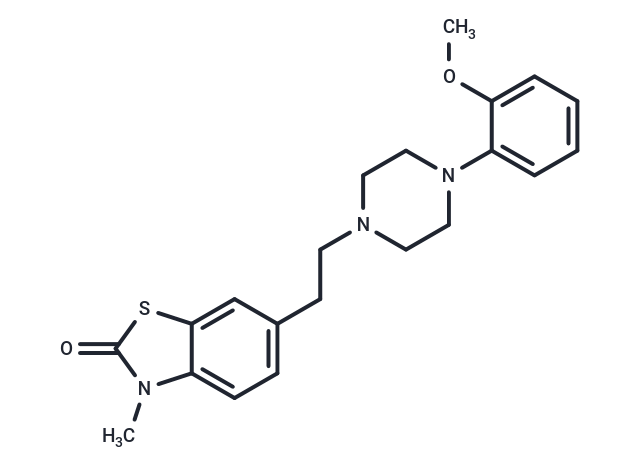

| Pack Size | Price | USA Stock | Global Stock | Quantity |
|---|---|---|---|---|
| 1 mg | $263 | In Stock | In Stock | |
| 5 mg | $642 | In Stock | In Stock | |
| 10 mg | $858 | In Stock | In Stock | |
| 25 mg | $1,270 | In Stock | In Stock | |
| 50 mg | $1,730 | In Stock | In Stock | |
| 100 mg | $2,320 | In Stock | In Stock |
| Description | 5-HT1A modulator 1 is a small molecule modulator, a high-affinity multi-target ligand with potent inhibitory activity against 5-HT1A receptor (IC50=2 nM), α1-adrenergic receptor (IC50=10 nM), and dopamine D2 receptor (IC50=40 nM). This compound is primarily used for research on neuropsychiatric disorders such as anxiety, depression, or schizophrenia. |
| Targets & IC50 | 5-HT1B receptor:300 nM, 5-HT2A receptor:500 nM, α1-adrenoceptor:10 nM, SPLA2:2 nM, D2 receptor:40 nM, 5-HT2C receptor:4000 nM |
| In vitro | Methods: Radioligand binding assays were performed in cells expressing the respective receptors to detect the affinity of 5-HT1A modulator 1 (Compound 24) for 5HT1B, 5-HT2A, and 5-HT2C receptors. Results: 5-HT1A modulator 1 showed affinity for 5HT1B, 5-HT2A, and 5-HT2C receptors with IC50 values of 300±55 nM, 500±75 nM, and 4000±440 nM, respectively. [1] |
| In vivo | Methods: A mouse model was used, and 5-HT1A modulator 1 (1 mg/kg) was administered via intraperitoneal injection to detect its antagonistic effect on 5-HT2A subtype and its effects on stereotypy and climbing behavior; a rat model was used, and 5-HT1A modulator 1 (2, 4, 8, 16 mg/kg) was administered orally to detect its antagonistic effects and effects on hyperactivity. [1] Results: In mice, 5-HT1A modulator 1 exhibited 94% antagonism of the 5-HT2A subtype and completely blocked stereotypy and climbing behavior. In rats, 63% and 58% antagonism was observed at doses of 2 mg/kg and 4 mg/kg, respectively; complete antagonism was achieved at doses of 8 mg/kg and 16 mg/kg (103% and 108%, respectively), with a significant 50% reduction in hyperactivity. [1] |
| Synonyms | 5-HT1Amodulator1 |
| Kinase Assay | Binding was determined using membranes prepared from bovine hippocampus. Receptors were labeled with 0.5 nM [3H]-8-OH-DPAT by incubating with 11 concentrations of test compounds (1-10^5 nM) for 30 min at 25°C. Nonspecific binding was determined using 10 μM buspirone. Competition experiments were analyzed using the iterative nonlinear least squares curve fitting program Inplot 4, GraphPad. IC50 values were calculated using the Cheng-Prusoff equation. |
| Animal Research | Inject Swiss mice with test compounds (e.g. 5-HT1A modulators 1, 0.25 and 1 mg/kg i.p) prior to injection of 5-HTP (400 mg/kg i.p). Count the number of head twitches that occurred during the 10 minutes starting 10 minutes after the injection of 5HTP. Cyproheptadine was used as reference compound. Wistar rats (n=6) were used. 5-HT1A Modulator 1 was tested at pharmacological doses (1 and 2 mg/kg i.p) and high doses (32 and 64 mg/kg i.p). The intensity of forepaw pedaling was expressed as a percentage of the maximum possible score. The 5-HT1A agonist 8-OH-DPAT induced forepaw trampling and was used as a reference compound. |
| Molecular Weight | 383.51 |
| Formula | C21H25N3O2S |
| Cas No. | 142477-34-7 |
| Smiles | COc1ccccc1N1CCN(CCc2ccc3n(C)c(=O)sc3c2)CC1 |
| Relative Density. | no data available |
| Storage | Powder: -20°C for 3 years | In solvent: -80°C for 1 year Shipping with blue ice/Shipping at ambient temperature. | ||||||||||||||||||||
| Solubility Information | DMSO: 5 mg/mL (13.04 mM), Sonication is recommended.  | ||||||||||||||||||||
Solution Preparation Table | |||||||||||||||||||||
DMSO
Note : The dilution table applies only to solid products. For liquid products, please calculate the stock solution based on the stated concentration and/or density. | |||||||||||||||||||||
 For example, if the intended dosage is 10 mg/kg for animals weighing 20 g , with a dosing volume of 100 μL per animal, and a total of 10 animals are to be administered, using a formulation of
  10% DMSO+ 40% PEG300+ 5% Tween 80+ 45% Saline/PBS/ddH2O , the resulting working solution concentration would be 2 mg/mL.
Dissolve 2 mg of the compound in 100 μL DMSO to obtain a stock solution at a concentration of 20 mg/mL . If the required concentration exceeds the compound's known solubility, please contact us for technical support before proceeding.
1) Add 100 μL of the DMSO stock solution to 400 µL PEG300 and mix thoroughly until the solution becomes clear.
2) Add 50 µL Tween 80 and mix well until fully clarified.
3) Add 450 µL Saline,PBS or ddH2O and mix thoroughly until a homogeneous solution is obtained.
| Size | Quantity | Unit Price | Amount | Operation |
|---|
 Feedback
 Hello! How can I help you today?
Copyright © 2015-2026 TargetMol Chemicals Inc. All Rights Reserved.
