


Shopping Cart
Remove All Your shopping cart is currently empty

Synonyms: Physalien
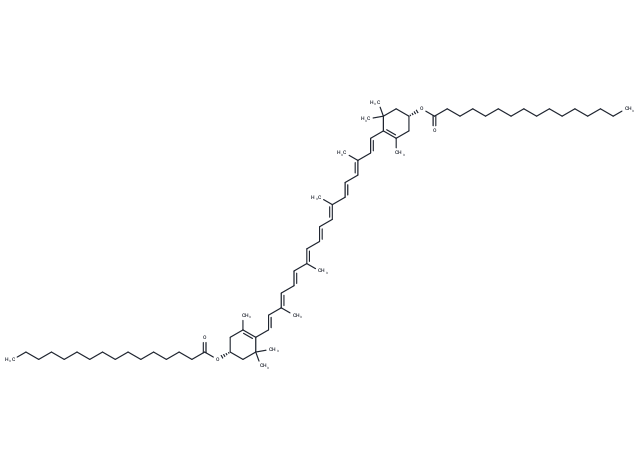
| Pack Size | Price | USA Stock | Global Stock | Quantity |
|---|---|---|---|---|
| 1 mg | $352 | - | In Stock |
| Description | Zeaxanthin dipalmitate (Physalien) is a lutein carotenoid found in fruits with anti-inflammatory, hepatoprotective, and anti-oxidative stress activity that attenuates ethanol-induced liver injury.Zeaxanthin dipalmitate restores mitochondrial autophagy, a function that has been inhibited by ethanol intoxication. Zeaxanthin dipalmitate protects degenerated photoreceptors in the retina of mice and improves visual acuity in a mouse model of photoreceptor degeneration, and may be used in studies of alcoholic fatty liver disease (AFLD) and retinitis pigmentosa (RP). |
| Targets & IC50 | lipocalin receptor 1 (AdipoR1 ):533 nM (kd), P2X7 receptor:81.2 nM (kd) |
| In vitro | Zeaxanthin dipalmitate directly interacted with P2X7 receptor (Kd=81.2 nM) and lipocalin receptor 1 (AdipoR1; Kd=533 nM) in a positive dose-dependent manner. Zeaxanthin dipalmitate (1 µM; 2 h) was able to completely or partially reverse the down-regulation of Atg5, beclin-1, and LC3A/B by ethanol (250 mM) in BRL-3A cells, as well as up-regulation of p62 by ethanol, and partially restored ethanol-suppressed LC3B expression in BRL-3A cells. It also partially restored the viability and ethanol-induced caspase-3/7 activity of ethanol-inhibited BRL-3A cells, and restored the ethanol-induced inhibition of mitochondrial autophagy in BRL-3A cells. [1][2] |
| In vivo | Zeaxanthin dipalmitate (10 mg/kg orally once daily for two weeks) effectively reduced serum ALT and AST levels due to prolonged ethanol challenge in an AFLD model. In addition, this dose of Zeaxanthin dipalmitate was able to significantly attenuate tissue damage and slow down the extent of hepatocyte apoptosis (as assessed by caspase-3/7 activity) and inflammation (TNF-alpha) due to AFLD. In rd10 mice, a single intravitreal injection of Zeaxanthin dipalmitate (~4 μM) was able to improve their visual behavior and delay the degeneration of retinal photoreceptors. Also, this dose enhanced the light response of photoreceptors, bipolar cells, and retinal ganglion cells, and reduced the expression of genes associated with inflammation, apoptosis, and oxidative stress in rd10 mice. [1][2] |
| Synonyms | Physalien |
| Molecular Weight | 1045.69 |
| Formula | C72H116O4 |
| Cas No. | 144-67-2 |
| Smiles | C(=C/C(=C/C=C/C(=C/C=C/C=C(/C=C/C=C(/C=C/C=1C(C)(C)C[C@H](OC(CCCCCCCCCCCCCCC)=O)CC1C)\C)\C)/C)/C)\C=2C(C)(C)C[C@H](OC(CCCCCCCCCCCCCCC)=O)CC2C |
| Relative Density. | 0.96 g/cm3 (Predicted) |
| Storage | Store at low temperature Powder: -20°C for 3 years | In solvent: -80°C for 1 year Shipping with blue ice/Shipping at ambient temperature. |
 For example, if the intended dosage is 10 mg/kg for animals weighing 20 g , with a dosing volume of 100 μL per animal, and a total of 10 animals are to be administered, using a formulation of
  10% DMSO+ 40% PEG300+ 5% Tween 80+ 45% Saline/PBS/ddH2O , the resulting working solution concentration would be 2 mg/mL.
Dissolve 2 mg of the compound in 100 μL DMSO to obtain a stock solution at a concentration of 20 mg/mL . If the required concentration exceeds the compound's known solubility, please contact us for technical support before proceeding.
1) Add 100 μL of the DMSO stock solution to 400 µL PEG300 and mix thoroughly until the solution becomes clear.
2) Add 50 µL Tween 80 and mix well until fully clarified.
3) Add 450 µL Saline,PBS or ddH2O and mix thoroughly until a homogeneous solution is obtained.
| Size | Quantity | Unit Price | Amount | Operation |
|---|
 Feedback
 Hello! How can I help you today?
Copyright © 2015-2026 TargetMol Chemicals Inc. All Rights Reserved.
