


Shopping Cart
Remove All Your shopping cart is currently empty

Synonyms:
| Pack Size | Price | USA Stock | Global Stock | Quantity |
|---|---|---|---|---|
| 1 mg | $465 | Inquiry | Inquiry |
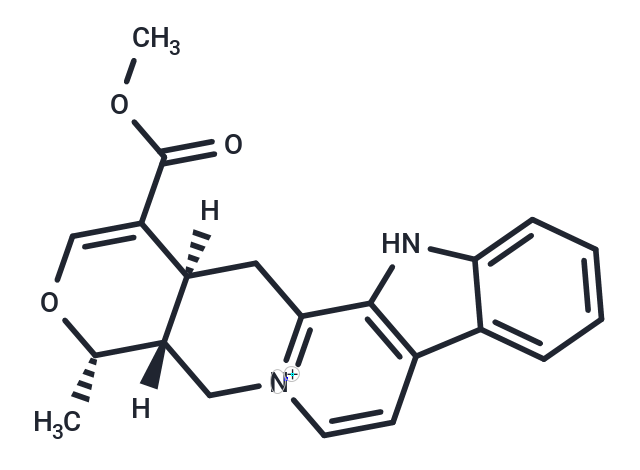
| Description | Serpentine is an alkaloid found in the roots of Rosa Centifolia that acts as an insulin sensitizer to assist insulin in lowering blood glucose.Serpentine activates the phosphorylation of AMPK, which stimulates glucose uptake by C2C12 cells.Serpentine increases the expression of GSK-3β mRNA in muscle tissues, which enhances glucose uptake.Serpentine also increases glucose production and hepatic gluconeogenesis.Serpentine has a significant effect on glucagon secretion and hepatic gluconeogenesis. Serpentine significantly increased glucagon secretion and hepatic gluconeogenesis. In high-fat diet/streptozotocin (HFD/STZ)-induced diabetic mice, Serpentine significantly prolonged insulin hypoglycemia, significantly decreased exogenous insulin use, and inhibited endogenous insulin secretion. |
| In vitro | This work investigates potential analytical variability in environmental investigations of natural occurrences of asbestos (NOA) due to intergrown Serpentine minerals. METHODS AND RESULTS: Franciscan complex and serpentinite rock samples were obtained from likely NOA sites in coastal Northern California with geographic information system (GIS) maps, then analyzed using polarized light microscopy (PLM), transmission electron microscopy with energy-dispersive X-ray analysis and selected area electron diffraction (TEM/SAED/EDS), and environmental scanning electron microscopy with EDS (ESEM/EDS). Non-asbestos Serpentine fibers were superficially similar to chrysotile but were differentiated quickly using TEM morphology criteria and reference SAED overlays. 94 NOA fibers were classified as asbestiform chrysotile (62%), polygonal Serpentine (34%), lizardite scrolls (2%), and lizardite laths (2%). Chrysotile fibril widths (mean = 42 nm) were significantly different from those of polygonal Serpentine and lizardite laths (167 and 505 nm, respectively), but not lizardite scrolls (37 nm).[1] |
| Molecular Weight | 349.4 |
| Formula | C21H21N2O3 |
| Cas No. | 18786-24-8 |
| Smiles | C(OC)(=O)C=1[C@]2(CC=3C4=C(C=5C(N4)=CC=CC5)C=C[N+]3C[C@@]2([C@H](C)OC1)[H])[H] |
| Relative Density. | 1.2214 g/cm3 (Estimated) |
| Storage | Store at low temperature Powder: -20°C for 3 years | In solvent: -80°C for 1 year Shipping with blue ice/Shipping at ambient temperature. |
 For example, if the intended dosage is 10 mg/kg for animals weighing 20 g , with a dosing volume of 100 μL per animal, and a total of 10 animals are to be administered, using a formulation of
  10% DMSO+ 40% PEG300+ 5% Tween 80+ 45% Saline/PBS/ddH2O , the resulting working solution concentration would be 2 mg/mL.
Dissolve 2 mg of the compound in 100 μL DMSO to obtain a stock solution at a concentration of 20 mg/mL . If the required concentration exceeds the compound's known solubility, please contact us for technical support before proceeding.
1) Add 100 μL of the DMSO stock solution to 400 µL PEG300 and mix thoroughly until the solution becomes clear.
2) Add 50 µL Tween 80 and mix well until fully clarified.
3) Add 450 µL Saline,PBS or ddH2O and mix thoroughly until a homogeneous solution is obtained.
| Size | Quantity | Unit Price | Amount | Operation |
|---|
 Feedback
 Hello! How can I help you today?
Copyright © 2015-2026 TargetMol Chemicals Inc. All Rights Reserved.
