


Shopping Cart
Remove All Your shopping cart is currently empty


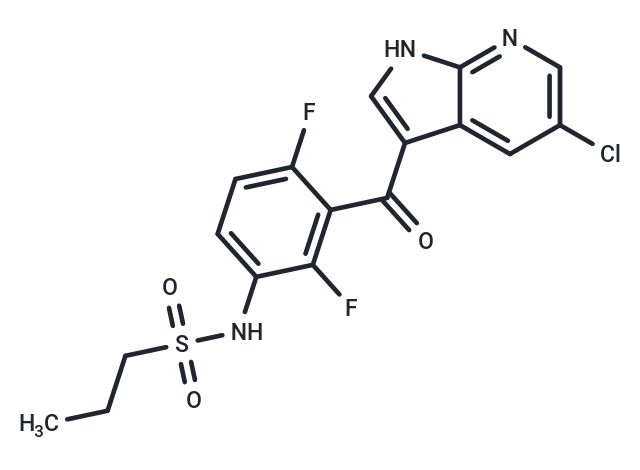
Synonyms: PLX4720

| Pack Size | Price | USA Stock | Global Stock | Quantity |
|---|---|---|---|---|
| 5 mg | $32 | In Stock | In Stock | |
| 10 mg | $48 | In Stock | In Stock | |
| 25 mg | $79 | In Stock | In Stock | |
| 50 mg | $101 | In Stock | In Stock | |
| 100 mg | $126 | In Stock | In Stock | |
| 1 mL x 10 mM (in DMSO) | $35 | In Stock | In Stock |
| Description | PLX-4720 is a potent and selective B-Raf (V600E) inhibitor designed to block the ATP-binding site of oncogenic B-Raf with IC50 of 13 nM. |
| Targets & IC50 | GK (human):2800 nM, HGK:2800 nM, BRK:130 nM, FRK:1300 nM, C-Raf1 (340D/Y341D):6.7 nM (cell free), CSF1R:3300 nM, Csk:1500 nM, Aurora A:3400 nM, KDR:2300 nM, FAK:1700 nM, B-Raf (V600E):13 nM (cell free), B-Raf:160 nM (cell free), FGFR:1900 nM, Src:1700 nM |
| In vitro | METHODS: 1205Lu and C8161 cells were treated with PLX4720 (0.1, 1, 10 μM, 24 hours) and stained with Annexin V/FITC and propidium iodide (PI) to analyze cell apoptosis. RESULTS PLX4720 induced cell cycle arrest and apoptosis in 1205Lu cells in a concentration-dependent manner. [1] METHODS: After 8505c, TPC-1 and NT cells were treated with PLX4720 (1μM or 10μM) for 72 hours, bromodeoxyuridine (BrdU, 10μM) was added for 1 hour, followed by cell cycle analysis, BrdU assay and apoptosis assay. RESULTS Treatment of 8505c cells with 1 μM PLX4720 resulted in a >90% reduction in phosphorylated ERK-1/ERK-2 protein levels after 1 hour; there was no significant difference in cell proliferation even after 72 hours, whereas treatment of 8505c cells with 10 μM PLX4720 Cells reduced phosphorylated ERK-1/ERK-2 BrdU uptake for 1 hour or 72 hours; in TPC-1 cells, treatment with 1 μM PLX4720 for 1 hour resulted in increased phosphorylated ERK-1/ERK-2 protein levels ( About 80%); PLX4720 phosphorylated ERK-1/ERK-2 decreased by about 45% after treatment with 10 μM for 1 hour; both 1 μM and 10 μM PLX4720 caused lower cell proliferation; only 10 μM PLX4720 decreased after 72 hours of treatment The migration of TPC-1 cells was inhibited; NT cells treated with 10 μM PLX4720 showed significantly reduced cell proliferation. [3] |
| In vivo | METHODS: Nude mice bearing BRAF COLO205 cells (BRAFV600E series mutation) were treated with PLX4720 (5, 20, 1000 mg/kg, once daily, orally) and tumor growth in the mice was observed. RESULTS The lower dose of 5 mg/kg PLX4720 had very limited effect on tumor growth; 20 mg/kg PLX4720 treatment of tumor-bearing mice resulted in a substantial block in tumor growth; PLX4720 treatment was well tolerated, and increasing the PLX4720 dose to 1,000 mg/kg resulted in increased plasma levels (up to 600 μM) without any evidence of adverse reactions. [1] |
| Synonyms | PLX4720 |
| Kinase Assay | In vitro Raf kinase activities: The in vitro kinase activities of wild type Raf and mutants are determined by measuring phosphorylation of biotinylated-MEK protein using Perkin-Elmer's AlphaScreen Technology. For each enzyme (0.1 ng), 20-μL reactions are carried out in 20 mM Hepes (pH 7.0), 10 mM MgCl2, 1 mM DTT, 0.01% Tween-20, 100 nM biotin-MEK protein, various ATP concentrations, and increasing concentrations of PLX-4720 at room temperature. Reactions are stopped at 2, 5, 8, 10, 20, and 30 minutes with 5 μL of a solution containing 20 mM Hepes (pH 7.0), 200 mM NaCl, 80 mM EDTA, and 0.3% BSA. The stop solution also includes phospho-MEK Antibody, Streptavidin-coated Donor beads and Protein A Acceptor beads. The antibody and beads are preincubated in stop solution in the dark at room temperature for 30 minutes. The final dilution of antibody is 1/2,000, and the final concentration of each bead is 10 μg/mL. The assay plates are incubated at room temperature for one hour then are read on a PerkinElmer AlphaQuest reader [1]. |
| Cell Research | Cells are treated with various concentrations PLX-4720 for 24, 48, and 72 hours. Cell proliferation is measured by using the CellTiter-Glo Luminescent Cell Viability Assay or MTT assay. For cell cycle analysis, supernatant and cells are collected, pelleted, and fixed with 70% ethanol. Before staining with propidium iodide (10 μg/mL), cells are incubated for 1 hour at 37 °C in 0.5 mg/mL RNase I to rid samples of residual RNA contamination. Samples are then analyzed by using the EPICS XL apparatus. For the assessment of apoptosis, media and cells are harvested and pelleted before staining with annexin-FITC and propidium iodide. Samples are subsequently analyzed by using the EPICS XL apparatus [1]. |
| Animal Research | Female athymic mice (NCr nu/nu) were implanted s.c. on day 0 with 30–60 mg COLO205 tumor fragments. Treatments began on day 11, when the mean estimated tumor mass was 104 mg (range, 95–113 mg). All animals were dosed with vehicle (5% DMSO, 1% methylcellulose) or PLX4720 suspended in vehicle by gavage daily for 14 consecutive days. Tumor burden (mg) was estimated from caliper measurements [1]. |
| Molecular Weight | 413.83 |
| Formula | C17H14ClF2N3O3S |
| Cas No. | 918505-84-7 |
| Smiles | CCCS(=O)(=O)Nc1ccc(F)c(C(=O)c2c[nH]c3ncc(Cl)cc23)c1F |
| Relative Density. | 1.55 |
| Storage | Powder: -20°C for 3 years | In solvent: -80°C for 1 year Shipping with blue ice/Shipping at ambient temperature. | |||||||||||||||||||||||||||||||||||
| Solubility Information | Ethanol: < 1 mg/mL (insoluble or slightly soluble) DMSO: 247 mg/mL (596.86 mM), Sonication is recommended.  H2O: < 1 mg/mL (insoluble or slightly soluble) | |||||||||||||||||||||||||||||||||||
| In Vivo Formulation | 10% DMSO+40% PEG300+5% Tween 80+45% Saline: 5 mg/mL (12.08 mM), Sonication is recommended. Please add the solvents sequentially, clarifying the solution as much as possible before adding the next one. Dissolve by heating and/or sonication if necessary. Working solution is recommended to be prepared and used immediately. The formulation provided above is for reference purposes only. In vivo formulations may vary and should be modified based on specific experimental conditions. | |||||||||||||||||||||||||||||||||||
Solution Preparation Table | ||||||||||||||||||||||||||||||||||||
DMSO
Note : The dilution table applies only to solid products. For liquid products, please calculate the stock solution based on the stated concentration and/or density. | ||||||||||||||||||||||||||||||||||||
 For example, if the intended dosage is 10 mg/kg for animals weighing 20 g , with a dosing volume of 100 μL per animal, and a total of 10 animals are to be administered, using a formulation of
  10% DMSO+ 40% PEG300+ 5% Tween 80+ 45% Saline/PBS/ddH2O , the resulting working solution concentration would be 2 mg/mL.
Dissolve 2 mg of the compound in 100 μL DMSO to obtain a stock solution at a concentration of 20 mg/mL . If the required concentration exceeds the compound's known solubility, please contact us for technical support before proceeding.
1) Add 100 μL of the DMSO stock solution to 400 µL PEG300 and mix thoroughly until the solution becomes clear.
2) Add 50 µL Tween 80 and mix well until fully clarified.
3) Add 450 µL Saline,PBS or ddH2O and mix thoroughly until a homogeneous solution is obtained.
| Size | Quantity | Unit Price | Amount | Operation |
|---|
 Feedback
 Hello! How can I help you today?
Copyright © 2015-2026 TargetMol Chemicals Inc. All Rights Reserved.
