


Shopping Cart
Remove All Your shopping cart is currently empty


Synonyms:

| Pack Size | Price | USA Stock | Global Stock | Quantity |
|---|---|---|---|---|
| 1 mg | $38 | In Stock | In Stock | |
| 5 mg | $77 | In Stock | In Stock | |
| 10 mg | $133 | In Stock | In Stock | |
| 25 mg | $273 | In Stock | In Stock | |
| 50 mg | $403 | In Stock | In Stock | |
| 100 mg | $573 | In Stock | In Stock | |
| 200 mg | $778 | In Stock | In Stock |
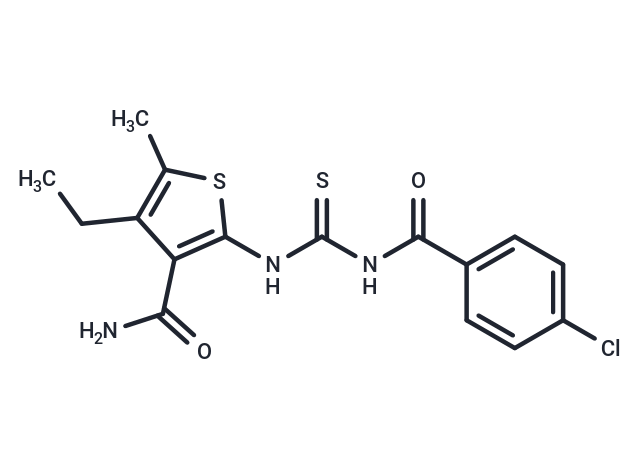
| Description | PI-273, a Substrate-Competitive, Specific Small-Molecule Inhibitor of PI4KIIα, Inhibits the Growth of Breast Cancer Cells |
| Targets & IC50 | PI4KIIα:0.47 μM |
| In vitro | PI-273 exhibited the greatest inhibitory effect on PI4KIIα kinase activity (IC50 = 0.47 μmol/L) and suppressed cell proliferation. Surface plasmon resonance and thermal shift assays indicated that PI-273 interacted directly with PI4KIIα. The kinetic analysis identified PI-273 as a reversible competitive inhibitor with respect to the substrate phosphatidylinositol (PI), which contrasted with most other PI kinase inhibitors that bind the ATP binding site. PI-273 reduced PI4P content, cell viability, and AKT signaling in wild-type MCF-7 cells, but not in PI4KIIα knockout MCF-7 cells, indicating that PI-273 is highly selective for PI4KIIα. Mutant analysis revealed the role of palmitoylation insertion in the selectivity of PI-273 for PI4KIIα. In addition, PI-273 treatment retarded cell proliferation by blocking cells in G2-M, inducing cell apoptosis and suppressing colony-forming ability. Importantly, PI-273 significantly inhibited MCF-7 cell-induced breast tumor growth without toxicity. PI-273 is the first substrate-competitive, a subtype-specific inhibitor of PI4KIIα, the use of which will facilitate evaluations of PI4KIIα as a cancer therapeutic target. |
| In vivo | PI-273 (intraperitoneal injection; 25 mg/kg/day; 15 days) significantly reduces tumor volume and weight in MCF-7 xenografts [1]. PI-273 (0.5 mg/kg intravenously or 1.5 mg/kg intragastrically; 0.08-5 hours) has a half-life of 0.411 hours for intravenous administration and 1.321 hours for intragastric administration, with an absolute bioavailability of 5.1% [1]. |
| Molecular Weight | 381.9 |
| Formula | C16H16ClN3O2S2 |
| Cas No. | 925069-34-7 |
| Smiles | CCc1c(C)sc(NC(=S)NC(=O)c2ccc(Cl)cc2)c1C(N)=O |
| Relative Density. | 1.425 g/cm3 (Predicted) |
| Storage | Powder: -20°C for 3 years | In solvent: -80°C for 1 year Shipping with blue ice/Shipping at ambient temperature. | ||||||||||
| Solubility Information | DMSO: 0.95 mg/mL (2.49 mM), Sonication is recommended.  | ||||||||||
Solution Preparation Table | |||||||||||
DMSO
Note : The dilution table applies only to solid products. For liquid products, please calculate the stock solution based on the stated concentration and/or density. | |||||||||||
 For example, if the intended dosage is 10 mg/kg for animals weighing 20 g , with a dosing volume of 100 μL per animal, and a total of 10 animals are to be administered, using a formulation of
  10% DMSO+ 40% PEG300+ 5% Tween 80+ 45% Saline/PBS/ddH2O , the resulting working solution concentration would be 2 mg/mL.
Dissolve 2 mg of the compound in 100 μL DMSO to obtain a stock solution at a concentration of 20 mg/mL . If the required concentration exceeds the compound's known solubility, please contact us for technical support before proceeding.
1) Add 100 μL of the DMSO stock solution to 400 µL PEG300 and mix thoroughly until the solution becomes clear.
2) Add 50 µL Tween 80 and mix well until fully clarified.
3) Add 450 µL Saline,PBS or ddH2O and mix thoroughly until a homogeneous solution is obtained.
| Size | Quantity | Unit Price | Amount | Operation |
|---|
 Feedback
 Hello! How can I help you today?
Copyright © 2015-2026 TargetMol Chemicals Inc. All Rights Reserved.
