


Shopping Cart
Remove All Your shopping cart is currently empty

Synonyms: Callistephin chloride
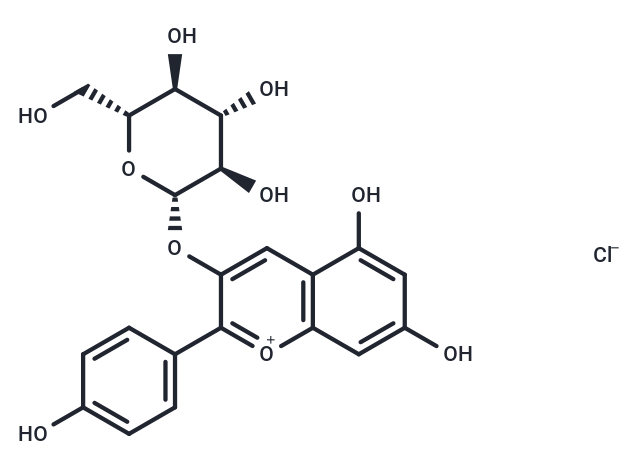
| Pack Size | Price | USA Stock | Global Stock | Quantity |
|---|---|---|---|---|
| 5 mg | $648 | Inquiry | Inquiry |
| Description | Pelargonidin-3-O-glucoside chloride (Callistephin chloride) is a natural anthocyanin compound widely found in plants such as strawberries and pomegranates. Pelargonidin-3-O-glucoside chloride belongs to the class of flavonoid polyphenols and exhibits antioxidant, anti-inflammatory, and neuroprotective biological activities. Pelargonidin-3-O-glucoside chloride exerts significant anti-inflammatory effects by inhibiting p38 MAPK phosphorylation and regulating the expression of inflammation-related proteins (iNOS, TNF-α, COX-2). It effectively scavenges DPPH radicals, reduces intracellular ROS levels, and inhibits lipid peroxidation. Pelargonidin-3-O-glucoside chloride alleviates glutamate-induced excitotoxicity, reduces neuronal apoptosis, and protects microglia and cerebellar granule neurons. Pelargonidin-3-O-glucoside chloride induces apoptosis in breast cancer cells and inhibits cell proliferation and metastasis. |
| In vitro | Methods: Human red blood cells were treated with pelargonidin-3-O-glucoside chloride (50 μM, 100 μM, 200 μM, 400 μM) and incubated with the red blood cell suspension for 10 or 30 minutes. Cell morphology was observed using a scanning electron microscope, and the percentage of spiny red blood cells was counted. Results: Pelargonidin-3-O-glucoside chloride induced the formation of spiked red blood cells in a concentration-dependent manner, with no hemolysis observed. [1] Methods: DPPC liposomes (containing the fluorescent probe DPH-PA) were treated with 0–200 µM pelargonidin-3-O-glucoside chloride and incubated for 60 minutes. Fluorescence decay caused by DPH-PA oxidation was monitored using fluorescence spectroscopy, and the antioxidant efficiency was calculated. Results: Pelargonidin-3-O-glucoside chloride effectively inhibited lipid peroxidation. [1] Methods: Mouse microglial cells (C8-4B) were first stimulated with LPS (100 ng/μL) and IFN-γ (1 ng/μL) for 2 hours, followed by the addition of pelargonidin-3-O-glucoside chloride (100 μM), with a total treatment duration of 24 hours. Cell viability was assessed using the CTG assay; NO concentration in the culture supernatant was measured using the Griess assay; and mRNA expression levels of iNOS, TNF-α, COX-2, and NF-κB p65 were analyzed by semi-quantitative PCR. Results: Pelargonidin-3-O-glucoside chloride reversed the LPS/IFN-γ-induced decrease in cell viability, downregulated the LPS/IFN-γ-induced increase in NO, and simultaneously inhibited the expression of iNOS, TNF-α, and COX-2. [2] |
| Synonyms | Callistephin chloride |
| Molecular Weight | 468.84 |
| Formula | C21H21ClO10 |
| Cas No. | 18466-51-8 |
| Smiles | O(C=1C(=[O+]C2=C(C1)C(O)=CC(O)=C2)C3=CC=C(O)C=C3)[C@@H]4O[C@H](CO)[C@@H](O)[C@H](O)[C@H]4O.[Cl-] |
| Relative Density. | no data available |
| Storage | Keep away from moisture,Keep away from direct sunlight Powder: -20°C for 3 years | In solvent: -80°C for 1 year Shipping with blue ice/Shipping at ambient temperature. | ||||||||||||||||||||||||||||||||||||||||
| Solubility Information | H2O: 40 mg/mL (85.32 mM), Sonication is recommended. DMSO: 80 mg/mL (170.63 mM) | ||||||||||||||||||||||||||||||||||||||||
Solution Preparation Table | |||||||||||||||||||||||||||||||||||||||||
H2O/DMSO
DMSO
Note : The dilution table applies only to solid products. For liquid products, please calculate the stock solution based on the stated concentration and/or density. | |||||||||||||||||||||||||||||||||||||||||
 For example, if the intended dosage is 10 mg/kg for animals weighing 20 g , with a dosing volume of 100 μL per animal, and a total of 10 animals are to be administered, using a formulation of
  10% DMSO+ 40% PEG300+ 5% Tween 80+ 45% Saline/PBS/ddH2O , the resulting working solution concentration would be 2 mg/mL.
Dissolve 2 mg of the compound in 100 μL DMSO to obtain a stock solution at a concentration of 20 mg/mL . If the required concentration exceeds the compound's known solubility, please contact us for technical support before proceeding.
1) Add 100 μL of the DMSO stock solution to 400 µL PEG300 and mix thoroughly until the solution becomes clear.
2) Add 50 µL Tween 80 and mix well until fully clarified.
3) Add 450 µL Saline,PBS or ddH2O and mix thoroughly until a homogeneous solution is obtained.
| Size | Quantity | Unit Price | Amount | Operation |
|---|
 Feedback
 Hello! How can I help you today?
Copyright © 2015-2026 TargetMol Chemicals Inc. All Rights Reserved.
