


Shopping Cart
Remove All Your shopping cart is currently empty

Synonyms:
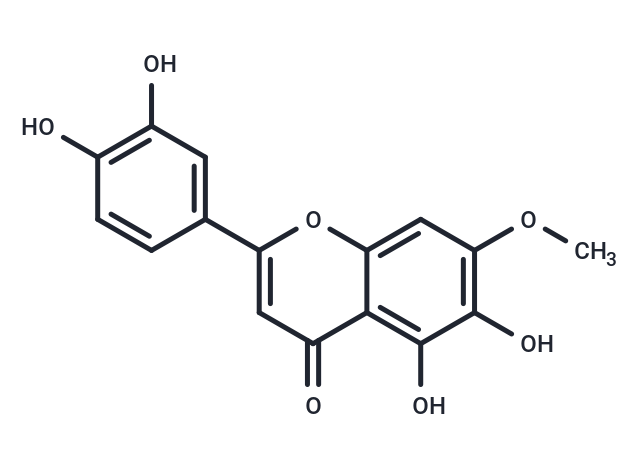
| Pack Size | Price | USA Stock | Global Stock | Quantity |
|---|---|---|---|---|
| 1 mg | $193 | - | In Stock | |
| 5 mg | $489 | - | In Stock | |
| 10 mg | $698 | - | In Stock |
| Description | Pedalitin is a natural flavonoid with inhibitory activity against tyrosinase, α-glucosidase, xanthine oxidase, and myeloperoxidase (MPO), with IC₅₀ values of 0.28 mM, 0.29 mM, 3.7 μM, and 3.8 nM, respectively. Pedalitin also exhibits antifungal activity against Cryptococcus neoformans, with a MIC of 3.9 mg/L, and can be used in studies of enzyme inhibition, inflammation, lipid metabolism, non-alcoholic fatty liver disease, and antifungal mechanisms. |
| Targets & IC50 | MRC5 cells:191.7 mg/L, U-87MG cells ATCC:175 mg/L, HepG2 cells:131.7 mg/L, MPO:3.8 nM, α-glucosidase:0.29 mM |
| In vitro | Method: Pedalitin was evaluated for myeloperoxidase (MPO) inhibitory activity. Result: Pedalitin inhibited MPO with an IC50 of 3.75 nM [1]. Method: Pedalitin was tested in a Weatherburn indophenol urease assay using urease from Proteus mirabilis; the reaction was incubated in phosphate buffer (pH 8.2) at 30 °C for 5 min, followed by addition of 66 mM urea and a further 20 min incubation. Result: Pedalitin (5 μL) inhibited urease activity by 30.1% [2]. Method: Pedalitin-treated Proteus mirabilis MTCC 425 cells were assessed for UreC gene expression by SYBR Green quantitative PCR. Result: Pedalitin significantly downregulated UreC expression relative to the control, Mean = 0.62 ± 0.11 [2]. Method: An in vitro assay determined the MICs of Pedalitin alone and in combination with amphotericin B against Cryptococcus spp. Result: The MIC was 3.9 mg/L for Pedalitin alone and 1 mg/L for Pedalitin combined with amphotericin B; the corresponding MICs for amphotericin B were 0.125 mg/L alone and 0.03 mg/L in combination [3]. Method: Pedalitin was evaluated for its inhibitory effect and mechanism on tyrosinase. Result: Pedalitin inhibited tyrosinase with an IC50 of 0.28 mM and was considered a mixed-type inhibitor [4]. Method: Pedalitin was evaluated for its inhibitory effect and mechanism on α-glucosidase. Result: Pedalitin inhibited α-glucosidase with an IC50 of 0.29 mM and was considered a mixed-type inhibitor [4]. |
| In vivo | Method: Pedalitin alone and in combination with amphotericin B were evaluated in a Galleria mellonella model. Result: Pedalitin combined with amphotericin B was considered more effective than monotherapy in the Galleria mellonella model. Pedalitin can be used for research on anticryptococcal treatment [3]. Method: Pedalitin alone and in combination with amphotericin B were evaluated in a murine model. Result: Pedalitin combined with amphotericin B was considered more effective than monotherapy in the murine model. Pedalitin can be used for research on anticryptococcal treatment [3]. |
| Molecular Weight | 316.26 |
| Formula | C16H12O7 |
| Cas No. | 22384-63-0 |
| Smiles | O=C1C=C(OC2=CC(OC)=C(O)C(O)=C12)C=3C=CC(O)=C(O)C3 |
| Relative Density. | 1.605g/cm3 |
| Storage | Store at low temperature,Keep away from direct sunlight,Keep away from moisture Powder: -20°C for 3 years | In solvent: -80°C for 1 year Shipping with blue ice/Shipping at ambient temperature. |
 For example, if the intended dosage is 10 mg/kg for animals weighing 20 g , with a dosing volume of 100 μL per animal, and a total of 10 animals are to be administered, using a formulation of
 10% DMSO+ 40% PEG300+ 5% Tween 80+ 45% Saline/PBS/ddH2O , the resulting working solution concentration would be 2 mg/mL.
Dissolve 2 mg of the compound in 100 μL DMSO to obtain a stock solution at a concentration of 20 mg/mL . If the required concentration exceeds the compound's known solubility, please contact us for technical support before proceeding.
1) Add 100 μL of the DMSO stock solution to 400 µL PEG300 and mix thoroughly until the solution becomes clear.
2) Add 50 µL Tween 80 and mix well until fully clarified.
3) Add 450 µL Saline,PBS or ddH2O and mix thoroughly until a homogeneous solution is obtained.
| Size | Quantity | Unit Price | Amount | Operation |
|---|
 Feedback
 Hello! How can I help you today?

Copyright © 2015-2026 TargetMol Chemicals Inc. All Rights Reserved.
