


Shopping Cart
Remove All Your shopping cart is currently empty

Synonyms: Otenabant (CP-945598) HCl, Otenabant, CP 945598 Hydrochloride
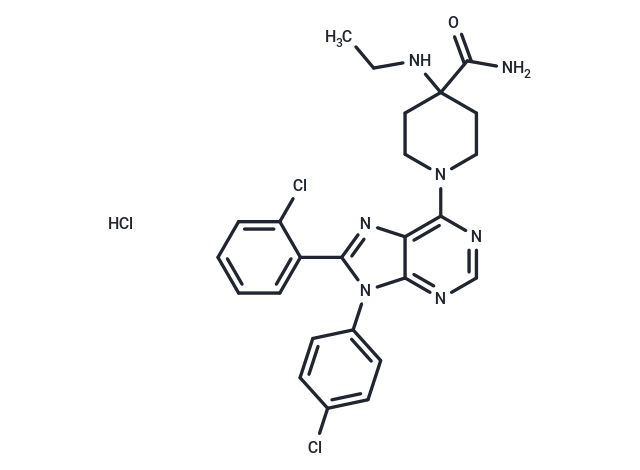
| Pack Size | Price | USA Stock | Global Stock | Quantity |
|---|---|---|---|---|
| 1 mg | $39 | In Stock | In Stock | |
| 2 mg | $54 | In Stock | In Stock | |
| 5 mg | $74 | In Stock | In Stock | |
| 10 mg | $123 | In Stock | In Stock | |
| 25 mg | $252 | In Stock | In Stock | |
| 50 mg | $466 | In Stock | - | |
| 100 mg | $683 | Inquiry | Inquiry |
| Description | Otenabant hydrochloride (Otenabant) (CP-945598) is a competitive, high affinity, selective antagonist of the CB1 receptor (Ki: 0.7 nM). |
| Targets & IC50 | CB1 (human):0.7 nM(Ki), CB1 (rat):2.8 nM(Ki) |
| In vitro | In a diet-induced obesity model in mice, CP-945598 (10 mg/kg) facilitated a 9% reduction in body weight over a 10-day weight loss study. CP-945598 significantly enhanced energy expenditure in rats and reduced the respiratory quotient, indicating a metabolic shift towards increased fat oxidation. Additionally, CP-945598 HCl reversed behaviors mediated by four cannabinoid agonists (hypothermia, spontaneous activity, catalepsy, and analgesia). In acute food intake models in rodent species, CP-945598 HCl suppressed appetite, further promoting fat oxidation and energy consumption. |
| In vivo | CP-945598 HCl exhibits lower affinity towards human CB2 receptors (Ki: 7.6 μM) and demonstrates inhibitory effects on the CB1 receptor. Additionally, it possesses moderate microsomal clearance, low affinity for hERG, and sufficient penetration of the central nervous system (CNS). |
| Synonyms | Otenabant (CP-945598) HCl, Otenabant, CP 945598 Hydrochloride |
| Kinase Assay | Membranes are prepared from CHOK1 cells stably transfected with the human CB-1 receptor cDNA. GTPγ [35S] binding assays are performed in a 96-well FlashPlate format in duplicate using 100 pM GTPγ [35S] and 10μg membrane per well in assay buffer composed of 50 mM Tris HCl, pH 7.4, 3 mM MgCl2, pH 7.4, 10 mM MgCl2, 20 mM EGTA, 100 mM NaCl, 30 μM GDP, 0.1% bovine serum albumin, and the following protease inhibitors: 100 μg/mL bacitracin, 100 μg/mL benzamidine, 5 μg/mL aprotinin, 5 μg/mL leupeptin. The assay mix is then incubated with increasing concentrations of antagonist (10-10M to 10-5 M) for 10 min and challenged with the cannabinoid agonist CP-55,940 (10 μM). Assays are performed at 30°C for 1 h. The FlashPlates are then centrifuged at 2000 g for 10 min. Stimulation of GTPγ [35S] binding is then quantified using a Wallac Microbeta. EC50 calculations are done using Prism by GraphPad. Inverse agonism is measured in the absence of agonist. |
| Molecular Weight | 546.88 |
| Formula | C25H26Cl3N7O |
| Cas No. | 686347-12-6 |
| Smiles | Cl.CCNC1(CCN(CC1)c1ncnc2n(c(nc12)-c1ccccc1Cl)-c1ccc(Cl)cc1)C(N)=O |
| Relative Density. | no data available |
| Storage | Powder: -20°C for 3 years | In solvent: -80°C for 1 year Shipping with blue ice/Shipping at ambient temperature. |
| Solubility Information | DMSO: Slightly soluble  |
 For example, if the intended dosage is 10 mg/kg for animals weighing 20 g , with a dosing volume of 100 μL per animal, and a total of 10 animals are to be administered, using a formulation of
  10% DMSO+ 40% PEG300+ 5% Tween 80+ 45% Saline/PBS/ddH2O , the resulting working solution concentration would be 2 mg/mL.
Dissolve 2 mg of the compound in 100 μL DMSO to obtain a stock solution at a concentration of 20 mg/mL . If the required concentration exceeds the compound's known solubility, please contact us for technical support before proceeding.
1) Add 100 μL of the DMSO stock solution to 400 µL PEG300 and mix thoroughly until the solution becomes clear.
2) Add 50 µL Tween 80 and mix well until fully clarified.
3) Add 450 µL Saline,PBS or ddH2O and mix thoroughly until a homogeneous solution is obtained.
| Size | Quantity | Unit Price | Amount | Operation |
|---|
 Feedback
 Hello! How can I help you today?
Copyright © 2015-2026 TargetMol Chemicals Inc. All Rights Reserved.
