


Shopping Cart
Remove All Your shopping cart is currently empty


Synonyms:
| Pack Size | Price | USA Stock | Global Stock | Quantity |
|---|---|---|---|---|
| 2 mg | $34 | In Stock | In Stock | |
| 5 mg | $53 | In Stock | In Stock | |
| 10 mg | $85 | In Stock | In Stock | |
| 25 mg | $156 | In Stock | In Stock | |
| 50 mg | $289 | In Stock | In Stock | |
| 100 mg | $423 | In Stock | In Stock | |
| 1 mL x 10 mM (in DMSO) | $62 | In Stock | In Stock |
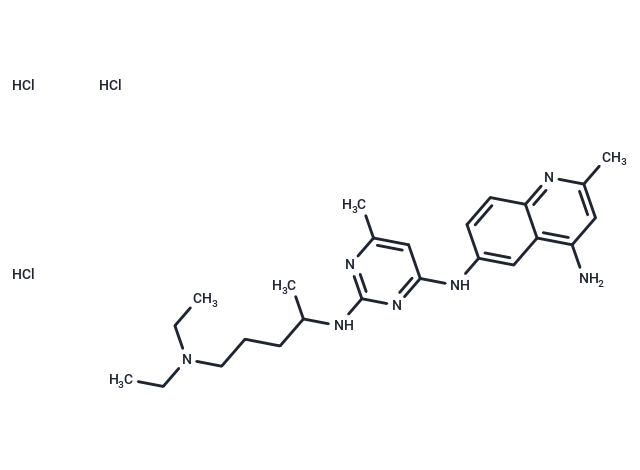
| Description | NSC 23766 trihydrochloride (Rac1 Inhibitor) is an inhibitor of Rac GTPase targeting Rac activation by GEFs (IC50: ~50 μM); no inhibitory for the closely related targets, RhoA or Cdc42. |
| Targets & IC50 | Rac GTPase:50 μM |
| In vitro | NSC23766 is identified to fit into a surface groove of Rac1 known to be critical for GEF specification. NSC23766 effectively inhibits Rac1 binding and activation by the Rac-specific GEF Trio or Tiam1 in a dose-dependent manner without interfering with the closely related Cdc42 or RhoA binding or activation by their respective GEFs or with Rac1 interaction with BcrGAP or effector PAK1. [1] NSC 23766 is active in regulating Rac GTPase functions on cytoskeleton and many cell functions including cell cycle, cell growth, adhesion, migration and gene transcription. NSC 23766 (50 μM) potently blocks serum or platelet-derived growth factor-induced Rac1 activation and lamellipodia formation without affecting the activity of endogenous Cdc42 or RhoA in NIH 3T3 cells. NSC 23766 reduces Trio or Tiam1 but not Vav, Lbc, Intersectin, or a constitutively active Rac1 mutant-stimulated NIH 3T3 cells growth and suppresses Trio, Tiam1, or Ras-induced cell transformation. NSC23766 dose-dependently inhibits PC-3 cells proliferation and anchorage-independent growth. 25 μM NSC23766 inhibits the PC-3 cell invasion through Matrigel by 85%. [1] 50 μM NSC 23766 inhibits thrombin-induced activation of Rac1 an d Rac2 in human platelets, as well as platelet aggregation. [2] NSC23766 prevents Aβ40 and Aβ42 production in swAPP-HEK293cells without affecting Notch and sAPPα. NSC23766 prevents γ-secretase activity in cell, but not act as a direct γ-secretase inhibitor. NSC23766 dose-dependently reduces levels of secreted and intracellular Aβ40 with IC50 of 48.94 μM. 50 μM NSC 23766 inhibits release of Aβ42 by 57.97%. [3] |
| In vivo | NSC23766 induces mobilization of hematopoietic stem cells/progenitors. Intraperitoneal administration of NSC23766 (2.5 mg/kg) into the ''poorly mobilizing '' C57Bl/6 mouse strain leads to a two-fold increase in circulating hematopoietic stem cells/progenitors 6 hr after injection. [2] NSC23766 alleviates lipopolysaccharide-induced acute pulmonary injury in mice. Treatment with NSC23766 at 1 or 3 mg/kg not only reduces the inflammatory cells infiltration and MPO activities, but also inhibits pro-inflammatory mediators, tumor necrosis factor-α and interleukin-1β, mRNA expression. NSC23766 also reduces Evans Blue and albumin accumulation in LPS-challenged lungs. [6] |
| Kinase Assay | Rho GTPase activity assay: Cells are grown in log phase in a 10-cm dish, and are starved in 0.5% serum medium or indicated otherwise for 24 h before lysis in a buffer containing 20 mM Tris HCl (pH 7.6), 100 mM NaCl, 10 mM MgCl2, 1% Nonidet P-40, 10% glycerol, and 1× protease inhibitor mixture. Lysates are clarified, the protein concentrations are normalized, and the GTP-bound Rac1 in the lysates is measured by an effector domain pull-down assay. For the His6-PAK1 PBD pull-down assay, cell lysates are incubated with Ni2+-agarose-immobilized His6-PAK1 PBD domain (~1 μg each) purified from E. coli for 30 min. The Ni2+-agarose co-precipitates are washed twice in the wash buffer and analyzed by immunoblotting with anti-Rac1 monoclonal antibody. |
| Cell Research | Cells (1.5 × 10⁴/mL) are seeded in each well of 96-well tissue culture plates with 200 μL of medium. After 24 hours of plating, the medium is replaced with 200 μL of fresh medium containing NSC23766 at the indicated concentrations. At the end of the treatment period 20 μL of MTS solution are added to each well and incubated at 37 ℃ for 2 hours. Absorbance at 490 nm is read on a 96-well plate reader.(Only for Reference) |
| Molecular Weight | 530.96 |
| Formula | C24H35N7·3HCl |
| Cas No. | 1177865-17-6 |
| Smiles | Cl.Cl.Cl.CCN(CC)CCCC(C)Nc1nc(C)cc(Nc2ccc3nc(C)cc(N)c3c2)n1 |
| Relative Density. | no data available |
| Storage | Store at low temperature Powder: -20°C for 3 years | In solvent: -80°C for 1 year Shipping with blue ice/Shipping at ambient temperature. | |||||||||||||||||||||||||||||||||||
| Solubility Information | H2O: 53.1 mg/mL (100.01 mM), Sonication is recommended. DMSO: 53.1 mg/mL (100.01 mM), Sonication is recommended. | |||||||||||||||||||||||||||||||||||
Solution Preparation Table | ||||||||||||||||||||||||||||||||||||
H2O/DMSO
Note : The dilution table applies only to solid products. For liquid products, please calculate the stock solution based on the stated concentration and/or density. | ||||||||||||||||||||||||||||||||||||
 For example, if the intended dosage is 10 mg/kg for animals weighing 20 g , with a dosing volume of 100 μL per animal, and a total of 10 animals are to be administered, using a formulation of
  10% DMSO+ 40% PEG300+ 5% Tween 80+ 45% Saline/PBS/ddH2O , the resulting working solution concentration would be 2 mg/mL.
Dissolve 2 mg of the compound in 100 μL DMSO to obtain a stock solution at a concentration of 20 mg/mL . If the required concentration exceeds the compound's known solubility, please contact us for technical support before proceeding.
1) Add 100 μL of the DMSO stock solution to 400 µL PEG300 and mix thoroughly until the solution becomes clear.
2) Add 50 µL Tween 80 and mix well until fully clarified.
3) Add 450 µL Saline,PBS or ddH2O and mix thoroughly until a homogeneous solution is obtained.
| Size | Quantity | Unit Price | Amount | Operation |
|---|
 Feedback
 Hello! How can I help you today?
Copyright © 2015-2026 TargetMol Chemicals Inc. All Rights Reserved.
