


Shopping Cart
Remove All Your shopping cart is currently empty


Synonyms: ABT-263
| Pack Size | Price | USA Stock | Global Stock | Quantity |
|---|---|---|---|---|
| 5 mg | $39 | In Stock | In Stock | |
| 10 mg | $54 | In Stock | In Stock | |
| 25 mg | $84 | In Stock | In Stock | |
| 50 mg | $141 | In Stock | In Stock | |
| 100 mg | $187 | In Stock | In Stock | |
| 200 mg | $322 | In Stock | In Stock | |
| 1 mL x 10 mM (in DMSO) | $48 | In Stock | In Stock |
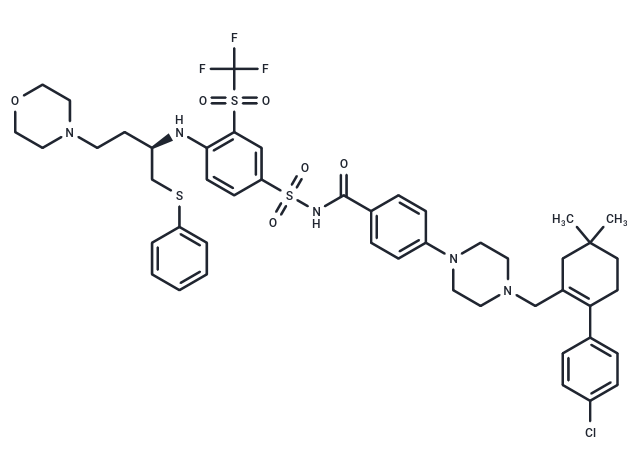
| Description | Navitoclax (ABT-263) is a potent oral Bcl-2 inhibitor that binds to Bcl-xL, Bcl-2, and Bcl-w proteins (Ki<1 nM), demonstrating antitumor activity and inducing apoptosis. |
| Targets & IC50 | Bcl-2:< 1 nM (Ki, cell free), BCL-W:< 1 nM (Ki, cell free), BCL-XL:0.4 nM (Ki, cell free) |
| In vitro | METHODS: Mouse primary B lymphocytes FL5.12/Bcl-xL and FL5.12/Bcl-2 were treated with Navitoclax (0.001-1000 nmol/L) for 48 h. Cell viability was measured using the CellTiter Glo. RESULTS: Navitoclax reversed the protection afforded by overexpression of Bcl-2 or Bcl-xL (EC50 of 60 and 20 nmol/L, respectively). In the presence of IL-3, Navitoclax was ineffective in inducing cell death in the absence of pro-apoptotic stimuli in FL5.12 cells. [1] METHODS: HCC cells PLC/PRF/5, Hep3B, HepG2, and Huh7 were treated with Navitoclax (5 μM) for 18 h, and the expression levels of target proteins were detected by Western Blot. RESULTS: After treatment with Navitoclax, Mcl-1 levels were significantly increased in all HCC cell lines, but Bcl-2 and B cl-xL levels did not change significantly. [2] |
| In vivo | METHODS: To detect anti-tumor activity in vivo, Navitoclax (100 mg/kg in 10% ethanol+30% polyethylene glycol 400+60% Phosal 50 PG) was administered orally to scid mice bearing human SCLC and ALL xenografts once a day for twenty-one days. RESULTS: Oral administration of Navitoclax resulted in tumor regression of SCLC and ALL xenografts in vivo. [1] METHODS: To assay antitumor activity in vivo, Navitoclax (50-100 mg/kg in 10% ethanol+30% polyethylene glycol 400+60% Phosal 50 PG) was administered orally as a single dose to scid mice bearing human SCLC tumor H146. RESULTS: Single-dose Navitoclax-treated H146 tumors showed a high number of dead and dying cells, including a well-vascularized tumor periphery. [3] |
| Synonyms | ABT-263 |
| Kinase Assay | ABT-737 and ABT-263 were synthesized as previously described. The enantiomer and BH3-only peptides were synthesized at Abbott. Binding affinities (Ki or IC50) were determined with competitive fluorescence polarization assays. The following peptide probe/protein pairs were used: f-bad (1 nmol/L) and Bcl-xL (6 nmol/L), f-Bax (1 nmol/L) and Bcl-2 (10 nmol/L), f-Bax (1 nmol/L) and Bcl-w (40 nmol/L), f-Noxa (2 nmol/L) and Mcl-1 (40 nmol/L), and f-Bax (1 nmol/L) and Bcl-2-A1 (15 nmol/L). Binding affinities for Bcl-xL were also determined using a time-resolved fluorescence resonance energy transfer assay. Bcl-xL (1 nmol/L, His tagged) was mixed with 200 nmol/L f-Bak, 1 nmol/L Tb-labeled anti-His antibody, and compound at room temperature for 30 min. Fluorescence was measured on an Envision plate reader using a 340/35 nm excitation filter and 520/525 (f-Bak) and 495/510 nm (Tb-labeled anti-His antibody) emission filters. Dissociation constants (Ki) were determined using Wang's equation [1]. |
| Cell Research | Human tumor cell lines were maintained at 37°C containing 5% CO2. SCLC cell lines were cultured in RPMI 1640 with 10% fetal bovine serum (FBS), 1% sodium pyruvate, 25 mmol/L HEPES, 4.5 g/L glucose, and 1% penicillin/streptomycin. Leukemia and lymphoma cell lines were cultured in RPMI 1640 supplemented with 10% FBS and 1% penicillin/streptomycin. Cells (1 × 10^4–5 × 10^4) were treated for 48 h in 96-well culture plates in a final volume of 100 μL and cytotoxicity was assessed with the CellTiter Glo assay [1]. |
| Animal Research | C.B.-17 scid-bg or C.B.-17 scid mice were implanted with 5 × 10^6 (1 × 10^6 for DoHH2) cells in 0.2 mL 50% Matrigel s.c. into the right flank. Tumor-bearing mice were size matched (~235 mm3; day 0) into treatment and control groups, ear tagged, and monitored individually. Tumor volume was measured two to three times weekly by electronic calipers (volume = length × width2 / 2). Tumor growth inhibition was calculated based on the difference in mean tumor volumes between treated and appropriate vehicle control groups. Partial response (PR) is defined as ≥50% tumor growth inhibition, and complete response (CR) is defined as nonpalpable tumor. All studies used 8 to 10 mice per group. ABT-263 was formulated in 10% ethanol, 30% polyethylene glycol 400, and 60% Phosal 50 PG and administered p.o. The other agents used [rituximab, doxorubicin, cyclophosphamide, vincristine, bortezomib, and prednisone] were administered i.p., p.o., or i.v. and formulated according to the manufacturers' recommendations. For combination studies, ABT-263 was given ~2 h before the other agents, except bortezomib, which was given ~4 h before ABT-263 [1]. |
| Molecular Weight | 974.61 |
| Formula | C47H55ClF3N5O6S3 |
| Cas No. | 923564-51-6 |
| Smiles | C(C1=C(CCC(C)(C)C1)C2=CC=C(Cl)C=C2)N3CCN(CC3)C4=CC=C(C(NS(=O)(=O)C5=CC(S(C(F)(F)F)(=O)=O)=C(N[C@H](CCN6CCOCC6)CSC7=CC=CC=C7)C=C5)=O)C=C4 |
| Relative Density. | 1.41 g/cm3 |
| Storage | Store at low temperature Powder: -20°C for 3 years | In solvent: -80°C for 1 year Shipping with blue ice/Shipping at ambient temperature. | |||||||||||||||||||||||||||||||||||
| Solubility Information | Ethanol: < 1 mg/mL (insoluble or slightly soluble) DMSO: 245 mg/mL (251.38 mM), Sonication is recommended.  H2O: < 1 mg/mL (insoluble or slightly soluble) | |||||||||||||||||||||||||||||||||||
| In Vivo Formulation | 10%DMSO+50% PEG300+5% Tween-80+35% Saline: 10 mg/mL (10.26 mM), Sonication is recommended. 10% DMSO+40% PEG300+5% Tween 80+45% Saline: 20 mg/mL (20.52 mM), Suspension. Please add the solvents sequentially, clarifying the solution as much as possible before adding the next one. Dissolve by heating and/or sonication if necessary. Working solution is recommended to be prepared and used immediately. The formulation provided above is for reference purposes only. In vivo formulations may vary and should be modified based on specific experimental conditions. | |||||||||||||||||||||||||||||||||||
Solution Preparation Table | ||||||||||||||||||||||||||||||||||||
DMSO
Note : The dilution table applies only to solid products. For liquid products, please calculate the stock solution based on the stated concentration and/or density. | ||||||||||||||||||||||||||||||||||||
 For example, if the intended dosage is 10 mg/kg for animals weighing 20 g , with a dosing volume of 100 μL per animal, and a total of 10 animals are to be administered, using a formulation of
  10% DMSO+ 40% PEG300+ 5% Tween 80+ 45% Saline/PBS/ddH2O , the resulting working solution concentration would be 2 mg/mL.
Dissolve 2 mg of the compound in 100 μL DMSO to obtain a stock solution at a concentration of 20 mg/mL . If the required concentration exceeds the compound's known solubility, please contact us for technical support before proceeding.
1) Add 100 μL of the DMSO stock solution to 400 µL PEG300 and mix thoroughly until the solution becomes clear.
2) Add 50 µL Tween 80 and mix well until fully clarified.
3) Add 450 µL Saline,PBS or ddH2O and mix thoroughly until a homogeneous solution is obtained.
| Size | Quantity | Unit Price | Amount | Operation |
|---|
 Feedback
 Hello! How can I help you today?
Copyright © 2015-2026 TargetMol Chemicals Inc. All Rights Reserved.
