


Shopping Cart
Remove All Your shopping cart is currently empty

Synonyms: Lucidenicacid B
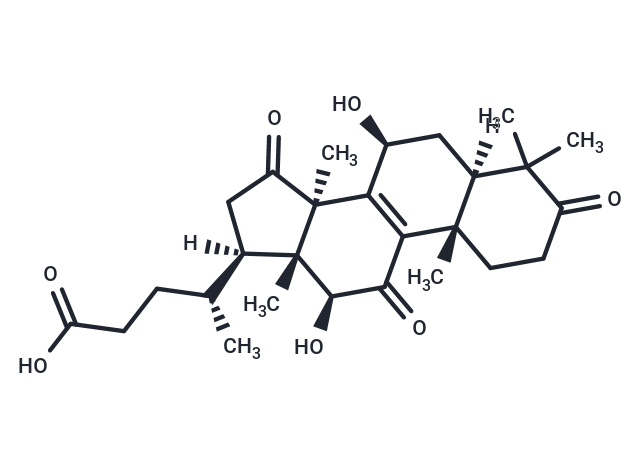
| Pack Size | Price | USA Stock | Global Stock | Quantity |
|---|---|---|---|---|
| 1 mg | $163 | - | In Stock |
| Description | Lucidenic acid B (Lucidenicacid B), a natural compound extracted from Ganoderma lucidum, induces activation of caspase-9 and caspase-3 and cleavage of PARP, which can induce apoptosis in human leukemia cells through mitochondrial mediation. Lucidenic acid B inhibits PMA-induced invasion of human hepatocellular carcinoma cells by inactivating the MAPK/ERK signaling pathway and decreasing the binding activity of NF-kappaB and AP-1. Lucidenic acid B had no effect on cell cycle and necrotic cells. |
| In vitro | The effect of Lucidenic acids (A, B, C, and N) isolated from a new G. lucidum (YK-02) on the induction of cell apoptosis and the apoptotic pathway in HL-60 cells was investigated. The results demonstrated that Lucidenic acid B (LAB) did not affect the cell cycle profile; however, it increased the number of early and late apoptotic cells but not necrotic cells. Treatment of HL-60 cells with LAB caused loss of mitochondria membrane potential. Moreover, the ratio of expression levels of pro- and antiapoptotic Bcl-2 family members was changed by LAB treatment. LAB-induced apoptosis involved the release of mitochondria cytochrome c and subsequently induced the activation of caspase-9 and caspase-3, which were followed by cleavage of poly(ADP-ribose) polymerase (PARP).[1] |
| Synonyms | Lucidenicacid B |
| Molecular Weight | 474.59 |
| Formula | C27H38O7 |
| Cas No. | 95311-95-8 |
| Smiles | C[C@]12C3=C([C@]4(C)[C@@](C[C@@H]3O)(C(C)(C)C(=O)CC4)[H])C(=O)[C@@H](O)[C@]1(C)[C@@]([C@@H](CCC(O)=O)C)(CC2=O)[H] |
| Relative Density. | 1.27 g/cm3 (Predicted) |
| Storage | Store at low temperature Powder: -20°C for 3 years | In solvent: -80°C for 1 year Shipping with blue ice/Shipping at ambient temperature. |
 For example, if the intended dosage is 10 mg/kg for animals weighing 20 g , with a dosing volume of 100 μL per animal, and a total of 10 animals are to be administered, using a formulation of
  10% DMSO+ 40% PEG300+ 5% Tween 80+ 45% Saline/PBS/ddH2O , the resulting working solution concentration would be 2 mg/mL.
Dissolve 2 mg of the compound in 100 μL DMSO to obtain a stock solution at a concentration of 20 mg/mL . If the required concentration exceeds the compound's known solubility, please contact us for technical support before proceeding.
1) Add 100 μL of the DMSO stock solution to 400 µL PEG300 and mix thoroughly until the solution becomes clear.
2) Add 50 µL Tween 80 and mix well until fully clarified.
3) Add 450 µL Saline,PBS or ddH2O and mix thoroughly until a homogeneous solution is obtained.
| Size | Quantity | Unit Price | Amount | Operation |
|---|
 Feedback
 Hello! How can I help you today?
Copyright © 2015-2026 TargetMol Chemicals Inc. All Rights Reserved.
