


Shopping Cart
Remove All Your shopping cart is currently empty


Synonyms: LSN-3318839, LSN 3318839
| Pack Size | Price | USA Stock | Global Stock | Quantity |
|---|---|---|---|---|
| 1 mg | $213 | In Stock | In Stock | |
| 5 mg | $538 | In Stock | In Stock | |
| 10 mg | $777 | In Stock | In Stock | |
| 25 mg | $1,180 | In Stock | In Stock | |
| 50 mg | $1,590 | In Stock | In Stock | |
| 100 mg | $2,170 | In Stock | In Stock |

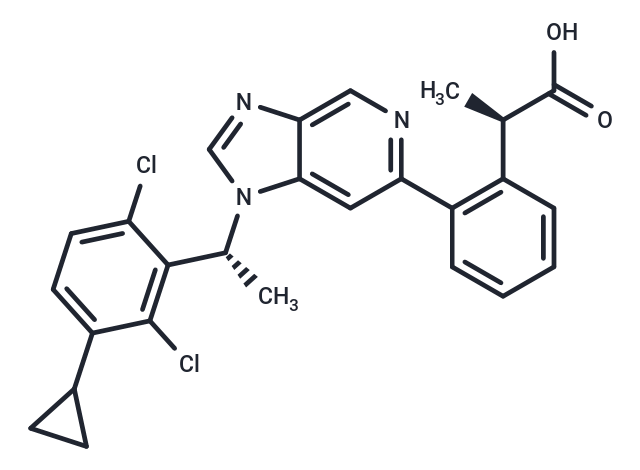
| Description | LSN3318839 is a small-molecule compound and a positive allosteric modulator of the glucagon-like peptide-1 receptor (GLP-1R), featuring oral activity and selective enhancement of G protein-coupled signaling, which promotes glucose-dependent insulin secretion for blood glucose reduction. |
| In vitro | Methods: The broth microdilution method was used to detect the in vitro antibacterial activity of LSN3318839. Strains including Staphylococcus aureus, MRSA, Streptococcus pneumoniae, and Haemophilus influenzae were selected. Serial concentration gradients were set, and MIC was determined after incubation at 37°C for 18–24 h. Results: LSN3318839 showed strong inhibitory effects against Gram-positive bacteria and some Gram-negative bacteria, with low MIC values against MRSA and significant concentration-dependent bactericidal effects. [1] Methods: The MTT assay was used to detect the in vitro antitumor activity of LSN3318839. Tumor cells HCT116, MCF7, HepG2, and A549, as well as normal cells L02 and HUVEC, were selected. Concentrations of 0–50 μM were set, and cells were incubated at 37°C with 5% CO₂ for 48 h. Results: LSN3318839 showed the strongest inhibitory effect against A549 cells, with an IC₅₀ of 5.4 μM. It elevated ROS levels, induced S-phase arrest, and activated the mitochondrial apoptosis pathway, with low toxicity to normal cells. [2] |
| In vivo | Methods: A C57BL/6 mouse LPS-induced systemic inflammation model was used. LSN3318839 was administered by oral gavage at doses of 50 and 100 mg/kg as a single dose, followed by intraperitoneal LPS injection 1 hour later to establish the model. The vehicle was conventional pharmaceutical excipients, with a vehicle control group and CA 4948 positive control group established. Results: LSN3318839 significantly reduced serum TNF-α levels in mice, with the 100 mg/kg dose showing efficacy comparable to the positive control drug, demonstrating definite in vivo anti-inflammatory activity and rapid oral onset. [3] |
| Synonyms | LSN-3318839, LSN 3318839 |
| Molecular Weight | 480.39 |
| Formula | C26H23Cl2N3O2 |
| Cas No. | 2764704-18-7 |
| Smiles | [C@H](C)(N1C=2C(N=C1)=CN=C(C2)C3=C([C@H](C(O)=O)C)C=CC=C3)C4=C(Cl)C(=CC=C4Cl)C5CC5 |
| Storage | Powder: -20°C for 3 years | In solvent: -80°C for 1 year Shipping with blue ice/Shipping at ambient temperature. | |||||||||||||||||||||||||||||||||||
| Solubility Information | DMSO: 255 mg/mL (530.82 mM), Sonication is recommended.  | |||||||||||||||||||||||||||||||||||
Solution Preparation Table | ||||||||||||||||||||||||||||||||||||
DMSO
Note : The dilution table applies only to solid products. For liquid products, please calculate the stock solution based on the stated concentration and/or density. | ||||||||||||||||||||||||||||||||||||
 For example, if the intended dosage is 10 mg/kg for animals weighing 20 g , with a dosing volume of 100 μL per animal, and a total of 10 animals are to be administered, using a formulation of
  10% DMSO+ 40% PEG300+ 5% Tween 80+ 45% Saline/PBS/ddH2O , the resulting working solution concentration would be 2 mg/mL.
Dissolve 2 mg of the compound in 100 μL DMSO to obtain a stock solution at a concentration of 20 mg/mL . If the required concentration exceeds the compound's known solubility, please contact us for technical support before proceeding.
1) Add 100 μL of the DMSO stock solution to 400 µL PEG300 and mix thoroughly until the solution becomes clear.
2) Add 50 µL Tween 80 and mix well until fully clarified.
3) Add 450 µL Saline,PBS or ddH2O and mix thoroughly until a homogeneous solution is obtained.
| Size | Quantity | Unit Price | Amount | Operation |
|---|
 Feedback
 Hello! How can I help you today?
Copyright © 2015-2026 TargetMol Chemicals Inc. All Rights Reserved.
