


Shopping Cart
Remove All Your shopping cart is currently empty


Synonyms: JTC801, JTC 801
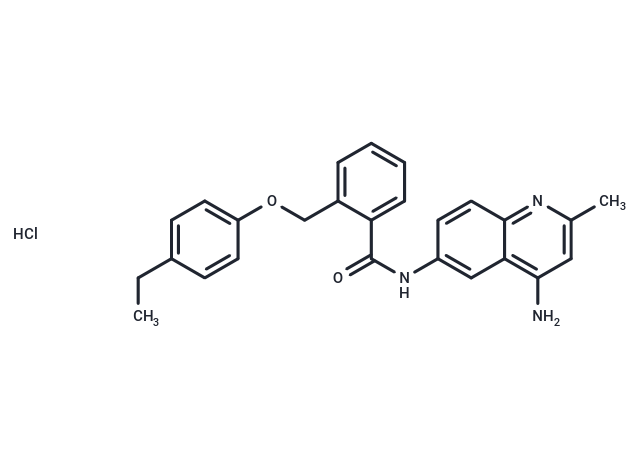
| Pack Size | Price | USA Stock | Global Stock | Quantity |
|---|---|---|---|---|
| 5 mg | $41 | In Stock | In Stock | |
| 10 mg | $66 | In Stock | In Stock | |
| 25 mg | $144 | In Stock | In Stock | |
| 1 mL x 10 mM (in DMSO) | $44 | In Stock | In Stock |
| Description | JTC-801 is a selective opioid receptor-like 1 (ORL1) receptor antagonist with an IC50 of 94 nM and weak inhibitory effects on δ, κ, and μ receptors. |
| Targets & IC50 | ORL1:94 nM |
| In vitro | JTC-801 displays about 12.5-, 129-, and 1055-fold selectivity for ORL1 receptor (Ki = 8.2 nM) over μ-, κ-, and δ-opioid receptors, respectively. JTC-801 does not inhibit forskolin-stimulated cyclic AMP accumulation in human ORL1 receptor-expressing HeLa cells, but it prevents nociceptin-induced inhibition of cyclic AMP accumulation, indicating that JTC-801 possesses full antagonistic activity. [2] In rat cerebrocortical membrane, JTC-801 inhibits ORL1 receptor with IC50 of 472 nM and μ-receptor with IC50 of 1831 nM. JTC-801 completely antagonizes the suppression of nociceptin on forskolin-induced accumulation of cyclic AMP with IC50 of 2.58 μM in HeLa cells expressing ORL1 receptor. [1] |
| In vivo | Oral administration of JTC-801 (0.3-3 mg/kg) antagonizes nociceptin-induced allodynia in mice, and shows analgesic effect in a hot plate test using mice and in a formalin test using rats. [2] In mouse hot-plate test, JTC-801 prolongs escape response latency (ERL) or exposed heat stimulus with minimum effective doses (MED) of 0.01 mg/kg by i.v. or 1 mg/kg by p.o. In the rat formalin test, JTC-801 reduces both the first and second phases of the nociceptive response with MED of 0.01 mg/kg71 by i.v. or 1 mg/kg by p.o. [1] JTC-801 dose-dependently normalizes paw withdrawal latency (PWL). Although JTC-801 does not inhibit a chronic constriction injury (CCI)-induced decrease in bone mineral content (BMC) and bone mineral density (BMD), it inhibits an increase in the number of osteoclasts. [3] Tactile allodynia induced by L5/L6 spinal nerve ligation is reversed by both systemic (3-30 mg/kg) and spinal (22.5 and 45 pg) JTC-801 in a dose-dependent manner. Furthermore, systemic JTC-801 reduces Fos-like immunoreactivity in the dorsal horn of the spinal cord (laminae I/II). [4] JTC-801 produces dose-dependent mechanical and cold anti-allodynic effects with ED50 of 0.83 mg/kg and 1.02 mg/kg, respectively. [6] |
| Synonyms | JTC801, JTC 801 |
| Kinase Assay | A suspension of membranes from human μ-opioid receptor-expressing CHO-K1 cells in 50 mM Tris-HCl buffer (pH 7.4) containing 5 mM MgCl2 and 10% sucrose is incubated at room temperature for 2.5 h with 0.33 nM 3H-labeled diprenorphine and various concentrations of JTC-801. The membranes are collected by filtration using Whatman 934-AH, and radioactivity is counted with a TopCount A9912V scintillation counter. Nonspecific binding (6.4%) is determined with 10 μM naloxone. Specific binding is calculated by subtracting nonspecific binding from the total binding. Data are the mean±SE (n=3). |
| Molecular Weight | 447.96 |
| Formula | C26H25N3O2·HCl |
| Cas No. | 244218-51-7 |
| Smiles | Cl.CCc1ccc(OCc2ccccc2C(=O)Nc2ccc3nc(C)cc(N)c3c2)cc1 |
| Relative Density. | no data available |
| Storage | Powder: -20°C for 3 years | In solvent: -80°C for 1 year Shipping with blue ice/Shipping at ambient temperature. | ||||||||||||||||||||||||||||||||||||||||
| Solubility Information | DMSO: 44.8 mg/mL (100.01 mM), Sonication is recommended. Ethanol: 9 mg/mL (20.09 mM), Sonication is recommended. | ||||||||||||||||||||||||||||||||||||||||
| In Vivo Formulation | 10% DMSO+40% PEG300+5% Tween 80+45% Saline: 2 mg/mL (4.46 mM), Sonication is recommended. Please add the solvents sequentially, clarifying the solution as much as possible before adding the next one. Dissolve by heating and/or sonication if necessary. Working solution is recommended to be prepared and used immediately. The formulation provided above is for reference purposes only. In vivo formulations may vary and should be modified based on specific experimental conditions. | ||||||||||||||||||||||||||||||||||||||||
Solution Preparation Table | |||||||||||||||||||||||||||||||||||||||||
Ethanol/DMSO
DMSO
Note : The dilution table applies only to solid products. For liquid products, please calculate the stock solution based on the stated concentration and/or density. | |||||||||||||||||||||||||||||||||||||||||
 For example, if the intended dosage is 10 mg/kg for animals weighing 20 g , with a dosing volume of 100 μL per animal, and a total of 10 animals are to be administered, using a formulation of
  10% DMSO+ 40% PEG300+ 5% Tween 80+ 45% Saline/PBS/ddH2O , the resulting working solution concentration would be 2 mg/mL.
Dissolve 2 mg of the compound in 100 μL DMSO to obtain a stock solution at a concentration of 20 mg/mL . If the required concentration exceeds the compound's known solubility, please contact us for technical support before proceeding.
1) Add 100 μL of the DMSO stock solution to 400 µL PEG300 and mix thoroughly until the solution becomes clear.
2) Add 50 µL Tween 80 and mix well until fully clarified.
3) Add 450 µL Saline,PBS or ddH2O and mix thoroughly until a homogeneous solution is obtained.
| Size | Quantity | Unit Price | Amount | Operation |
|---|
 Feedback
 Hello! How can I help you today?
Copyright © 2015-2026 TargetMol Chemicals Inc. All Rights Reserved.
