


Shopping Cart
Remove All Your shopping cart is currently empty


Synonyms: HOE 33342, bisBenzimide H 33342
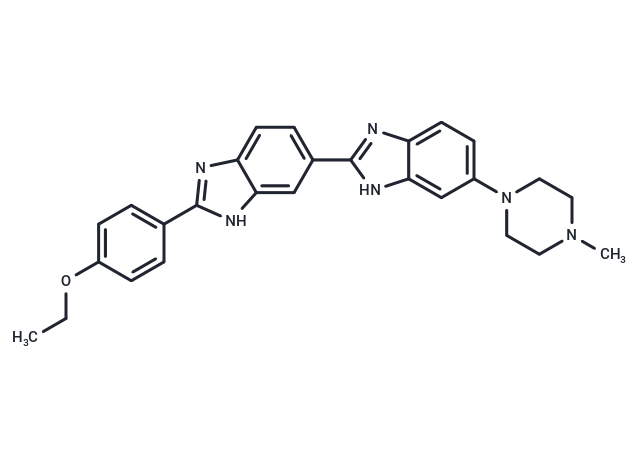
| Pack Size | Price | USA Stock | Global Stock | Quantity |
|---|---|---|---|---|
| 10 mg | $30 | In Stock | In Stock | |
| 25 mg | $46 | In Stock | In Stock | |
| 50 mg | $65 | In Stock | In Stock | |
| 100 mg | $92 | In Stock | In Stock | |
| 1 mL x 10 mM (in DMSO) | $30 | In Stock | In Stock |

| Description | Hoechst 33342 (bisBenzimide H 33342) is a lipophilic fluorescent dye belonging to the bisbenzimidazole class and a cell-permeable fluorescent DNA dye. Hoechst 33342 can penetrate the membranes of living cells to achieve non-invasive staining of live cell nuclei, exhibiting excellent fluorescence properties and extremely low cytotoxicity. |
| Targets & IC50 | HEK293 cells:18 μM, HeLa cells:0.3 μM, A549 cells:0.98 μg/mL, U-87MG cells ATCC:4.2 μM, MCF-7 cells:0.5 μM, BEAS-2B cells:1.95 μg/mL, DU-145 cells:4.25 μM |
| In vitro | Methods: In vitro cultures of dorsal root ganglia (DRG) from Sprague Dawley rats on embryonic day 16 were fixed with 4% paraformaldehyde at room temperature for 15 minutes. Hoechst 33342, PBS diluted 1:100, incubated at room temperature in the dark for 30 minutes, and observed under a fluorescence microscope (DAPI filter: 335-383/420-470 nm). Results: H33342 not only clearly labeled cell nuclei but also distinctly labeled DRG neurites with an excellent signal-to-noise ratio.[1] |
| Synonyms | HOE 33342, bisBenzimide H 33342 |
| Molecular Weight | 452.55 |
| Formula | C27H28N6O |
| Cas No. | 23491-52-3 |
| Smiles | CCOc1ccc(cc1)-c1nc2ccc(cc2[nH]1)-c1nc2ccc(cc2[nH]1)N1CCN(C)CC1 |
| Relative Density. | 1.274 g/cm3 (Predicted) |
| Storage | Keep away from direct sunlight Powder: -20°C for 3 years | In solvent: -80°C for 1 year Shipping with blue ice/Shipping at ambient temperature. | ||||||||||||||||||||||||||||||
| Solubility Information | DMSO: 41.7 mg/mL (92.14 mM), Sonication is recommended.  | ||||||||||||||||||||||||||||||
| In Vivo Formulation | 10% DMSO+40% PEG300+5% Tween-80+45% Saline: 0.5 mg/mL (1.1 mM), Sonication is recommended. Please add the solvents sequentially, clarifying the solution as much as possible before adding the next one. Dissolve by heating and/or sonication if necessary. Working solution is recommended to be prepared and used immediately. The formulation provided above is for reference purposes only. In vivo formulations may vary and should be modified based on specific experimental conditions. | ||||||||||||||||||||||||||||||
Solution Preparation Table | |||||||||||||||||||||||||||||||
DMSO
Note : The dilution table applies only to solid products. For liquid products, please calculate the stock solution based on the stated concentration and/or density. | |||||||||||||||||||||||||||||||
 For example, if the intended dosage is 10 mg/kg for animals weighing 20 g , with a dosing volume of 100 μL per animal, and a total of 10 animals are to be administered, using a formulation of
  10% DMSO+ 40% PEG300+ 5% Tween 80+ 45% Saline/PBS/ddH2O , the resulting working solution concentration would be 2 mg/mL.
Dissolve 2 mg of the compound in 100 μL DMSO to obtain a stock solution at a concentration of 20 mg/mL . If the required concentration exceeds the compound's known solubility, please contact us for technical support before proceeding.
1) Add 100 μL of the DMSO stock solution to 400 µL PEG300 and mix thoroughly until the solution becomes clear.
2) Add 50 µL Tween 80 and mix well until fully clarified.
3) Add 450 µL Saline,PBS or ddH2O and mix thoroughly until a homogeneous solution is obtained.
| Size | Quantity | Unit Price | Amount | Operation |
|---|
 Feedback
 Hello! How can I help you today?
Copyright © 2015-2026 TargetMol Chemicals Inc. All Rights Reserved.
