


Shopping Cart
Remove All Your shopping cart is currently empty

Synonyms: GSK2140944, GSK 2140944
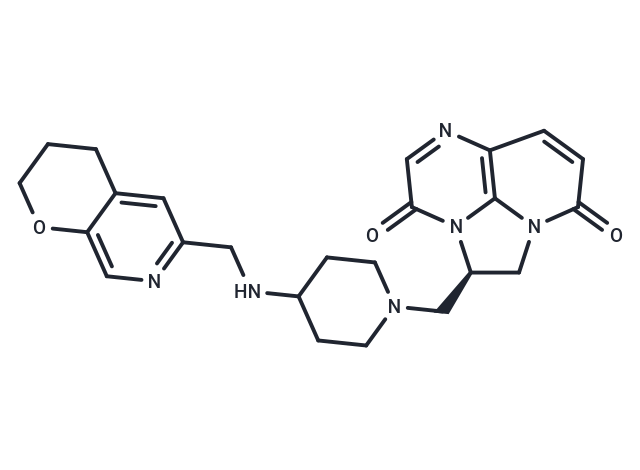
| Pack Size | Price | USA Stock | Global Stock | Quantity |
|---|---|---|---|---|
| 1 mg | $108 | In Stock | In Stock | |
| 2 mg | $177 | In Stock | In Stock | |
| 5 mg | $346 | In Stock | In Stock | |
| 10 mg | $596 | In Stock | In Stock | |
| 25 mg | $1,190 | In Stock | In Stock | |
| 50 mg | $1,830 | In Stock | In Stock | |
| 100 mg | $2,630 | - | In Stock | |
| 1 mL x 10 mM (in DMSO) | $342 | In Stock | In Stock |
| Description | Gepotidacin is a triazaacenaphthylene inhibitor of bacterial type II topoisomerase that, while targeting similar enzymes as fluoroquinolones, is structurally distinct and expected to have a lower potential for resistance development, serving as a novel antibacterial agent. |
| In vitro | Gepotidacin has in vitro activity against causative pathogens of acute bacterial skin and skin structure infections (ABSSSIs) [3]. Gepotidacin inhibits bacterial DNA gyrase and topoisomerase IV via a unique mechanism and has demonstrated in vitro activity against gram-negative and gram-positive bacteria, including drug-resistant strains. It also targets pathogens associated with other conventional and biothreat infections. The MIC50 and MIC90 for gepotidacin against the 25 N. gonorrhoeae isolates tested are 0.12 and 0.25 μg/mL, respectively [1]. The gepotidacin MIC90s are as follows: Streptococcus pyogenes (0.25 μg/mL), Escherichia coli (2 μg/mL), Moraxella catarrhalis (≤0.06 μg/mL), Streptococcus pneumoniae (0.25 μg/mL), Haemophilus influenzae (1 μg/mL), Clostridium perfringens (0.5 μg/mL), and Shigella spp. (1 μg/mL) [2]. |
| In vivo | For six methicillin-resistant Staphylococcus vitis vinifera (MRSA) isolates, the minimum inhibitory concentration (MIC) of Gepotidacin ranged between 0.125~0.5 mg/L. The alveolar epithelial lining fluid (ELF) penetration ratio of this drug was 1.1~1.4. In a neutropenic murine model, the maximum bacterial clearance effect reached 1.1~3.1 log10 CFU. The mean free drug area under the curve to minimum inhibitory concentration ratios (fAUC/MIC) required to achieve bacterial growth stasis and a 1-log reduction were 59.3 ± 34.6 and 148.4 ± 83.3, respectively [4]. |
| Synonyms | GSK2140944, GSK 2140944 |
| Molecular Weight | 448.52 |
| Formula | C24H28N6O3 |
| Cas No. | 1075236-89-3 |
| Smiles | C([C@H]1N2C=3N(C1)C(=O)C=CC3N=CC2=O)N4CCC(NCC=5C=C6C(=CN5)OCCC6)CC4 |
| Relative Density. | 1.52 g/cm3 (Predicted) |
| Storage | Store at low temperature Powder: -20°C for 3 years | In solvent: -80°C for 1 year Shipping with blue ice/Shipping at ambient temperature. | ||||||||||||||||||||
| Solubility Information | DMSO: 5.5 mg/mL (12.26 mM), Sonication is recommended. | ||||||||||||||||||||
Solution Preparation Table | |||||||||||||||||||||
DMSO
Note : The dilution table applies only to solid products. For liquid products, please calculate the stock solution based on the stated concentration and/or density. | |||||||||||||||||||||
 For example, if the intended dosage is 10 mg/kg for animals weighing 20 g , with a dosing volume of 100 μL per animal, and a total of 10 animals are to be administered, using a formulation of
  10% DMSO+ 40% PEG300+ 5% Tween 80+ 45% Saline/PBS/ddH2O , the resulting working solution concentration would be 2 mg/mL.
Dissolve 2 mg of the compound in 100 μL DMSO to obtain a stock solution at a concentration of 20 mg/mL . If the required concentration exceeds the compound's known solubility, please contact us for technical support before proceeding.
1) Add 100 μL of the DMSO stock solution to 400 µL PEG300 and mix thoroughly until the solution becomes clear.
2) Add 50 µL Tween 80 and mix well until fully clarified.
3) Add 450 µL Saline,PBS or ddH2O and mix thoroughly until a homogeneous solution is obtained.
| Size | Quantity | Unit Price | Amount | Operation |
|---|
 Feedback
 Hello! How can I help you today?
Copyright © 2015-2026 TargetMol Chemicals Inc. All Rights Reserved.
