


Shopping Cart
Remove All Your shopping cart is currently empty

Synonyms:
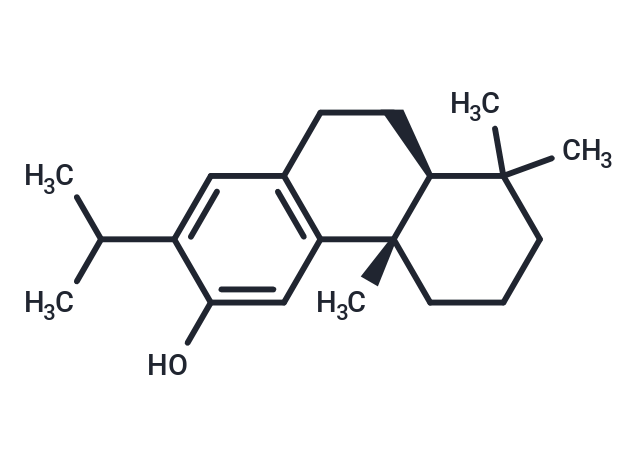
| Pack Size | Price | USA Stock | Global Stock | Quantity |
|---|---|---|---|---|
| 5 mg | $1,400 | Inquiry | Inquiry |
| Description | Ferruginol has anti-plasmodial, leishmanicidal, anti-ulcerogenic, cardioprotective, anticancer, anti-oxidative and anti-inflammatory activities, it can induce apoptosis in non-small cell lung cancer (NSCLC) cells. |
| In vitro | The radial accumulation pattern of Ferruginol was examined from sapwood and through the intermediate wood to the heartwood by direct mapping using time-of-flight secondary ion mass spectrometry (TOF-SIMS). The data were compared with quantitative results obtained from a novel method of gas chromatography analysis using laser microdissection sampling and with water distribution obtained from cryo-scanning electron microscopy. Ferruginol initially accumulated in the middle of the intermediate wood, in the earlywood near the annual ring boundary. It accumulated throughout the entire earlywood in the inner intermediate wood, and in both the earlywood and the latewood in the heartwood. The process of Ferruginol accumulation continued for more than eight annual rings. Ferruginol concentration peaked at the border between the intermediate wood and heartwood, while the concentration was less in the latewood compared with the earlywood in each annual ring. Ferruginol tended to accumulate around the ray parenchyma cells. In addition, at the border between the intermediate wood and heartwood, the accumulation was higher in areas without water than in areas with water[1] |
| Molecular Weight | 286.459 |
| Formula | C20H30O |
| Cas No. | 514-62-5 |
| Smiles | CC(C)c1cc2CC[C@H]3C(C)(C)CCC[C@]3(C)c2cc1O |
| Relative Density. | 0.988 g/cm3 at 20℃ |
| Storage | Powder: -20°C for 3 years | In solvent: -80°C for 1 year Shipping with blue ice/Shipping at ambient temperature. |
 For example, if the intended dosage is 10 mg/kg for animals weighing 20 g , with a dosing volume of 100 μL per animal, and a total of 10 animals are to be administered, using a formulation of
  10% DMSO+ 40% PEG300+ 5% Tween 80+ 45% Saline/PBS/ddH2O , the resulting working solution concentration would be 2 mg/mL.
Dissolve 2 mg of the compound in 100 μL DMSO to obtain a stock solution at a concentration of 20 mg/mL . If the required concentration exceeds the compound's known solubility, please contact us for technical support before proceeding.
1) Add 100 μL of the DMSO stock solution to 400 µL PEG300 and mix thoroughly until the solution becomes clear.
2) Add 50 µL Tween 80 and mix well until fully clarified.
3) Add 450 µL Saline,PBS or ddH2O and mix thoroughly until a homogeneous solution is obtained.
| Size | Quantity | Unit Price | Amount | Operation |
|---|
 Feedback
 Hello! How can I help you today?
Copyright © 2015-2026 TargetMol Chemicals Inc. All Rights Reserved.
