


Shopping Cart
Remove All Your shopping cart is currently empty


Synonyms: SSR97193, Ferrochloroquine
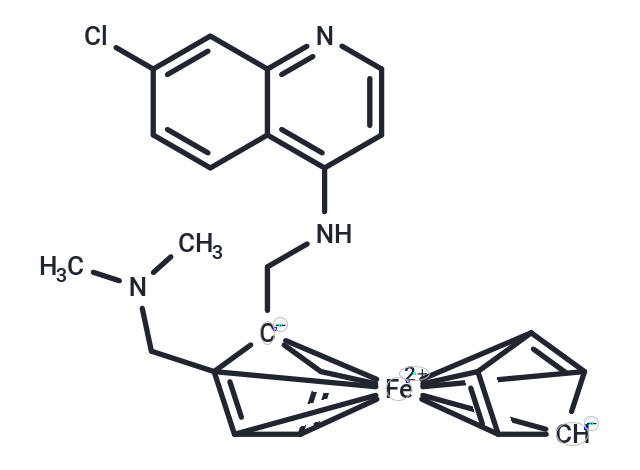

| Pack Size | Price | USA Stock | Global Stock | Quantity |
|---|---|---|---|---|
| 10 mg | $41 | In Stock | In Stock | |
| 25 mg | $83 | In Stock | In Stock | |
| 50 mg | $139 | In Stock | In Stock | |
| 100 mg | $208 | In Stock | In Stock | |
| 1 mL x 10 mM (in DMSO) | $30 | In Stock | In Stock |
| Description | Ferroquine (Ferrochloroquine) is a ferrocenyl analogue of Chloroquine with antimalarial activity. Ferroquine induces oxidative stress and the subsequent destruction of the membrane, resulting in parasiticidal effect on Plasmodium. |
| In vitro | All newly transformed schistosomula (NTS) exposed to 33.3 µM hydroxyl-ferroquine (FQ-OH), Ferroquine (FQ), and Ruthenoquine (RQ) displays strongly decrease liabilities, after 24 hours post-incubation. All NTS exposed to 33.3 µM RQ have died, while Ferroquine and FQ-OH treated worms are strongly affected but still alive, after 72 hours post-incubation [1]. |
| In vivo | Ferroquine (200 and 800 mg/kg; mice ) treatment, displays low total worm burden reductions of 19.4% and 35.6%. One of the mice treated with 800 mg/kg Ferroquine died within 24 hours post-treatment. No activity is observed treating mice with Ruthenoquine at 200 mg/kg. Hence, modification of Chloroquine (CQ) by a ferrocenyl or ruthenocenyl fragment does not increase the antischistosomal properties of CQ. A total worm burden reduction of 17.3% is observed following treatment with hydroxyl-ferroquine. Furthermore, in one of the hydroxyl-ferroquine treated mice many dead worms are recovered and a hepatic shift (i.e. worms migrating to the liver) observed. Hence, Ferroquine and hydroxyl-ferroquine show weak antischistosomal activity in vivo[1]. |
| Synonyms | SSR97193, Ferrochloroquine |
| Molecular Weight | 433.76 |
| Formula | C23H24ClFeN3 |
| Cas No. | 185055-67-8 |
| Smiles | ClC1=CC2=NC=CC(NC[C-]34[CH]5=[CH]6[CH]7=C3([Fe+2]675489%10%11[CH]%12=[CH]8[CH-]9[CH]%10=[CH]%12%11)CN(C)C)=C2C=C1 |
| Relative Density. | no data available |
| Storage | Powder: -20°C for 3 years | In solvent: -80°C for 1 year Shipping with blue ice/Shipping at ambient temperature. | ||||||||||||||||||||
| Solubility Information | DMSO: 7.5 mg/mL (17.29 mM), Sonication is recommended. | ||||||||||||||||||||
Solution Preparation Table | |||||||||||||||||||||
DMSO
Note : The dilution table applies only to solid products. For liquid products, please calculate the stock solution based on the stated concentration and/or density. | |||||||||||||||||||||
 For example, if the intended dosage is 10 mg/kg for animals weighing 20 g , with a dosing volume of 100 μL per animal, and a total of 10 animals are to be administered, using a formulation of
  10% DMSO+ 40% PEG300+ 5% Tween 80+ 45% Saline/PBS/ddH2O , the resulting working solution concentration would be 2 mg/mL.
Dissolve 2 mg of the compound in 100 μL DMSO to obtain a stock solution at a concentration of 20 mg/mL . If the required concentration exceeds the compound's known solubility, please contact us for technical support before proceeding.
1) Add 100 μL of the DMSO stock solution to 400 µL PEG300 and mix thoroughly until the solution becomes clear.
2) Add 50 µL Tween 80 and mix well until fully clarified.
3) Add 450 µL Saline,PBS or ddH2O and mix thoroughly until a homogeneous solution is obtained.
| Size | Quantity | Unit Price | Amount | Operation |
|---|
 Feedback
 Hello! How can I help you today?
Copyright © 2015-2026 TargetMol Chemicals Inc. All Rights Reserved.
