


Shopping Cart
Remove All Your shopping cart is currently empty


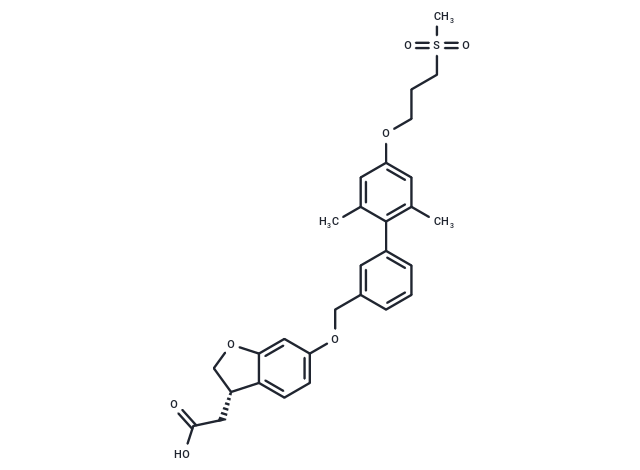
Synonyms: TAK875
| Pack Size | Price | USA Stock | Global Stock | Quantity |
|---|---|---|---|---|
| 1 mg | $44 | In Stock | In Stock | |
| 5 mg | $97 | In Stock | In Stock | |
| 10 mg | $152 | In Stock | In Stock | |
| 25 mg | $263 | In Stock | In Stock | |
| 50 mg | $396 | In Stock | In Stock | |
| 100 mg | $579 | In Stock | In Stock | |
| 200 mg | $793 | In Stock | In Stock | |
| 1 mL x 10 mM (in DMSO) | $125 | In Stock | In Stock |
| Description | Fasiglifam (TAK875) is a potent, selective and orally bioavailable GPR40 agonist. |
| Targets & IC50 | FFA1/GPR40:72 nM.(EC50) |
| In vitro | Fasiglifam(0.01-10 μM) produces a concentration-dependent increase in intracellular IP production in CHO-hGPR40, with EC50 of 0.072 μM.Fasiglifam(0.1-10 μM) dose-dependently augments intracellular IP production in CHO cells[1]. Fasiglifam(3-30 μM) concentration-dependently augments [Ca2+]i. In the presence of 10 mM glucose, Fasiglifam(0.001-10 μM) dose-dependently stimulats insulin secretion from INS-1 833/15 cells[2]. |
| In vivo | Fasiglifam(10 mg/kg, p.o.) increases plasma insulin levels in ZDF rats. Fasiglifam(30 mg/kg, p.o.) improves fasting hyperglycemia without affecting fasting normoglycemia. Fasiglifamat 30 mg/kg, which is a 3- to 10-fold higher dose compared with the dose that improved glucose tolerance in diabetic rats, does not alter fasting glucose levels in SD rats with normal glucose homeostasis. Likewise, Fasiglifamdoes not significantly alter insulin secretion in SD rats with normal fasting glucose levels [1]. |
| Synonyms | TAK875 |
| Kinase Assay | INS-1 832/13 cells are suspended in RPMI medium containing 11 mM glucose and the supplements described above. These cells are seeded at a density of 2×10⁴?cells/well in a 96-well black plate coated with poly-D-lysine, and 1% BSA and 0.1% DMSO alone (control), palmitic acid (62.5, 125, 250, 500, and 1000 μM), oleic acid (62.5, 125, 250, 500, and 1000 μM), or TAK-875 (6.25, 12.5, 25, 50, and 100 μM) is added to the plate with 1% BSA and 0.1% DMSO, followed by culture for 72 h. After the culture, caspase 3/7 activity is measured with the Apo-one homogeneous caspase 3/7 assay according to the manufacturer's instructions. Fluorescence intensity is measured at an excitation of 485 nm and an emission at 535 nm. |
| Cell Research | TAK-875 is dissolved in 1% BSA and 0.1% DMSO.? INS-1 832/13 cells are suspended in RPMI medium and seeded in a 96-well plate at a density of 2×10⁴ cells/well; 1% BSA and 0.1% DMSO alone (control), palmitic acid (10, 100, and 1000 μM), oleic acid (10, 100, and 1000 μM), or TAK-875 (1, 10, and 100 μM) is added to the plate. After 72-h culture, medium is discarded, and cells are preincubated for 2 h with KRBH containing 1 mM glucose and 0.2% BSA at 37°C. After discarding of the preincubation buffer, KRBH containing 1 or 20 mM glucose and 0.2% BSA is added, and the plate is further incubated for 2 h. The insulin concentration in the supernatant is measured as described above. To measure intracellular insulin content, INS-1 832/13 cells are exposed to 1% BSA and 0.1% DMSO alone (control), palmitic acid (1000 μM), oleic acid (1000 μM), or TAK-875 (100 μM) with 1% BSA and 0.1% DMSO. After incubation, cells are washed once with phosphate-buffered saline, and acid-ethanol solution is added to each well, followed by sonication on ice. Intracellular insulin is extracted by overnight incubation at ?30°C, followed by separation of supernatant by centrifugation at 12,000 rpm×5 min at 4°C. |
| Molecular Weight | 524.63 |
| Formula | C29H32O7S |
| Cas No. | 1000413-72-8 |
| Smiles | Cc1cc(OCCCS(C)(=O)=O)cc(C)c1-c1cccc(COc2ccc3[C@H](CC(O)=O)COc3c2)c1 |
| Relative Density. | 1.252 g/cm3 |
| Storage | Powder: -20°C for 3 years | In solvent: -80°C for 1 year Shipping with blue ice/Shipping at ambient temperature. | |||||||||||||||||||||||||||||||||||
| Solubility Information | DMSO: 150 mg/mL (285.92 mM), Sonication is recommended.  | |||||||||||||||||||||||||||||||||||
| In Vivo Formulation | 10% DMSO+40% PEG300+5% Tween 80+45% Saline: 2 mg/mL (3.81 mM), Sonication is recommended. 10% DMSO+90% Saline: 10 mg/mL (19.06 mM), Suspension. Please add the solvents sequentially, clarifying the solution as much as possible before adding the next one. Dissolve by heating and/or sonication if necessary. Working solution is recommended to be prepared and used immediately. The formulation provided above is for reference purposes only. In vivo formulations may vary and should be modified based on specific experimental conditions. | |||||||||||||||||||||||||||||||||||
Solution Preparation Table | ||||||||||||||||||||||||||||||||||||
DMSO
Note : The dilution table applies only to solid products. For liquid products, please calculate the stock solution based on the stated concentration and/or density. | ||||||||||||||||||||||||||||||||||||
 For example, if the intended dosage is 10 mg/kg for animals weighing 20 g , with a dosing volume of 100 μL per animal, and a total of 10 animals are to be administered, using a formulation of
  10% DMSO+ 40% PEG300+ 5% Tween 80+ 45% Saline/PBS/ddH2O , the resulting working solution concentration would be 2 mg/mL.
Dissolve 2 mg of the compound in 100 μL DMSO to obtain a stock solution at a concentration of 20 mg/mL . If the required concentration exceeds the compound's known solubility, please contact us for technical support before proceeding.
1) Add 100 μL of the DMSO stock solution to 400 µL PEG300 and mix thoroughly until the solution becomes clear.
2) Add 50 µL Tween 80 and mix well until fully clarified.
3) Add 450 µL Saline,PBS or ddH2O and mix thoroughly until a homogeneous solution is obtained.
| Size | Quantity | Unit Price | Amount | Operation |
|---|
 Feedback
 Hello! How can I help you today?
Copyright © 2015-2026 TargetMol Chemicals Inc. All Rights Reserved.
