


Shopping Cart
Remove All Your shopping cart is currently empty

Synonyms: RWJ-53308, RWJ53308, RWJ 53308
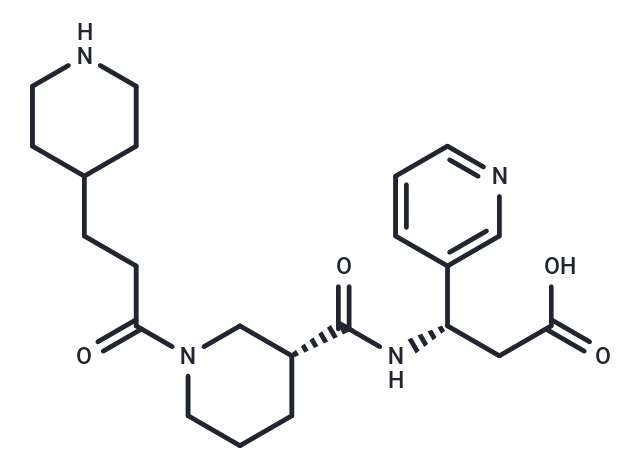
| Pack Size | Price | USA Stock | Global Stock | Quantity |
|---|---|---|---|---|
| 1 mg | $397 | In Stock | In Stock | |
| 5 mg | $970 | In Stock | In Stock | |
| 10 mg | $1,290 | - | In Stock | |
| 25 mg | $1,950 | - | In Stock | |
| 50 mg | $2,620 | - | In Stock | |
| 100 mg | $3,530 | - | In Stock |
| Description | Elarofiban(RWJ-53308) is a novel and orally active GPIIb/IIIa antagonist. |
| In vitro | Elarofiban (RWJ-53308) is a novel nonpeptide glycoprotein IIb/IIIa (GPIIb/IIIa) antagonist that inhibits fibrinogen binding to GPIIb/IIIa with an IC(50) of 0.4+/-0.3 nM. RWJ-53308 inhibits thrombin-induced platelet aggregation in human gel-filtered platelets (IC(50)=60+/-12 nM) and platelet aggregation in human platelet-rich plasma (PRP) in response to collagen, arachidonic acid, ADP, and SFLLRN-NH(2) (IC(50)=60+/-10, 150+/-30, 70+/-4, and 160+/-80 nM, respectively).[4] |
| In vivo | The potency of Elarofiban (RWJ-53308) in dog and guinea pig PRP is similar to human PRP. RWJ-53308 inhibits ex vivo collagen- and ADP-induced platelet aggregation in conscious dogs for up to 4 h following 0.3 mg/kg iv, and through 4 and 6 h following 1 and 3 mg/kg po. Oral bioavailability is 16+/-7%. RWJ-53308 reduces thrombus weight in a canine arteriovenous (AV) shunt model following intravenous (0.01-0.1 mg/kg) and oral (3 mg/kg) administration. In a guinea pig carotid artery pinch-injury model, RWJ-53308 completely suppresses thrombus-induced cyclic flow reductions (CFR) at 0.7 mg/kg iv. RWJ-53308 also blocks thrombus formation in photoactivation- and ferric chloride-induced models of thrombosis in guinea pigs at 0.3 and 1 mg/kg iv, respectively. In summary, RWJ-53308 is a potent orally active GPIIb/IIIa antagonist that may be useful for both acute and chronic treatment of arterial thrombotic disorders.[4] |
| Synonyms | RWJ-53308, RWJ53308, RWJ 53308 |
| Molecular Weight | 416.51 |
| Formula | C22H32N4O4 |
| Cas No. | 198958-88-2 |
| Smiles | [C@H](NC(=O)[C@H]1CN(C(CCC2CCNCC2)=O)CCC1)(CC(O)=O)C=3C=CC=NC3 |
| Relative Density. | 1.203 g/cm3 (Predicted) |
| Storage | Powder: -20°C for 3 years | In solvent: -80°C for 1 year Shipping with blue ice/Shipping at ambient temperature. | |||||||||||||||||||||||||||||||||||
| Solubility Information | DMSO: 60 mg/mL (144.05 mM), Sonication is recommended.  | |||||||||||||||||||||||||||||||||||
Solution Preparation Table | ||||||||||||||||||||||||||||||||||||
DMSO
Note : The dilution table applies only to solid products. For liquid products, please calculate the stock solution based on the stated concentration and/or density. | ||||||||||||||||||||||||||||||||||||
 For example, if the intended dosage is 10 mg/kg for animals weighing 20 g , with a dosing volume of 100 μL per animal, and a total of 10 animals are to be administered, using a formulation of
  10% DMSO+ 40% PEG300+ 5% Tween 80+ 45% Saline/PBS/ddH2O , the resulting working solution concentration would be 2 mg/mL.
Dissolve 2 mg of the compound in 100 μL DMSO to obtain a stock solution at a concentration of 20 mg/mL . If the required concentration exceeds the compound's known solubility, please contact us for technical support before proceeding.
1) Add 100 μL of the DMSO stock solution to 400 µL PEG300 and mix thoroughly until the solution becomes clear.
2) Add 50 µL Tween 80 and mix well until fully clarified.
3) Add 450 µL Saline,PBS or ddH2O and mix thoroughly until a homogeneous solution is obtained.
| Size | Quantity | Unit Price | Amount | Operation |
|---|
 Feedback
 Hello! How can I help you today?
Copyright © 2015-2026 TargetMol Chemicals Inc. All Rights Reserved.
