


Shopping Cart
Remove All Your shopping cart is currently empty

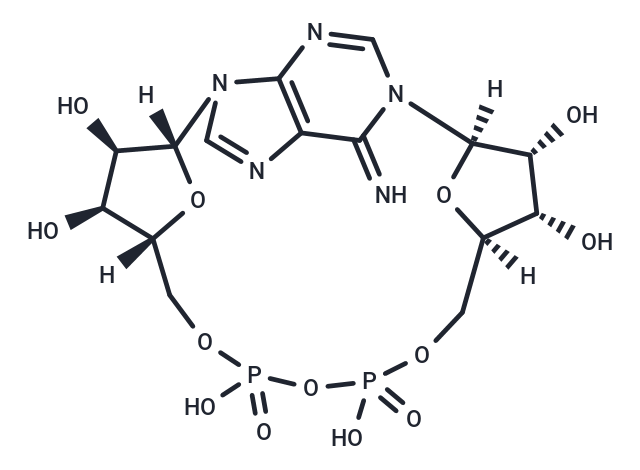
Synonyms: cADPR
| Pack Size | Price | USA Stock | Global Stock | Quantity |
|---|---|---|---|---|
| 500 µg | $1,083 | Inquiry | Inquiry |
| Description | Cyclic ADP-ribose (cADPR) is an effective calcium mobilization second messenger synthesized from NAD+ by ADP-ribosyl cyclase. It mainly increases cytosolic calcium through Ryanodine receptor-mediated endoplasmic reticulum release and extracellular influx via the opening of TRPM2 channels. |
| In vitro | In cells, cyclic ADP ribose (cADPR) plays an important role in the following processes: cell proliferation and differentiation, regulating for example the expansion of mesenchymal stem cells and hematopoietic progenitor cells, neuronal differentiation of PC12 cells and mouse embryonic stem cells Cardiomyocyte differentiation. |
| In vivo | In mammals, cyclic ADP-ribose (cADPR) plays an important role in the following processes: inflammation and immune response, including neutrophil chemotaxis and T cell activation; smooth muscle cell contraction in arteries and bronchial tubes, involved Hypoxic pulmonary vasoconstriction and the pathogenesis of inflammation / allergic airway diseases; myometrial contractility, which ultimately helps delivery; myocardial cell contraction in adult heart tissue, involved in angiotensin II and β-adrenaline Myocardial hypertrophy and arrhythmia caused by isoproterenol; endocrine and exocrine pancreatic secretion; social behavior of mice, including memory formation and spatial learning, are related to oxytocin secretion and may be related to niacin deficiency. In addition, cyclic ADP-ribose (cADPR) is involved in the activation and fertilization of eggs in seaweeds and sea urchins, early development of sea urchins, abscisic acid signaling in sponges and plants, cell fission in dinoflagellates, and pathogenicity of Toxoplasma gondii. |
| Synonyms | cADPR |
| Molecular Weight | 541.3 |
| Formula | C15H21N5O13P2 |
| Cas No. | 119340-53-3 |
| Smiles | O[C@H]1[C@@]2(N3C4=C(N=C3)C(=N)N(C=N4)[C@@]5(O[C@@]([C@@H](O)[C@H]5O)(COP(=O)(O)OP(=O)(O)OC[C@@](O2)([C@H]1O)[H])[H])[H])[H] |
| Relative Density. | 2.57 g/cm3 |
| Storage | Powder: -20°C for 3 years | In solvent: -80°C for 1 year Shipping with blue ice/Shipping at ambient temperature. |
 For example, if the intended dosage is 10 mg/kg for animals weighing 20 g , with a dosing volume of 100 μL per animal, and a total of 10 animals are to be administered, using a formulation of
  10% DMSO+ 40% PEG300+ 5% Tween 80+ 45% Saline/PBS/ddH2O , the resulting working solution concentration would be 2 mg/mL.
Dissolve 2 mg of the compound in 100 μL DMSO to obtain a stock solution at a concentration of 20 mg/mL . If the required concentration exceeds the compound's known solubility, please contact us for technical support before proceeding.
1) Add 100 μL of the DMSO stock solution to 400 µL PEG300 and mix thoroughly until the solution becomes clear.
2) Add 50 µL Tween 80 and mix well until fully clarified.
3) Add 450 µL Saline,PBS or ddH2O and mix thoroughly until a homogeneous solution is obtained.
| Size | Quantity | Unit Price | Amount | Operation |
|---|
 Feedback
 Hello! How can I help you today?
Copyright © 2015-2026 TargetMol Chemicals Inc. All Rights Reserved.
