


Shopping Cart
Remove All Your shopping cart is currently empty


Synonyms:
| Pack Size | Price | USA Stock | Global Stock | Quantity |
|---|---|---|---|---|
| 50 mg | $34 | In Stock | In Stock | |
| 100 mg | $50 | In Stock | In Stock | |
| 500 mg | $148 | In Stock | In Stock | |
| 1 mL x 10 mM (in DMSO) | $50 | In Stock | In Stock |
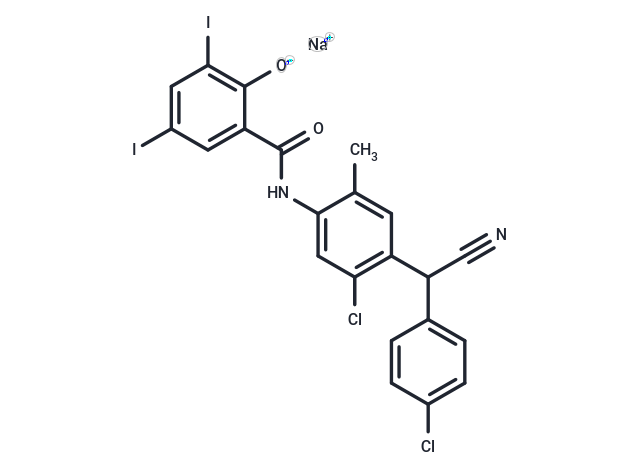
| Description | Closantel is a salicylanilide anthelmintic compound; exhibits different anthelmintic spectra and apparent toxicity in mammals. |
| In vitro | Closantel inhibits drug resistant S. aureus and E. faecium with MICs of 1 μg/mL and 1 μg/mL. Closantel inhibits MRSA and E.faecalis with MICs of 2 μg/mL and 1 μg/mL. [1] Closantel completely blocks the infection of host cells with E. chaffeensis or A. phagocytophilum, treatment of infected cells 1 day post infection with closantel clears infection in dose-dependent manner. Closantel inhibits the autokinase activities of the three E. chaffeensis sensor kinases from E. chaffeensis. [2] Closantel (50 μg/mL) causes an initial burst of contractions of much greater amplitude and frequency than normal in tissue vessel, the stimulation of amplitude and frequency lasted for nearly 15 min and is accompanied by a rise in muscle tone, which reaches a maximum at 16 min, at a level greater than 1.5 times the maximal normal amplitude. [3] |
| In vivo | Closantel (10 mg/kg) results in gross surface damage from 24 hours onwards in rats administrated with 25 metacercarial cysts of F. hepatica, in the form of erosion of the anterior and posterior extremities of the fluke and large-scale sloughing of the tegument on both dorsal and ventral surfaces. [3] Closantel (7.5 mg/kg) combined with broad-spectrum anthelmintic is very effective against H. contortus but ineffective against Trichostrongylus spp in lambs. [4] Closantel significantly reduces isotope levels in closantel-resistant adult Haemonchus contortus infected sheep. [5] |
| Molecular Weight | 685.06 |
| Formula | C22H13Cl2I2N2O2·Na |
| Cas No. | 61438-64-0 |
| Smiles | [Na+].Cc1cc(C(C#N)c2ccc(Cl)cc2)c(Cl)cc1NC(=O)c1cc(I)cc(I)c1[O-] |
| Relative Density. | no data available |
| Storage | Powder: -20°C for 3 years | In solvent: -80°C for 1 year Shipping with blue ice/Shipping at ambient temperature. | |||||||||||||||||||||||||||||||||||
| Solubility Information | H2O: < 1 mg/mL (insoluble or slightly soluble) DMSO: 93 mg/mL (135.75 mM), Sonication is recommended. Ethanol: 93 mg/mL (135.75 mM), Sonication is recommended. | |||||||||||||||||||||||||||||||||||
| In Vivo Formulation | 10% DMSO+90% Corn Oil: 3.3 mg/mL (4.82 mM), Sonication is recommended. Please add the solvents sequentially, clarifying the solution as much as possible before adding the next one. Dissolve by heating and/or sonication if necessary. Working solution is recommended to be prepared and used immediately. The formulation provided above is for reference purposes only. In vivo formulations may vary and should be modified based on specific experimental conditions. | |||||||||||||||||||||||||||||||||||
Solution Preparation Table | ||||||||||||||||||||||||||||||||||||
DMSO/Ethanol
Note : The dilution table applies only to solid products. For liquid products, please calculate the stock solution based on the stated concentration and/or density. | ||||||||||||||||||||||||||||||||||||
 For example, if the intended dosage is 10 mg/kg for animals weighing 20 g , with a dosing volume of 100 μL per animal, and a total of 10 animals are to be administered, using a formulation of
  10% DMSO+ 40% PEG300+ 5% Tween 80+ 45% Saline/PBS/ddH2O , the resulting working solution concentration would be 2 mg/mL.
Dissolve 2 mg of the compound in 100 μL DMSO to obtain a stock solution at a concentration of 20 mg/mL . If the required concentration exceeds the compound's known solubility, please contact us for technical support before proceeding.
1) Add 100 μL of the DMSO stock solution to 400 µL PEG300 and mix thoroughly until the solution becomes clear.
2) Add 50 µL Tween 80 and mix well until fully clarified.
3) Add 450 µL Saline,PBS or ddH2O and mix thoroughly until a homogeneous solution is obtained.
| Size | Quantity | Unit Price | Amount | Operation |
|---|
 Feedback
 Hello! How can I help you today?
Copyright © 2015-2026 TargetMol Chemicals Inc. All Rights Reserved.
