


Shopping Cart
Remove All Your shopping cart is currently empty

Synonyms:
| Pack Size | Price | USA Stock | Global Stock | Quantity |
|---|---|---|---|---|
| 1 mg | $229 | - | In Stock | |
| 5 mg | $577 | - | In Stock | |
| 10 mg | $822 | - | In Stock | |
| 25 mg | $1,230 | - | In Stock |
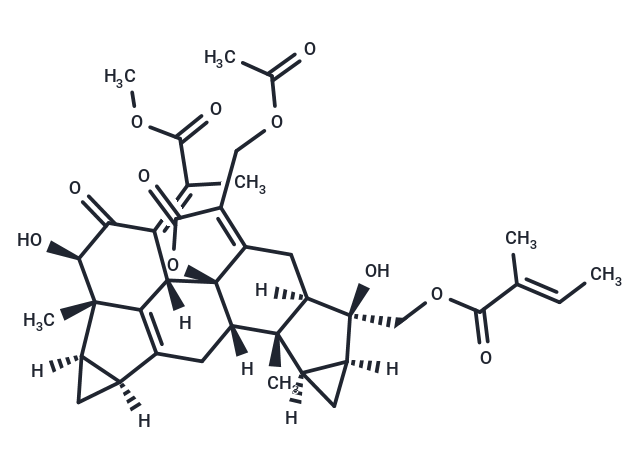
| Description | Chlorahololide D is a natural lindane-type sesquiterpene dimer and selective potassium channel blocker that stimulates reactive oxygen species ROS levels to cause cell cycle arrest in the G2 phase, modulates Bcl-2 and Bax and FAK, thereby inhibiting MCF-7 cell growth and triggering apoptosis. Chlorahololide D inhibits tumor proliferation, migration and angiogenesis in in vivo experiments and has anti-breast cancer potential. |
| Targets & IC50 | HepG2 cells:13.7 μM, Rat dissociated hippocampal neurons:2.7±0.3μM, MCF-7 cells:6.7 μM |
| In vitro | Chlorahololides D exhibited potent and selective potassium channel blocking activity on the delayed rectifier (IK) K+ current in rat dissociated hippocampal neurons, with the IC50 values of 2.7±0.3μM.[1] Chlorahololide D exhibited potent cytotoxicity against MCF-7 breast cancer cells with an IC₅₀ of 6.7 μM, and moderate activity against HepG2 liver cancer cells (IC₅₀ = 13.7 μM).[2] |
| In vivo | In MCF-7 xenograft zebrafish models, Chlorahololide D (2.5–10 μM) significantly reduced tumor fluorescence intensity and the number of metastatic foci.[2] In transgenic zebrafish models, Chlorahololide D disrupted the formation of intersegmental vessels (ISVs) and dorsal longitudinal anastomotic vessels (DLAVs) in a dose-dependent manner (5–20 μM), indicating strong anti-angiogenic activity.[2] |
| Molecular Weight | 676.75 |
| Formula | C38H44O11 |
| Cas No. | 943136-39-8 |
| Smiles | C(\C(OC)=O)(/C)=C\1/[C@@]2([C@@]34[C@]([C@@]5(C)[C@]6([C@](C6)([C@](COC(/C(=C/C)/C)=O)(O)[C@@]5(CC3=C(COC(C)=O)C(=O)O4)[H])[H])[H])(CC7=C2[C@](C)([C@]8([C@@]7(C8)[H])[H])[C@@H](O)C1=O)[H])[H] |
| Relative Density. | 1.41 g/cm3 (Predicted) |
| Storage | Store at low temperature Powder: -20°C for 3 years | In solvent: -80°C for 1 year Shipping with blue ice/Shipping at ambient temperature. |
 For example, if the intended dosage is 10 mg/kg for animals weighing 20 g , with a dosing volume of 100 μL per animal, and a total of 10 animals are to be administered, using a formulation of
  10% DMSO+ 40% PEG300+ 5% Tween 80+ 45% Saline/PBS/ddH2O , the resulting working solution concentration would be 2 mg/mL.
Dissolve 2 mg of the compound in 100 μL DMSO to obtain a stock solution at a concentration of 20 mg/mL . If the required concentration exceeds the compound's known solubility, please contact us for technical support before proceeding.
1) Add 100 μL of the DMSO stock solution to 400 µL PEG300 and mix thoroughly until the solution becomes clear.
2) Add 50 µL Tween 80 and mix well until fully clarified.
3) Add 450 µL Saline,PBS or ddH2O and mix thoroughly until a homogeneous solution is obtained.
| Size | Quantity | Unit Price | Amount | Operation |
|---|
 Feedback
 Hello! How can I help you today?
Copyright © 2015-2026 TargetMol Chemicals Inc. All Rights Reserved.
