


Shopping Cart
Remove All Your shopping cart is currently empty

Synonyms:

| Pack Size | Price | USA Stock | Global Stock | Quantity |
|---|---|---|---|---|
| 2 mg | $30 | In Stock | In Stock | |
| 5 mg | $44 | In Stock | In Stock | |
| 10 mg | $62 | In Stock | In Stock | |
| 25 mg | $130 | In Stock | In Stock | |
| 50 mg | $219 | In Stock | In Stock | |
| 100 mg | $328 | In Stock | In Stock | |
| 200 mg | $492 | - | In Stock | |
| 1 mL x 10 mM (in DMSO) | $48 | In Stock | In Stock |
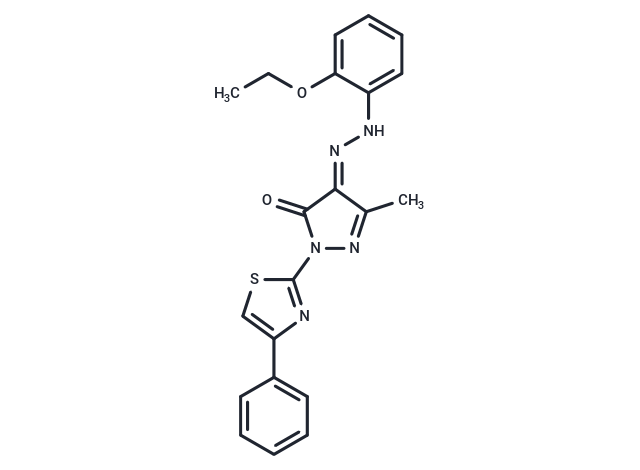
| Description | BAM 7 is a direct and specific activator of proapoptotic Bax (EC50: 3.3 μM). |
| Targets & IC50 | Bax:3.3 mM(EC50) |
| In vivo | In vitro experiments show that BAM7 induces BAX-mediated pore formation, BAX oligomerization, and BAX-dependent cell death. By activating BAX within cells, BAM7 selectively triggers BAX-mediated apoptosis. Its efficacy is limited to cells containing BAX, where it induces the biochemical and morphological hallmarks of BAX-mediated apoptosis. BAM7 binds directly to the N-terminal BH3 domain of BAX, facilitating interaction at the surface and BAX activation via the BIM BH3 helix. Moreover, BAM7 dose-dependently and temporally triggers the conversion of BAX from monomers to oligomers. |
| Kinase Assay | Fluorescence polarization binding assays: Direct binding curves are first generated by incubating FITC-BIM SAHB (50 nM) with serial dilutions of fulllength BAX, BCL-XLΔC, MCL-1ΔNΔC, BFL-1/A1ΔC or BAKΔC and fluorescence polarization measured at 20 minutes on a SpectraMax M5 microplate reader. For competition assays, a serial dilution of small molecule or acetylated BIM SAHB (Ac-BIM SAHB) is combined with FITC-BIM SAHB (50 nM), followed by the addition of recombinant protein at ~EC75 concentration, as determined by the direct binding assay (BAX, BAKΔC: 500 nM; BCL-XLΔC, MCL-1ΔNΔC, BFL-1/A1ΔC: 200 nM). Fluorescence polarization is measured at 20 minutes and IC50 values calculated by nonlinear regression analysis of competitive binding curves using Prism software. |
| Cell Research | MEFs (2.5 × 10³ cells per well) are seeded in 96-well opaque plates for 18-24 h and then incubated with serial dilutions of BAM7, ANA-BAM16 or vehicle (0.15% (v/v) DMSO) in DMEM at 37 °C in a final volume of 100 μL. Cell viability is assayed at 24 h by addition of CellTiter-Glo reagent according to the manufacturer's protocol, and luminescence is measured using a SpectraMax M5 microplate reader. Viability assays are performed in at least triplicate, and the data are normalized to vehicle-treated control wells.(Only for Reference) |
| Molecular Weight | 405.47 |
| Formula | C21H19N5O2S |
| Cas No. | 331244-89-4 |
| Smiles | CCOc1ccccc1N\N=C1/C(C)=NN(C1=O)c1nc(cs1)-c1ccccc1 |
| Relative Density. | 1.34 g/cm3 (Predicted) |
| Storage | Powder: -20°C for 3 years | In solvent: -80°C for 1 year Shipping with blue ice/Shipping at ambient temperature. | ||||||||||||||||||||
| Solubility Information | DMSO: 4.1 mg/mL (10.11 mM), Sonication is recommended. | ||||||||||||||||||||
Solution Preparation Table | |||||||||||||||||||||
DMSO
Note : The dilution table applies only to solid products. For liquid products, please calculate the stock solution based on the stated concentration and/or density. | |||||||||||||||||||||
 For example, if the intended dosage is 10 mg/kg for animals weighing 20 g , with a dosing volume of 100 μL per animal, and a total of 10 animals are to be administered, using a formulation of
  10% DMSO+ 40% PEG300+ 5% Tween 80+ 45% Saline/PBS/ddH2O , the resulting working solution concentration would be 2 mg/mL.
Dissolve 2 mg of the compound in 100 μL DMSO to obtain a stock solution at a concentration of 20 mg/mL . If the required concentration exceeds the compound's known solubility, please contact us for technical support before proceeding.
1) Add 100 μL of the DMSO stock solution to 400 µL PEG300 and mix thoroughly until the solution becomes clear.
2) Add 50 µL Tween 80 and mix well until fully clarified.
3) Add 450 µL Saline,PBS or ddH2O and mix thoroughly until a homogeneous solution is obtained.
| Size | Quantity | Unit Price | Amount | Operation |
|---|
 Feedback
 Hello! How can I help you today?
Copyright © 2015-2026 TargetMol Chemicals Inc. All Rights Reserved.
