


Shopping Cart
Remove All Your shopping cart is currently empty


Synonyms:
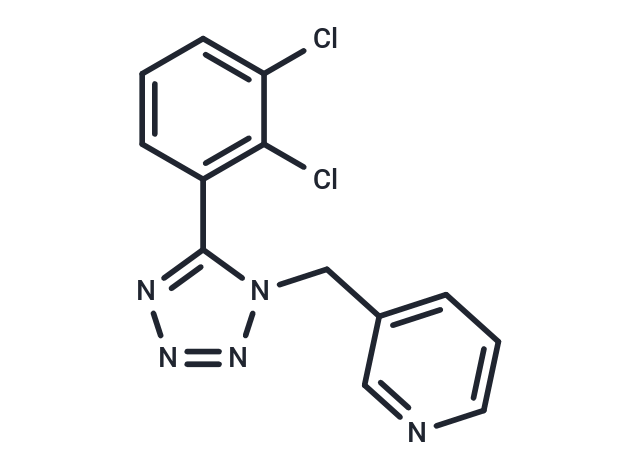
| Pack Size | Price | USA Stock | Global Stock | Quantity |
|---|---|---|---|---|
| 2 mg | $41 | In Stock | In Stock | |
| 5 mg | $66 | In Stock | In Stock | |
| 10 mg | $98 | In Stock | In Stock | |
| 25 mg | $189 | In Stock | In Stock | |
| 50 mg | $313 | In Stock | In Stock | |
| 100 mg | $555 | In Stock | In Stock | |
| 1 mL x 10 mM (in DMSO) | $74 | In Stock | In Stock |
| Description | A 438079 is a potent and selective antagonist of the P2X7 receptor (pIC50: 6.9). |
| Targets & IC50 | P2X7 receptor:6.9(pIC50) |
| In vitro | A 438079 blocks BzATP-(10 μM) evoked changes in intracellular calcium concentrations with an IC50 of 321 nM in 1321N1 cells stably expressing rat P2X7 receptors. A 438079 is also selective for the P2X7 receptor, at concentrations up to 100 μM[1]. |
| In vivo | In neuropathic rats noxious and innocuous evoked activity of different classes of spinal neurons is reduced by A 438079 (80 μmol/kg, i.v.), and it significantly raises withdrawal thresh-olds in both the SNL and CCI models[1]. A 438079 has superior neuroprotective effects compared with an equal dose of phenobarbital (25 mg/kg)[2]. A 438079 partially but significantly prevents the 6-OHDA-induced depletion of striatal DA stores[3]. Pretreatment with A 438079 reduces nociceptive behavior scores in the HC model[4]. |
| Kinase Assay | Human astrocytoma cells, 1321N1, are grown to stably express rat P2X7, human P2X4, P2X2a, P2X2/3, P2X1, P2Y1 and P2Y2 recombinant receptors. Agonist, BzATP, 2,3-O-(4-ben-zoylbenzoyl)-ATP or ATP-induced changes in intracellular Ca2+ concentrations are assessed in all of the cell lines using the Ca2+ chelating dye, Fluo-4, in conjunction with a Fluorometric Imaging Plate Reader. The cells are plated out the day before the experiment onto poly-D-lysine-coated black 96 well plates. After the agonist addition, changes in intracellular Ca2+ concentrations are recorded, per second, for 3 min. Ligands are tested at 11 half-log concentrations from 0.1nM to 100 μM. BzATP or ATP concentrations corresponds to the EC70 values for each receptor to enable comparison of antagonist potencies across the multiple P2 receptor subtypes. A 438079 is added to the cell plate and ?uorescence data are collected for 3 min before the addition of agonist, subsequently, data are then collected for another 2 min. The pEC50 or pIC50 values are derived from a single curve ?t [1]. |
| Animal Research | To confirm A 438079 reach the brain after systemic administration, P10 rat pups are injected with 5 mg/kg A 438079 and killed either 10 min, 30 min, or 2 h later (n=4 per group). Blood samples are centrifuged at 1000×g for 10 min to isolate the plasma. Samples are analyzed using LC-MS/MS by a service provider. Briefly, protein is precipitated from 50 μL aliquots of the individual plasma or brain tissue homogenate, and A 438079 is quantified by LC-MS/MS from a five-point standard curve [2]. |
| Molecular Weight | 306.15 |
| Formula | C13H9Cl2N5 |
| Cas No. | 899507-36-9 |
| Smiles | Clc1cccc(-c2nnnn2Cc2cccnc2)c1Cl |
| Relative Density. | no data available |
| Storage | Store at low temperature Powder: -20°C for 3 years | In solvent: -80°C for 1 year Shipping with blue ice/Shipping at ambient temperature. |
| Solubility Information | DMSO: 145 mg/mL (473.62 mM), Sonication is recommended.  H2O: 0.2 mg/mL (0.65 mM), Sonication is recommended. |
| In Vivo Formulation | 10% DMSO+90% Saline: 10 mg/mL (32.66 mM), Solution. Please add the solvents sequentially, clarifying the solution as much as possible before adding the next one. Dissolve by heating and/or sonication if necessary. Working solution is recommended to be prepared and used immediately. The formulation provided above is for reference purposes only. In vivo formulations may vary and should be modified based on specific experimental conditions. |
 For example, if the intended dosage is 10 mg/kg for animals weighing 20 g , with a dosing volume of 100 μL per animal, and a total of 10 animals are to be administered, using a formulation of
  10% DMSO+ 40% PEG300+ 5% Tween 80+ 45% Saline/PBS/ddH2O , the resulting working solution concentration would be 2 mg/mL.
Dissolve 2 mg of the compound in 100 μL DMSO to obtain a stock solution at a concentration of 20 mg/mL . If the required concentration exceeds the compound's known solubility, please contact us for technical support before proceeding.
1) Add 100 μL of the DMSO stock solution to 400 µL PEG300 and mix thoroughly until the solution becomes clear.
2) Add 50 µL Tween 80 and mix well until fully clarified.
3) Add 450 µL Saline,PBS or ddH2O and mix thoroughly until a homogeneous solution is obtained.
| Size | Quantity | Unit Price | Amount | Operation |
|---|
 Feedback
 Hello! How can I help you today?
Copyright © 2015-2026 TargetMol Chemicals Inc. All Rights Reserved.
